

Pressure Relief Valves (PRVs) are among the most critical safety devices used across oil and gas facilities. They are designed to prevent overpressure scenarios that can lead to equipment failure, environmental incidents, operational shutdowns, and serious safety consequences.
Yet, despite their importance, many inspection companies and asset operators continue to struggle with delayed PRV inspections caused by manual processes, fragmented records, scheduling conflicts, and limited field visibility.
These delays often appear insignificant on the surface. However, operationally, they introduce substantial risks that impact compliance, production continuity, workforce safety, and asset integrity.
This article explores why PRV inspection delays occur, the operational risks they create, and how digital inspection management platforms such as InspectionsTrack Software Suite by Sky Soft Connections help inspection teams maintain inspection schedules, improve traceability, and reduce compliance exposure.
Pressure Relief Valves act as the final protective barrier when abnormal pressure conditions occur.
They are commonly installed on:
If these valves fail to operate correctly, excessive pressure can damage assets or compromise personnel safety.
Consequently, inspection schedules are not administrative requirements. They represent critical components of an organization’s process safety strategy.
Inspection delays rarely occur because teams intentionally ignore compliance requirements.
More often, operational inefficiencies gradually disrupt inspection timelines.
Common causes include:
Many organisations still depend on:
As inspection volumes increase, these methods become difficult to manage.
Important inspection dates can easily be overlooked.
Inspection coordinators often struggle to answer questions such as:
Without real-time dashboards, planning becomes reactive.
Offshore inspections involve:
Even minor disruptions can delay inspection execution.
Field inspections, QA reviews, certificate generation, and client reporting frequently occur in separate systems.
As a result, bottlenecks emerge between inspection completion and final approval.

PRVs exist to prevent dangerous overpressure situations.
When inspection intervals extend beyond approved limits, organisations lose confidence that safety devices will function as intended.
Potential consequences include:
Safety barriers lose effectiveness when inspection assurance deteriorates.
Inspection records often form part of:
Delayed inspections create documentation gaps.
During audits, organisations may struggle to demonstrate:
These shortcomings increase compliance risk.
A PRV discovered to be overdue during an audit or shutdown planning exercise may require immediate action.
Consequently, operations teams may face:
Reactive inspections are almost always more expensive than planned inspections.
Inspection coordinators often spend excessive time:
These administrative burdens reduce productivity and limit strategic planning capacity.
Inspection companies depend heavily on trust.
Clients expect visibility into:
Repeated delays can negatively influence future contract opportunities.
| Operational Area | Manual Processes | Digital Inspection Software |
|---|---|---|
| Inspection Scheduling | Spreadsheet reminders | Automated due-date tracking |
| Field Data Collection | Paper forms | Mobile inspections |
| Certificate Management | Shared folders | Centralised digital records |
| Audit Readiness | Time-consuming retrieval | Instant document access |
| Inspection Visibility | Limited | Real-time dashboards |
| Reporting | Manual compilation | Automated reporting workflows |
| Client Communication | Email dependent | Client reporting portals |
The difference extends beyond efficiency.
Digital systems improve operational control.
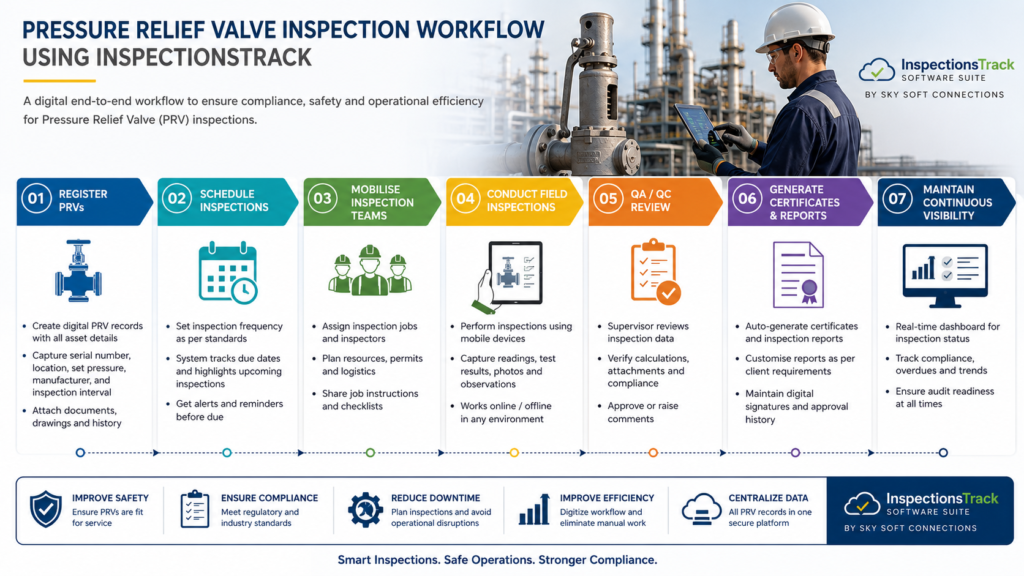
Inspection teams create digital records containing:
The platform tracks inspection frequencies and highlights assets approaching their due dates.
Inspection coordinators gain forward visibility.
Using InspectionsTrack Software Suite, teams coordinate:
This reduces scheduling conflicts.
Inspectors complete inspections using mobile devices.
They can capture:
Both online and offline capabilities support remote environments.
Supervisors validate inspection information before approval.
This improves report accuracy.
Approved inspections automatically feed into reporting processes.
Inspection teams avoid repetitive administrative tasks.
Dashboards provide oversight of:
Decision-makers remain informed.
InspectionsTrack Software Suite by Sky Soft Connections was developed to address operational bottlenecks commonly experienced by inspection businesses.
Key capabilities include:
The system monitors upcoming inspection dates and reduces reliance on manual reminders.
Field teams can complete inspections directly from mobile devices.
This accelerates reporting cycles.
Inspection histories remain accessible through a single platform.
Teams avoid searching through multiple systems.
Managers gain visibility into inspection workloads and completion status.
This improves planning decisions.
Inspection information can be consolidated into professional reports, reducing administrative effort.
Digital records support faster responses during client reviews and compliance audits.
Inspection leaders should assess whether they experience the following challenges:
If several of these conditions exist, digital transformation opportunities likely remain.
Improving PRV inspection performance requires more than adding personnel.
High-performing inspection organisations focus on:
These capabilities enable proactive asset management rather than reactive firefighting.
Explore Inspectionstrack Pressure Gauge and PRV Module
Pressure Relief Valve inspection delays often begin as administrative inconveniences.
However, over time, they evolve into operational risks capable of affecting safety performance, regulatory compliance, production continuity, and client relationships.
Inspection organisations that continue relying on fragmented processes face increasing complexity as asset inventories expand.
Conversely, companies adopting specialised inspection management platforms gain greater control over inspection scheduling, field execution, reporting, and compliance oversight.
InspectionsTrack Software Suite by Sky Soft Connections helps inspection companies transition from reactive inspection management to a proactive, audit-ready approach designed for the realities of modern oil and gas operations.
For organisations seeking improved visibility, streamlined workflows, and stronger compliance performance, digital inspection management has become an operational necessity rather than a future consideration.
Read more : The Future of Pressure Gauge Calibration: Mobile Inspections, Digital Certificates, and Real-Time Reporting
Delayed inspections increase uncertainty regarding valve performance during overpressure events, potentially compromising process safety.
Inspection delays can create audit gaps, overdue certifications, and difficulties demonstrating regulatory adherence.
Common causes include manual tracking systems, poor scheduling visibility, offshore mobilisation constraints, and disconnected reporting processes.
Inspection software centralises records, automates scheduling, enables mobile inspections, and provides real-time visibility into inspection activities.

Working at height is one of the most demanding activities in industrial environments. For rope access teams, however, safety depends on more than having the right equipment. Fall protection equipment must also be inspected correctly,…

A flare stack may look like a simple vertical structure standing above a rig or production facility. In reality, it is one of the most important safety systems for handling flammable gases and relieving potentially…


