
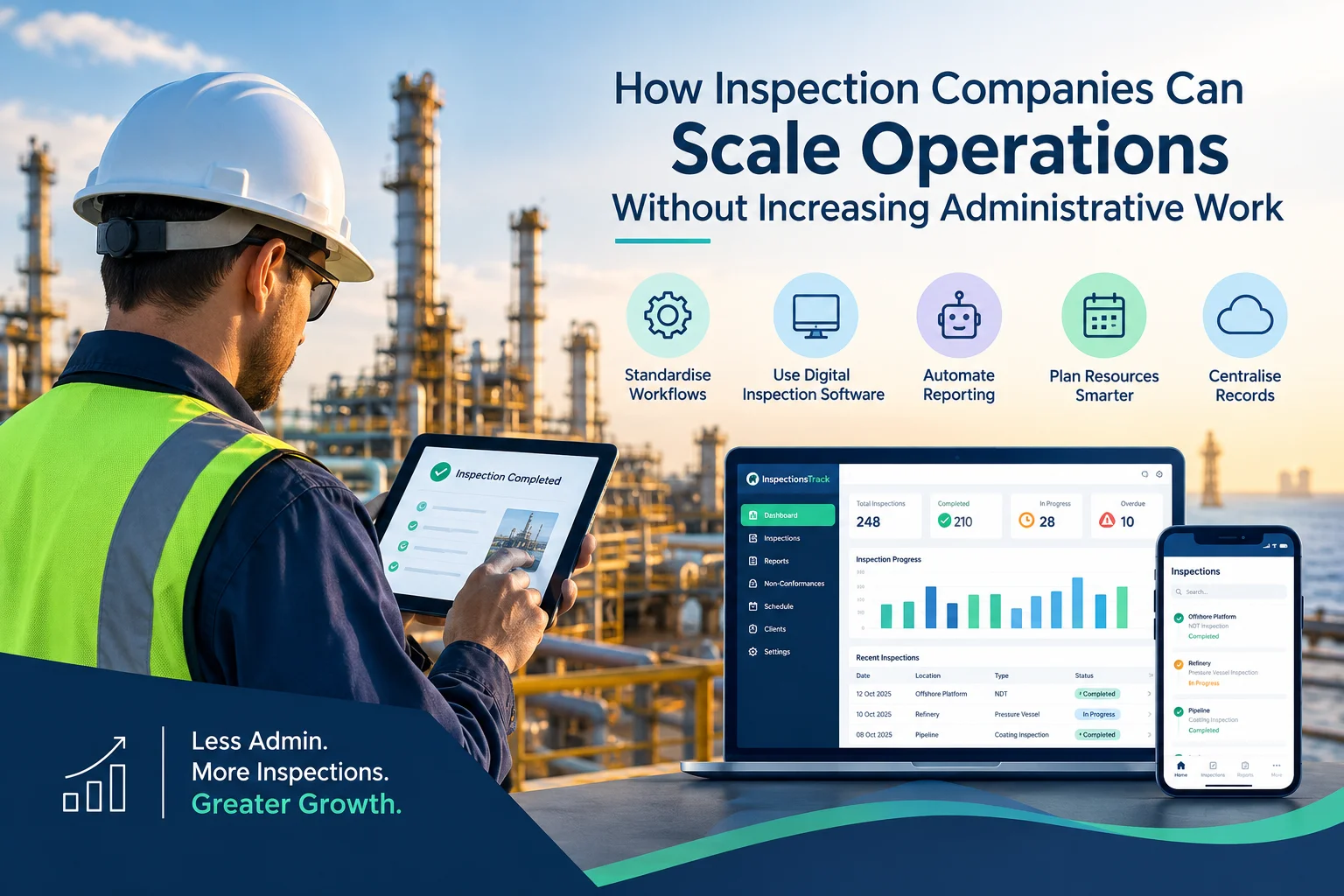
Inspection companies in the oil and gas industry face a common challenge: how to handle more inspections, manage larger projects, and meet client deadlines without increasing administrative workload. As businesses grow, inspection teams must manage more reports, inspection records, client requirements, and compliance documentation. Without efficient processes, these tasks can slow down operations and increase costs.
However, growth does not always require more administrative staff. By standardising workflows, digitising inspection records, automating repetitive tasks, and using inspection management software, companies can increase operational capacity while keeping administrative work under control.
In this guide, we explore practical strategies that help inspection companies scale efficiently while maintaining quality, accountability, and client satisfaction.
As inspection businesses take on more projects, administrative tasks often increase alongside fieldwork. Teams must coordinate inspectors, track inspection progress, prepare reports, manage non-conformances, and deliver documentation to clients.
When these activities rely on spreadsheets, paper forms, and manual communication, even a small increase in project volume can create significant pressure.
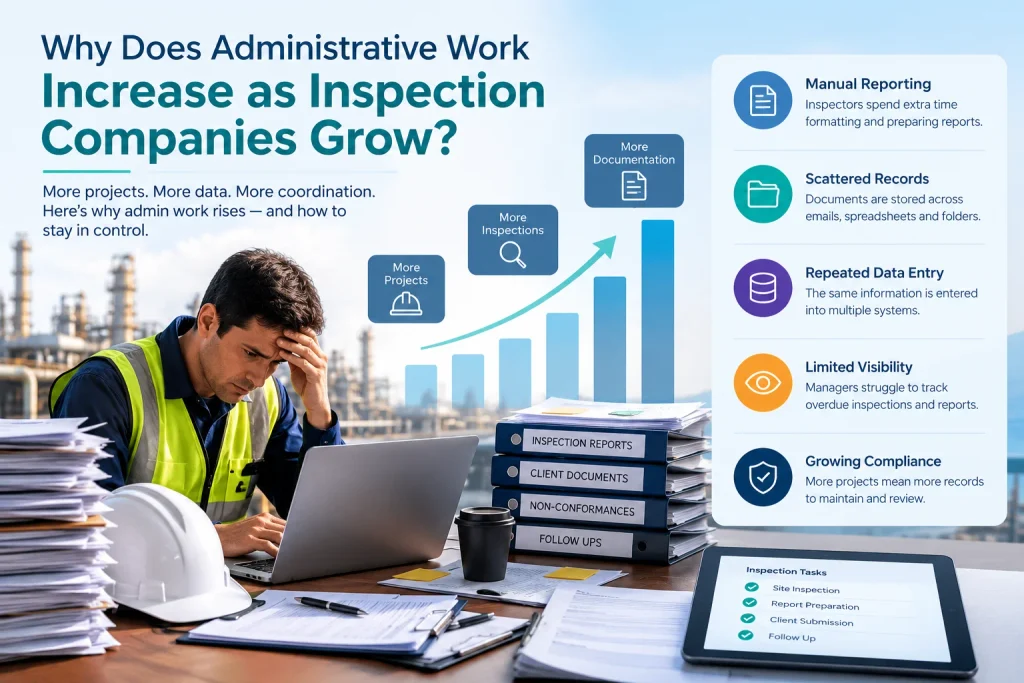
Common challenges include:
Therefore, inspection companies need processes that support higher workloads without multiplying administrative tasks.
First, establish consistent procedures for recurring inspection activities. Standardisation reduces confusion, prevents duplicated work, and makes it easier to manage multiple projects simultaneously.
For example, an oil and gas inspection company can create standard workflows for non-destructive testing (NDT), pressure equipment inspections, pipeline inspections, and other recurring inspection activities.
Each workflow should define:
As a result, inspectors follow a consistent process instead of relying on individual working methods. Managers also spend less time correcting reports or explaining procedures repeatedly.
Paper-based inspections and disconnected spreadsheets become harder to manage as project volumes increase. Digital inspection management software helps centralise records and reduce the administrative effort required to manage them.
With a suitable system, inspection teams can record findings, attach evidence, update inspection status, and maintain project documentation in a structured environment.
For oil and gas inspection businesses, InspectionsTrack provides a software solution focused on managing inspection operations and supporting digital inspection workflows.
Using inspection management software can help companies:
Consequently, teams can spend more time conducting inspections and less time managing paperwork.
Inspection reports are essential deliverables. However, preparing them manually can consume valuable time, especially when inspectors handle multiple assignments each day.
Instead of creating every report from scratch, companies should use standard digital templates and automated data capture wherever practical.
For instance, an inspection workflow can capture findings, measurements, photographs, equipment details, and inspector information in a structured format. Approved data can then populate the relevant sections of a report, reducing repeated typing.
Companies can also automate routine activities such as:
Nevertheless, automation should include appropriate review and approval controls. Inspectors and authorised reviewers must still verify technical findings and ensure reports meet client requirements.
Scaling inspection operations requires more than hiring additional inspectors. Companies must also ensure that available personnel are assigned efficiently.
Poor scheduling can result in duplicated site visits, idle time, missed deadlines, and unnecessary travel costs.
To improve resource allocation, inspection managers should maintain clear visibility into inspector availability, qualifications, locations, project priorities, and upcoming deadlines.
A practical scheduling process should include:
With better planning, companies can increase the number of inspections completed using their existing resources.
When inspection information is spread across multiple systems, employees often spend time searching for documents instead of completing productive work.
A centralised inspection management process makes it easier to access project records, inspection findings, reports, and outstanding actions from a consistent source.
This is particularly important in oil and gas operations, where inspection records may be needed for client reviews, maintenance planning, audits, and compliance verification.
| Administrative challenge | Practical solution | Expected operational benefit |
|---|---|---|
| Missing inspection documents | Centralised digital records | Faster document retrieval |
| Repeated data entry | Structured digital data capture | Less duplicated work |
| Late inspection reports | Templates and automated reminders | More consistent delivery |
| Unclear inspection status | Centralised progress tracking | Better management visibility |
| Unresolved non-conformances | Action tracking and notifications | Improved accountability |
Furthermore, centralised information helps managers identify bottlenecks across projects. They can determine whether delays originate from fieldwork, report preparation, technical review, or client approval.
Before hiring additional administrative staff, inspection companies should assess where their existing processes lose time.
Tracking a small set of operational metrics can reveal whether delays result from insufficient capacity or inefficient workflows.
Consider monitoring these key performance indicators (KPIs):
Review these metrics regularly. If administrative hours per inspection decrease while inspection volume increases, the company is improving its ability to scale.
However, productivity improvements should never compromise inspection quality, technical accuracy, or safety requirements.
As inspection companies expand into new locations, serve additional clients, or manage larger oil and gas projects, disconnected tools become increasingly difficult to maintain.
InspectionsTrack can be considered as part of a broader strategy to digitise inspection operations, improve record management, and support more consistent workflows across projects.
When evaluating inspection software, companies should assess whether it supports their actual operational needs, including:
The right solution should reduce unnecessary administration without introducing complicated processes of its own. Therefore, evaluate software against real inspection workflows and test it with a representative project before wider implementation.
Inspection companies do not need to transform every process at once. A phased approach can deliver improvements while minimising disruption.
| Phase | Action | Objective |
|---|---|---|
| Week 1 | Review current workflows and administrative bottlenecks | Identify wasted effort |
| Week 2 | Standardise forms, reporting requirements, and responsibilities | Reduce inconsistency |
| Weeks 3–4 | Pilot digital inspection workflows and automation | Reduce manual tasks |
| Month 2 | Track KPIs and refine the process | Measure improvements |
| Month 3 onwards | Expand successful workflows across projects | Support sustainable growth |
The exact timeline will depend on company size, software requirements, and project complexity. Nevertheless, starting with one high-volume inspection workflow allows teams to identify practical improvements before expanding the approach.
Inspection companies can scale operations without increasing administrative work by improving processes rather than simply adding people. Standardised workflows, digital documentation, automated reporting, better scheduling, and centralised records all help teams handle greater workloads more efficiently.
For oil and gas inspection providers, the objective is to increase operational capacity while maintaining technical quality, traceability, and client confidence.
By combining clear procedures with suitable inspection management software, such as InspectionsTrack, companies can reduce repetitive administrative tasks, improve project visibility, and build a more scalable inspection operation.
The key is simple: make existing workflows more efficient before increasing the resources needed to manage them.
Read more : How to Meet Client SLAs in Inspection Services: Deadlines, Deliverables and Accountability
They can standardise inspection workflows, digitise documentation, automate routine notifications, and centralise records. These improvements reduce repetitive tasks and help existing teams manage larger workloads.
Inspection management software can organise inspection records, support structured data capture, improve progress tracking, and streamline reporting. The exact benefits depend on the software’s features and how the company implements them.
Oil and gas inspections often require detailed technical records, supporting evidence, traceability, and timely reporting. Digital inspection management can make these records easier to organise, review, and retrieve.
Companies should evaluate digital forms, reporting, scheduling, document management, corrective action tracking, access controls, and audit trails. The solution should match their inspection workflows and client requirements.
Inspections Track is an inspection software option for businesses looking to manage inspection operations digitally. Companies should assess its available features against their specific requirements to determine the best fit for their workflows.

Meeting client Service Level Agreements (SLAs) is essential for inspection companies working in demanding industries such as oil and gas, energy, and industrial maintenance. Clients expect inspections to be completed on time, reports to be…
Implementing inspection management software can help oil and gas inspection companies reduce paperwork, improve reporting accuracy, and manage jobs more efficiently. However, the biggest concern for many operations managers is simple: How can you introduce…


