

Meeting client Service Level Agreements (SLAs) is essential for inspection companies working in demanding industries such as oil and gas, energy, and industrial maintenance. Clients expect inspections to be completed on time, reports to be accurate, and findings to be delivered in a clear, professional format. However, managing multiple inspection projects, field teams, and reporting deadlines can make these expectations difficult to maintain.
A missed deadline can delay maintenance work, affect project schedules, and damage client confidence. Therefore, inspection companies need a structured approach to SLA management in inspection services, supported by clear responsibilities, reliable reporting processes, and effective inspection management software.
In this guide, we explain how to meet client SLAs, manage inspection deliverables, improve accountability, and use digital tools to maintain consistent service quality.
A Service Level Agreement (SLA) defines the service standards, responsibilities, and timelines an inspection company agrees to meet. It establishes measurable expectations between the service provider and the client.
In oil and gas inspections, SLAs may cover inspection scheduling, fieldwork completion, non-destructive testing (NDT) reports, equipment inspections, quality documentation, and the communication of critical findings.
Common SLA requirements include:
For example, an oil and gas operator may require a field inspection to be completed on Tuesday and the final report to be submitted within 24 hours. The inspection team must therefore manage both the fieldwork deadline and the reporting deadline.
Oil and gas inspection projects often involve complex assets, strict schedules, multiple contractors, and potentially hazardous working environments. Consequently, even a small delay can affect other project activities.
Meeting SLAs helps inspection companies achieve several important objectives.

Clients need confidence that inspection providers will deliver the agreed services consistently. When inspections and reports arrive on time, clients can plan maintenance, review findings, and make informed operational decisions.
Late inspection reports can hold up maintenance approvals, asset handovers, or follow-up work. By monitoring deadlines throughout the inspection process, teams can identify potential delays before they affect the wider project.
Rushed reporting increases the risk of incomplete records and overlooked findings. A structured workflow gives inspectors enough time to verify results, attach supporting evidence, and complete quality checks.
SLAs may form part of a wider contract containing specific performance requirements. Consistent monitoring helps companies identify non-compliance, maintain accurate records, and demonstrate whether agreed service standards have been met.
Meeting SLAs requires more than simply reminding employees about deadlines. Instead, inspection companies should establish a repeatable process that covers planning, execution, reporting, and performance review.
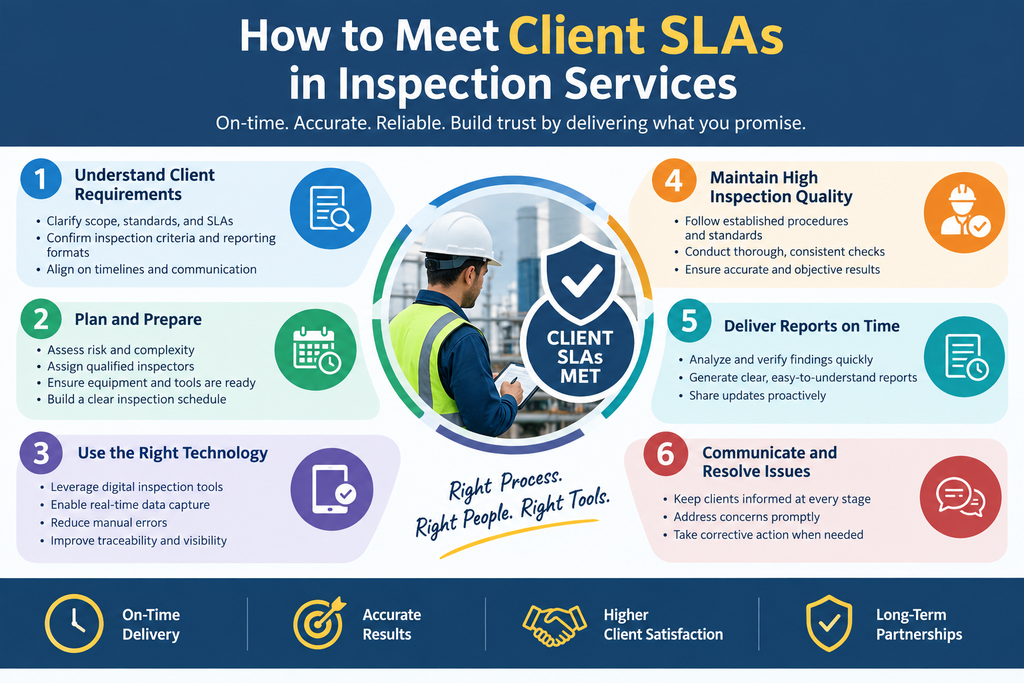
First, translate contractual requirements into measurable targets. Vague expectations such as “submit reports quickly” leave room for misunderstanding.
Instead, specify exactly what must be delivered, who is responsible, and when the deadline applies.
For example:
| SLA requirement | Example target | Measurement |
|---|---|---|
| Inspection completion | Complete by the agreed date | Percentage completed on time |
| Report submission | Within 24 hours of inspection completion | Reporting turnaround time |
| Critical findings | Escalate immediately according to the agreed procedure | Escalation compliance |
| Report quality | Submit complete, verified reports | First-time acceptance rate |
| Corrective actions | Track actions against agreed due dates | Overdue action count |
These are illustrative targets, not universal industry standards. Actual SLA requirements should reflect the contract, asset risk, inspection type, and client expectations.
Once targets are defined, share them with project managers, inspectors, reporting personnel, and quality teams. As a result, everyone understands the required service level.
Next, build an inspection schedule that accounts for deadlines, asset priorities, site access, personnel availability, and reporting requirements.
For example, scheduling ten inspections for one day may seem efficient. However, if the team cannot complete the fieldwork and prepare the associated reports within the agreed timeframe, the schedule creates unnecessary SLA risk.
To avoid this problem:
Moreover, review the schedule regularly. When a new high-priority inspection arises, assess its impact on existing commitments before changing team assignments.
A completed inspection does not automatically mean the job is finished. The client may also expect a formal report, photographs, test results, inspection checklists, equipment details, and recommendations.
Therefore, create standardised deliverable templates for each inspection type.
A typical inspection report package may include:
Standardisation reduces repetitive administrative work and helps teams avoid missing essential information. Furthermore, consistent report formats make it easier for clients to review findings across different assets and projects.
Waiting until a deadline has passed to check progress is one of the most common SLA management mistakes.
Instead, monitor each inspection from assignment through completion and final report submission.
A practical workflow includes the following stages:
At each stage, record the status, responsible person, and relevant deadline. Additionally, introduce reminders for approaching due dates and escalation procedures for overdue work.
This approach makes delays easier to identify and helps managers intervene before an SLA is breached.
As inspection volumes grow, spreadsheets, emails, and paper records can become difficult to manage. Information may be scattered across departments, while managers struggle to determine which inspections are overdue or which reports still require approval.
Digital inspection management software can help centralise inspection schedules, field records, reporting workflows, and performance information.
For companies working in the oil and gas inspections industry, InspectionsTrack provides a relevant software option to consider when improving digital inspection management. Inspection teams can explore how a centralised digital workflow can support better visibility, recordkeeping, and coordination across inspection activities.
When evaluating InspectionsTrack or any inspection management platform, consider whether the available features support your specific SLA requirements, including:
The exact capabilities available will depend on the software configuration and product features. Therefore, verify that the selected platform supports the reminders, dashboards, integrations, and reporting controls your contracts require.
Ultimately, the goal is to reduce manual administration and give managers a clearer view of inspection progress.
Even a well-designed workflow can fail if employees do not know who owns each task.
For every inspection, identify the person responsible for completing the work, reviewing the deliverables, and communicating with the client.
A simple responsibility matrix can help.
| Activity | Primary responsibility | Supporting role |
|---|---|---|
| Schedule inspection | Project coordinator | Operations manager |
| Perform field inspection | Assigned inspector | Inspection supervisor |
| Prepare report | Inspector or reporting specialist | Technical reviewer |
| Verify report quality | Designated reviewer | Quality manager |
| Submit deliverables | Project coordinator | Reporting team |
| Escalate SLA risks | Project manager | Operations manager |
Adapt this structure to your company size and contractual obligations. In smaller teams, one person may perform multiple roles. Nevertheless, each responsibility should remain clearly assigned.
Furthermore, managers should review missed deadlines to understand the underlying cause rather than automatically blaming the assigned employee. Common causes include unrealistic schedules, unavailable equipment, incomplete information, and excessive workloads.
Sometimes, delays cannot be avoided. Site access issues, unexpected equipment conditions, severe weather, or additional testing requirements may affect an inspection schedule.
However, poor communication can make a manageable delay much worse.
When a potential SLA breach arises:
Early communication allows clients to adjust their plans and helps preserve trust. Importantly, a revised deadline should not be treated as approved unless the client or authorised representative agrees where required.
To improve SLA compliance, companies need reliable performance indicators. Tracking a few meaningful KPIs is generally more useful than collecting large amounts of data without acting on it.
| KPI | What it measures | Why it matters |
|---|---|---|
| On-time inspection rate | Inspections completed by the agreed deadline | Shows scheduling and execution performance |
| On-time reporting rate | Reports submitted within the agreed turnaround time | Identifies reporting bottlenecks |
| First-time report acceptance | Reports accepted without major corrections | Measures deliverable quality |
| Overdue inspection count | Inspections past their due dates | Highlights immediate SLA risks |
| Corrective action closure rate | Actions completed within agreed timeframes | Tracks follow-up performance |
| SLA breach rate | Commitments that were not met | Shows overall compliance trends |
For example, if 92 out of 100 reports are submitted within their contractual deadlines, the on-time reporting rate is 92%.
[\text{On-time reporting rate}=
\frac{\text{Reports submitted on time}}{\text{Total reports due}}\times100]
In this example, the company should investigate the eight late reports, identify recurring causes, and implement corrective measures. Reviewing performance weekly or monthly, depending on inspection volume and risk, helps managers recognise patterns before they become persistent problems.
Even experienced inspection providers can struggle with SLA compliance when their processes are inconsistent.
Avoid these common mistakes:
By addressing these issues, inspection companies can build a more reliable and transparent service delivery process.
Use this checklist when starting a new inspection project or reviewing an existing contract.
This checklist gives project managers a straightforward way to identify gaps and maintain consistent service standards.
Meeting client SLAs in inspection services requires effective planning, accurate documentation, timely reporting, and clear accountability. Inspection companies must manage the entire process, from scheduling fieldwork to delivering verified reports and closing corrective actions.
For oil and gas inspection providers, a structured digital workflow can also improve visibility across projects and reduce the administrative burden of managing multiple commitments. Solutions such as InspectionsTrack are worth evaluating as part of a broader strategy to strengthen inspection management and support consistent service delivery.
Ultimately, the best SLA management approach combines realistic deadlines, capable inspection teams, standardised deliverables, proactive communication, and measurable performance reviews. By putting these practices into place, inspection companies can improve client confidence, reduce avoidable delays, and deliver a more dependable inspection service.
Read more: How to Implement Inspection Management Software Without Disrupting Field Operations
An SLA defines the agreed deadlines, reporting requirements, service quality standards, and responsibilities an inspection company must meet for its client.
Companies can meet client SLAs by setting clear deadlines, assigning responsibilities, standardising reports, monitoring progress, and communicating potential delays early.
Inspection management software helps teams organise inspection schedules, maintain digital records, monitor task progress, and improve visibility into outstanding reports and corrective actions.
InspectionsTrack is a software option for oil and gas inspection providers to consider when improving digital inspection workflows, documentation, and coordination. Companies should verify the available features against their specific SLA requirements.
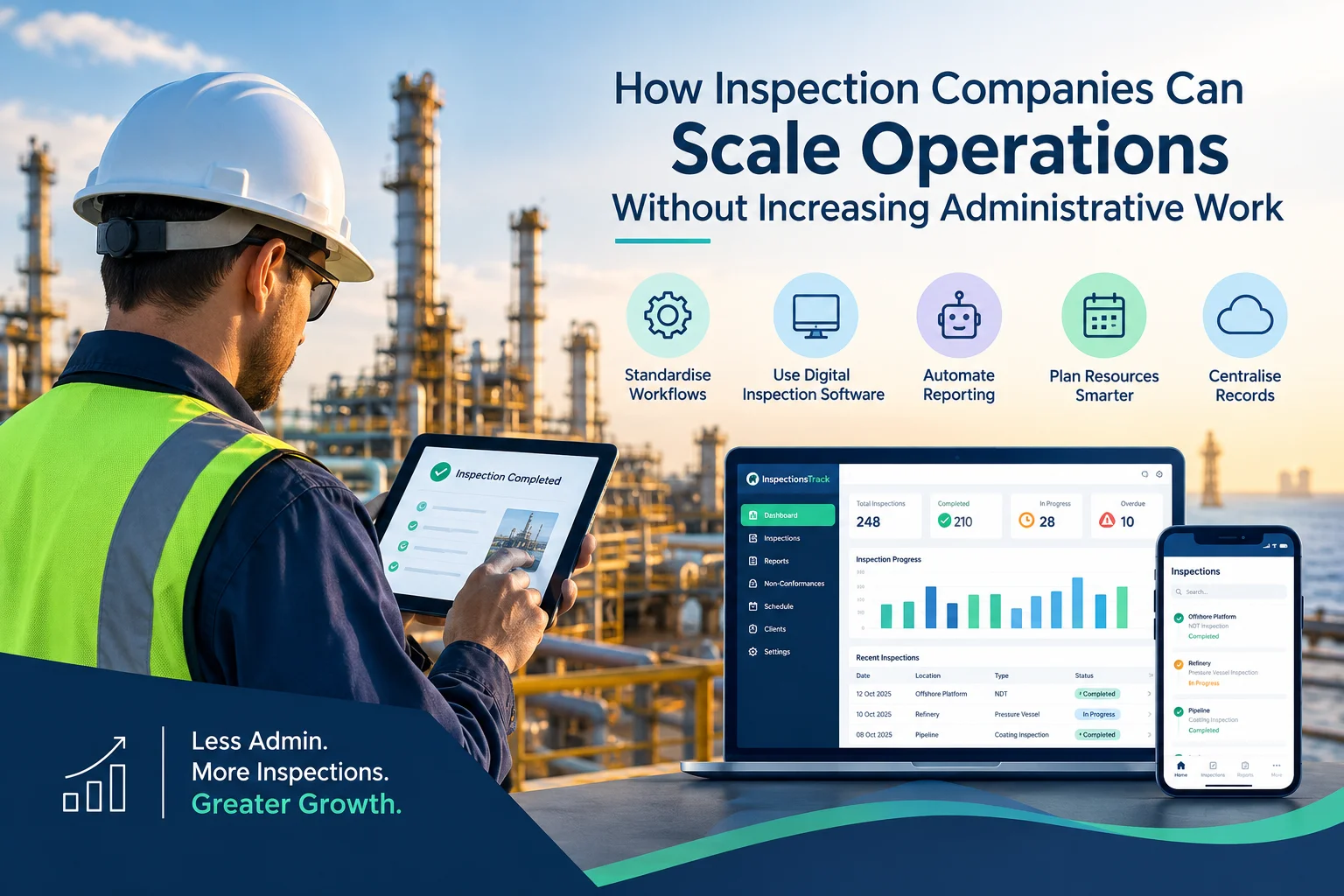
Inspection companies in the oil and gas industry face a common challenge: how to handle more inspections, manage larger projects, and meet client deadlines without increasing administrative workload. As businesses grow, inspection teams must manage…
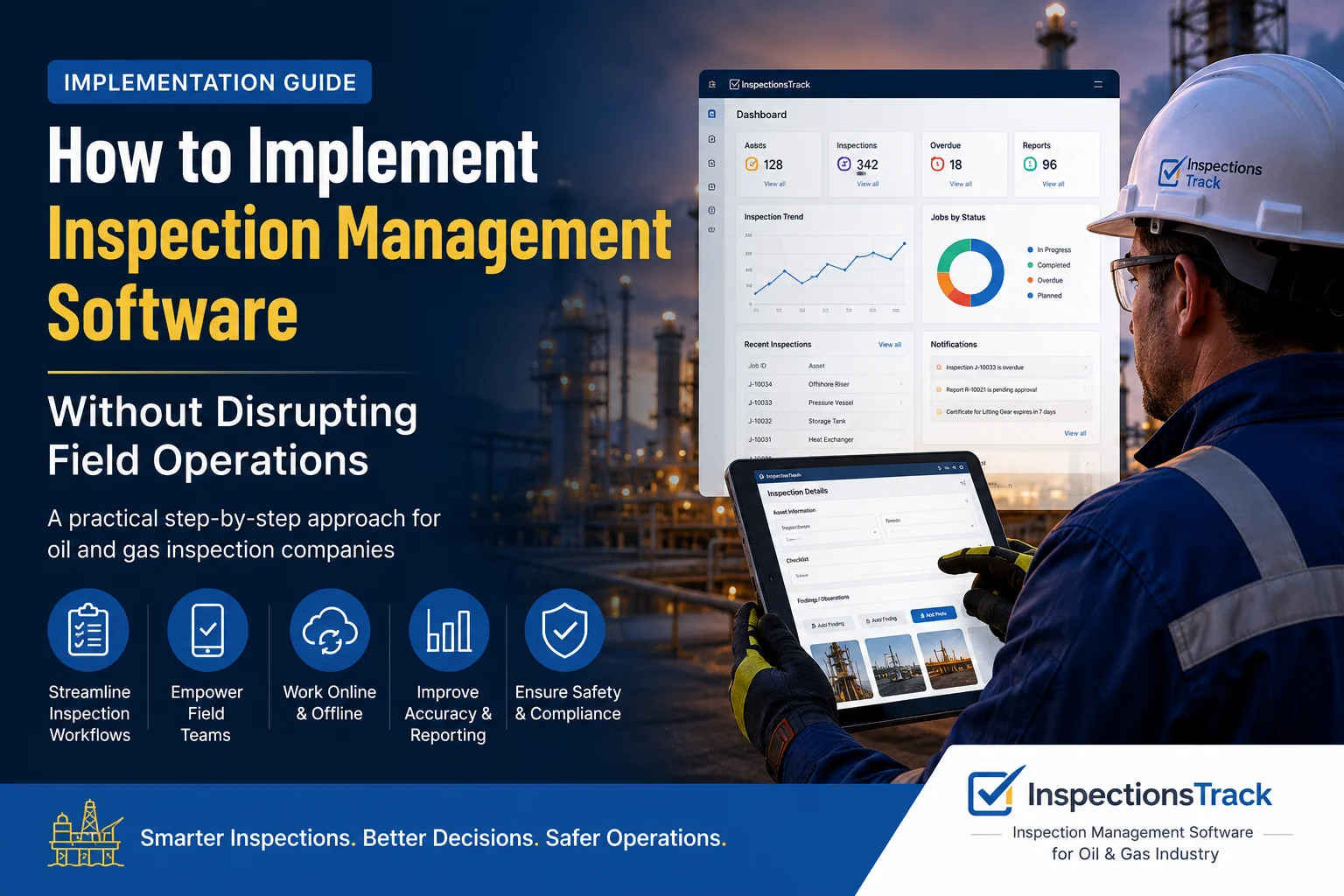
Implementing inspection management software can help oil and gas inspection companies reduce paperwork, improve reporting accuracy, and manage jobs more efficiently. However, the biggest concern for many operations managers is simple: How can you introduce…


Comment (1)
Scale Inspection Operations: 7 Proven Ways to Grow - inspectionstrack
Oct 20, 2026[…] Read more : How to Meet Client SLAs in Inspection Services: Deadlines, Deliverables and Accountability […]
Comments are closed.