
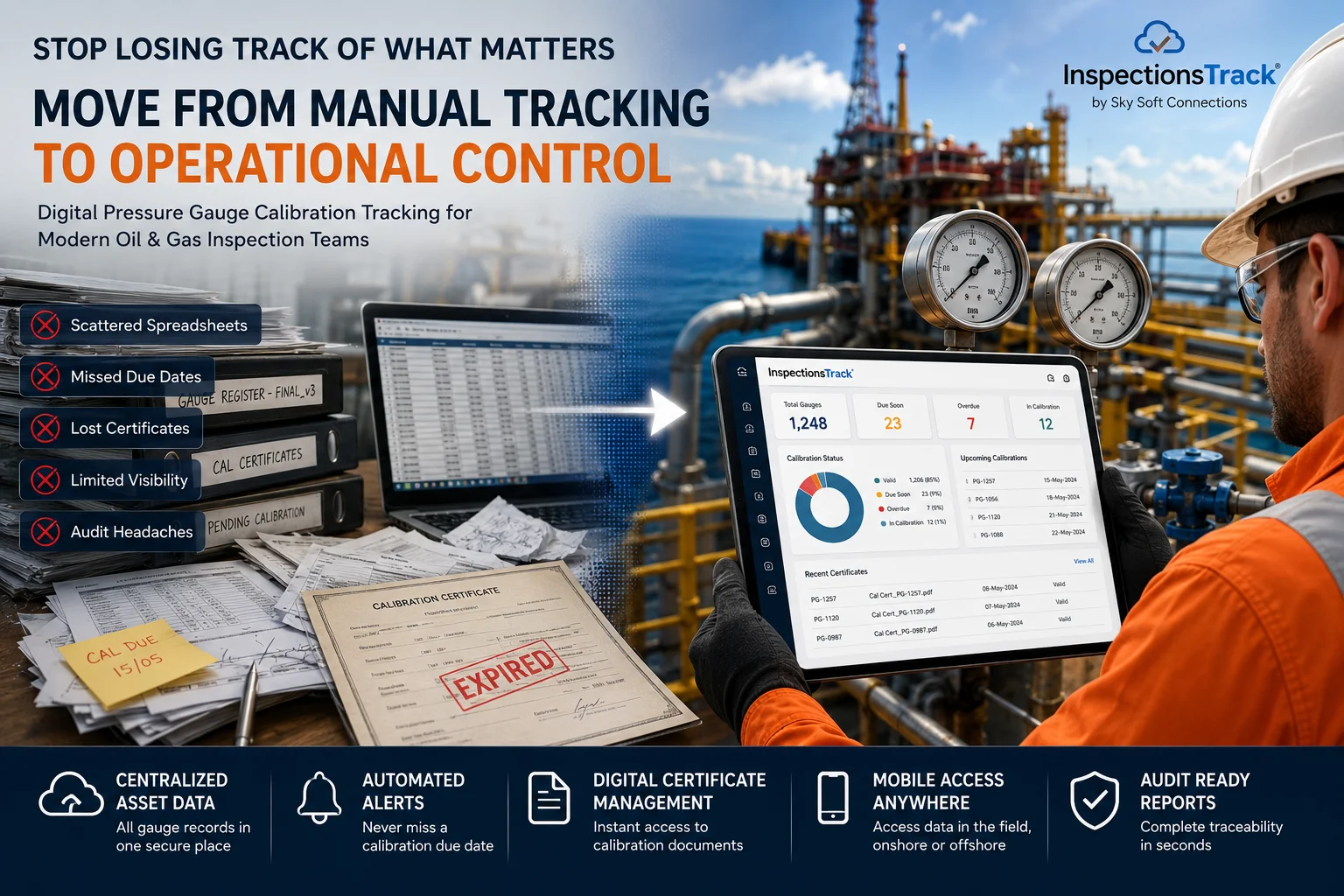
Pressure gauge play a critical role in oil and gas operations. From drilling equipment and pressure vessels to hydraulic systems and process pipelines, these instruments provide essential data that influences operational safety, regulatory compliance, and asset integrity.
Yet many inspection companies still rely on spreadsheets, paper certificates, email reminders, and disconnected databases to manage pressure gauge calibration schedules.
The problem is no longer just administrative inefficiency.
Manual calibration tracking has become an operational risk.
As inspection volumes increase and compliance requirements tighten, modern inspection teams need a more reliable approach.
Inspection teams often manage hundreds or thousands of pressure gauges across multiple clients, rigs, workshops, and offshore assets.
Under these conditions, manual tracking methods begin to fail.
Common scenarios include:
These challenges directly impact inspection efficiency and audit readiness.

Modern inspection companies manage far more assets than they did a decade ago.
A single offshore campaign may involve:
Tracking these assets manually creates unnecessary complexity.
As the number of instruments grows, the likelihood of human error increases.
Many organizations continue using Excel-based calibration registers.
However, spreadsheets cannot provide:
As a result, teams often operate using outdated information.
This becomes particularly problematic during offshore mobilizations.
Oil and gas clients increasingly expect inspection providers to demonstrate robust quality controls.
During audits, inspectors may need immediate access to:
Manual systems slow down this process considerably.
Consequently, audit preparation becomes reactive instead of proactive.
The impact extends beyond administrative inconvenience.
Using an out-of-calibration pressure gauge may result in:
Manual tracking can contribute to:
Organizations may experience:
| Area | Manual Tracking | Digital Tracking |
|---|---|---|
| Calibration reminders | Calendar entries or emails | Automated notifications |
| Certificate storage | Shared folders | Centralized repository |
| Asset visibility | Limited | Real-time dashboards |
| Audit preparation | Time-consuming | Instant access |
| Field accessibility | Office-dependent | Mobile-enabled |
| Traceability | Difficult | Complete audit trails |
| Reporting | Manual compilation | Automated reports |
| Scalability | Poor | Designed for growth |
The operational gap between these approaches continues to widen.
Many inspection companies unknowingly follow a fragmented workflow.
Technicians create asset records in spreadsheets.
Certificates are saved locally or emailed internally.
Managers manually review upcoming expiry dates.
Teams send individual emails to responsible personnel.
Staff search through multiple folders to compile evidence.
Each step introduces opportunities for:
Modern inspection software addresses these limitations by centralizing the entire process.
The InspectionsTrack Software Suite by Sky Soft Connections enables inspection teams to manage calibration activities through a single platform.
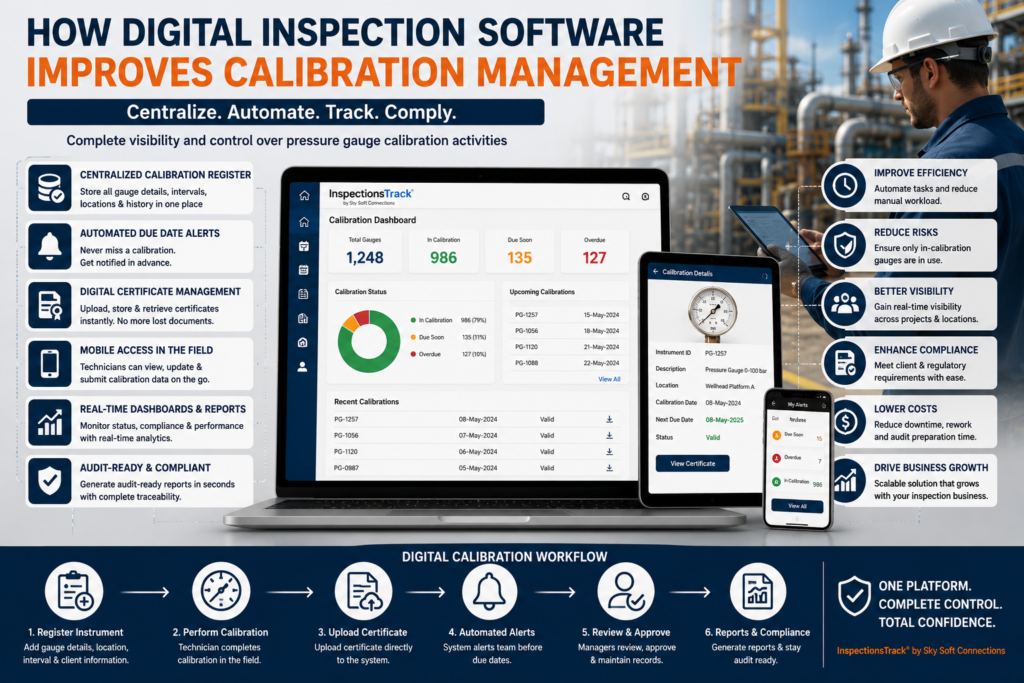
Key capabilities include:
Inspection teams can maintain a structured database containing:
Instead of relying on manual reviews, the system automatically alerts relevant personnel when calibrations approach expiry.
This helps teams plan proactively.
Certificates remain linked directly to each instrument record.
As a result, technicians and managers can retrieve documentation instantly.
Field personnel can access relevant information using mobile devices.
This improves operational continuity during:
Inspection organizations can generate reports quickly when responding to:
Consider an inspection company managing 1,500 pressure gauges across multiple offshore clients.
Using manual systems, the organization faces several challenges:
By implementing a digital calibration workflow using InspectionsTrack Software Suite, the company can:
The objective is not simply digitization.
It is operational control.
If your organization experiences any of the following, it may be time to modernize calibration tracking.
Ignoring these warning signs often compounds existing inefficiencies.
Digital transformation within oil and gas inspections is no longer limited to reporting.
Organizations increasingly recognize that supporting processes also require modernization.
Pressure gauge calibration tracking is one of those areas.
Inspection teams that digitize these workflows often benefit from:
Most importantly, they create a scalable foundation for future growth.
Manual systems increase the likelihood of missed due dates, lost certificates, and inconsistent records, which can affect compliance and operational safety.
Digital platforms centralize records, automate reminders, and provide audit trails that support regulatory and client requirements.
Yes. Modern systems such as InspectionsTrack allow organizations to manage instruments across different clients, projects, and locations.
Typical records include asset ID, serial number, calibration interval, certificate history, location, client ownership, and next due date.
Manual pressure gauge calibration tracking may have worked when inspection programs were smaller and less complex.
However, today’s inspection environment demands greater visibility, stronger traceability, and faster access to information.
Inspection companies operating in the oil and gas sector cannot afford fragmented processes that rely heavily on spreadsheets and individual oversight.
Digital solutions such as the InspectionsTrack Software Suite by Sky Soft Connections help organizations transform calibration management from a reactive administrative task into a proactive operational capability.
For inspection teams seeking to improve compliance readiness, reduce risk, and support long-term growth, modernizing calibration tracking is becoming less of an option and more of a necessity.
Read more : How Inspection Companies Improve Pressure Gauge Calibration Compliance Using Digital Software
Working at height is one of the most demanding activities in industrial environments. For rope access teams, however, safety depends on more than having the right equipment. Fall protection equipment must also be inspected correctly,…
A flare stack may look like a simple vertical structure standing above a rig or production facility. In reality, it is one of the most important safety systems for handling flammable gases and relieving potentially…


