
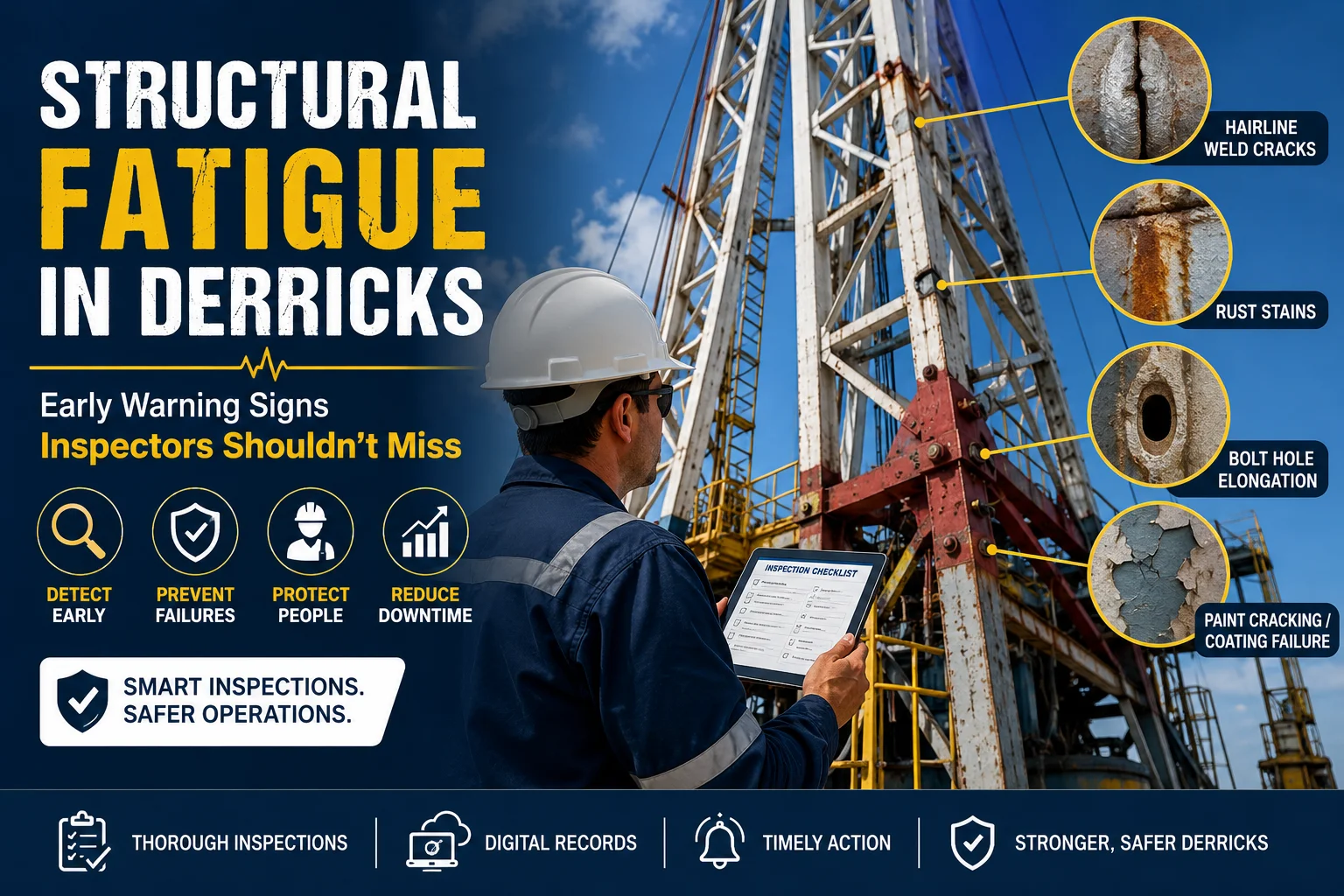
Structural fatigue in derricks remains one of the most overlooked threats in offshore and onshore drilling operations. Unlike sudden mechanical failures, fatigue damage develops gradually through repeated loading cycles, environmental stress, and operational wear. Consequently, by the time visible cracks appear, the structure may already be approaching a critical condition.
Therefore, identifying early warning signs is essential for maintaining asset integrity, preventing costly downtime, and ensuring personnel safety.
In this guide, you’ll learn how structural fatigue develops, what inspectors should look for during inspections, how modern digital inspection software improves fatigue monitoring, and why proactive inspection strategies significantly reduce operational risk.
Structural fatigue refers to the progressive weakening of steel components caused by repeated cyclic loading rather than a single overload event.
Every drilling operation places continuous stress on the derrick structure. Although each load cycle may remain well below the material’s maximum strength, thousands—or even millions—of cycles eventually create microscopic cracks that grow over time.
Unlike corrosion, fatigue damage often remains hidden until advanced stages.
Common causes include:
As a result, fatigue inspection forms a critical component of every asset integrity management program.
A fatigued derrick doesn’t simply lose efficiency—it becomes a significant safety hazard.
If inspectors fail to identify fatigue early, organizations may face:
Consequently, inspection teams should never rely solely on visual observations without systematic documentation and historical comparisons.
Fatigue damage generally progresses through predictable stages.
| Stage | What Happens | Inspection Priority |
|---|---|---|
| Crack Initiation | Microscopic cracks begin | Very High |
| Crack Propagation | Cracks gradually extend | Critical |
| Structural Weakening | Members lose strength | Severe |
| Final Failure | Sudden fracture occurs | Emergency |
The earlier inspectors detect fatigue, the lower the repair costs and operational disruption.
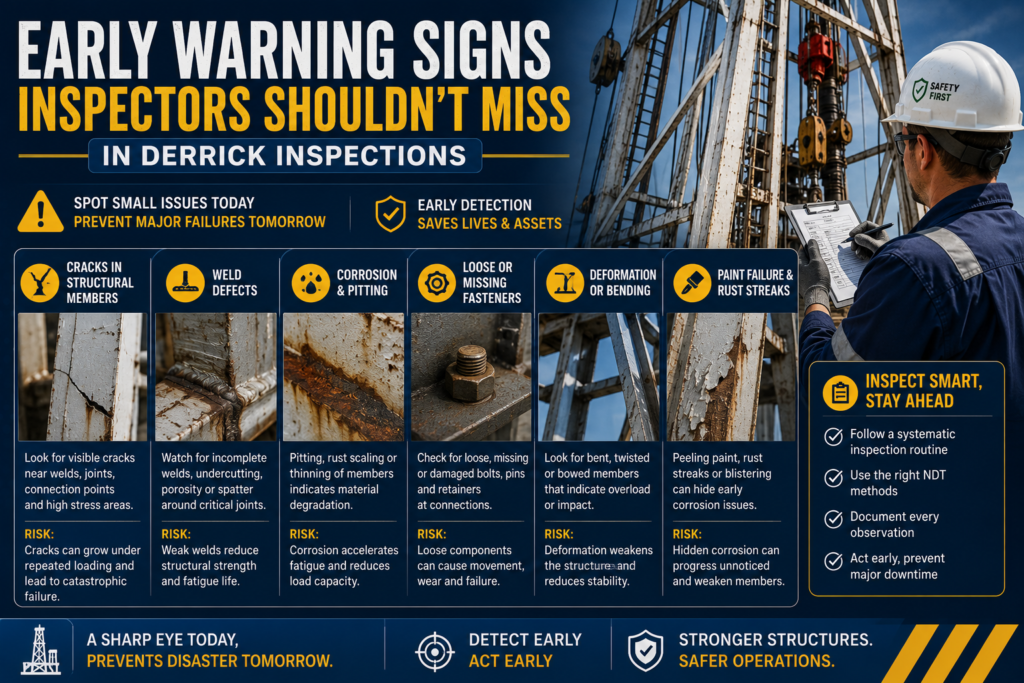
Welded joints experience high stress concentrations.
Inspectors should carefully examine:
Even extremely small cracks deserve immediate documentation because they often represent the beginning of fatigue failure.
Rust bleeding frequently indicates hidden cracking beneath protective coatings.
Although many inspectors associate rust with corrosion, localized rust streaks around welded joints often signal fatigue crack openings.
Pay close attention to:
Protective coatings usually fail before structural members do.
Therefore, inspectors should investigate:
These cosmetic changes often reveal movement within the underlying steel.
Repeated loading causes holes to deform gradually.
Signs include:
This indicates that cyclic loading has exceeded acceptable movement limits.
Inspectors should compare current geometry with previous inspection records.
Watch for:
Even slight distortion may indicate deeper fatigue damage.
Repeated vibration gradually loosens structural connections.
Inspectors should verify:
Loose fasteners increase stress concentrations elsewhere in the structure.
Operators often notice changes before visible defects appear.
Investigate reports of:
These symptoms frequently indicate developing fatigue.
Corrosion and fatigue often work together.
This combination—known as corrosion fatigue—significantly shortens structural life.
Areas requiring additional attention include:
| Inspection Area | Fatigue Risk | Inspection Method |
|---|---|---|
| Welded Connections | Very High | Visual + NDT |
| Crown Block Supports | High | Visual + UT |
| Derrick Legs | High | Visual + Thickness Check |
| Cross Bracing | High | Visual + MPI |
| Base Connections | Critical | Detailed Structural Inspection |
| Guy Wire Attachments | High | Visual + Torque Check |
| Pipe Handling Equipment Supports | Medium | Visual Inspection |
Visual inspection remains essential, but it should not stand alone.
The most effective fatigue inspection program combines multiple techniques.
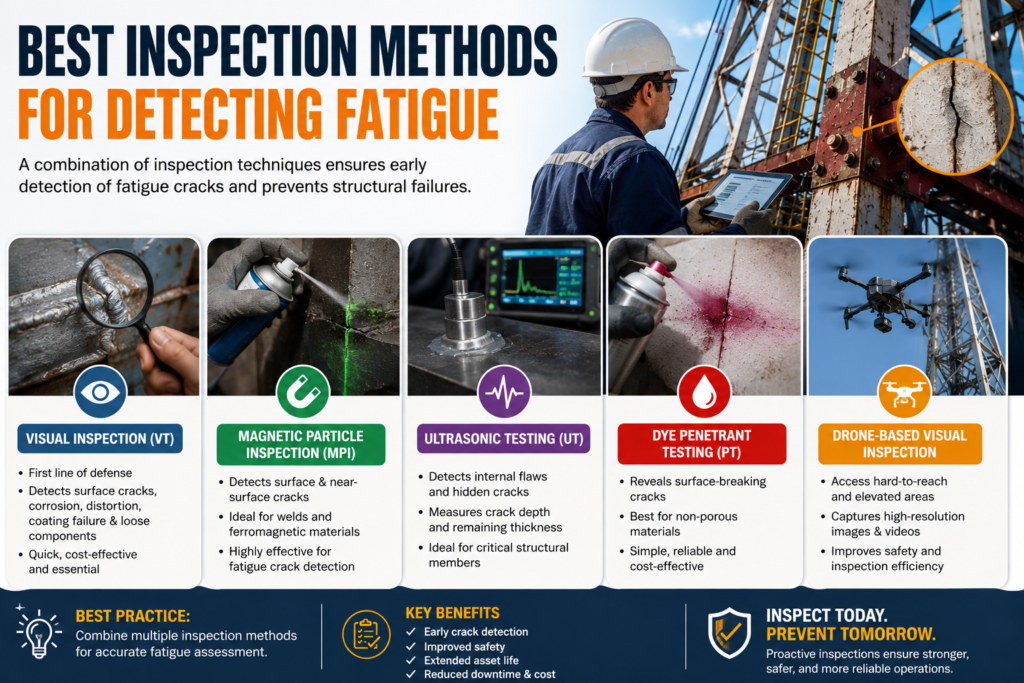
Ideal for:
Best for detecting:
Effective for identifying:
Useful for:
Increasingly used for:
Drones improve inspector safety while providing high-resolution imagery for detailed assessments.
Many fatigue failures result from inspection errors rather than inspection frequency.
Avoid these common mistakes:
Standardized digital inspection workflows help eliminate these issues.
Paper-based inspections often make it difficult to compare defects over time.
Digital inspection platforms, however, provide consistent records, photographic evidence, and historical tracking that support more accurate fatigue assessments.
InspectionsTrack is purpose-built for the oil and gas inspection industry and helps inspection companies manage structural inspections more efficiently.
Key capabilities include:
By digitizing inspections, teams can identify recurring fatigue patterns, monitor crack progression, and make informed maintenance decisions before failures occur.
Implementing preventive strategies significantly extends derrick service life.
Recommended practices include:
A proactive maintenance strategy reduces both safety risks and lifecycle costs.
Read more : Set Pressure vs. Actual Pressure: Diagnosing Drift in Pressure Relief Valves
Repeated cyclic loading from drilling operations, vibration, wind, heavy lifting, and environmental conditions gradually weakens structural steel and creates fatigue cracks.
Visual inspection can identify many early warning signs such as cracks, rust staining, coating failures, and distortion. However, combining visual inspections with NDT methods like MPI or UT provides more reliable results.
Welded joints, cross braces, crown block supports, base connections, gusset plates, and highly stressed structural members are generally the most susceptible to fatigue.
Inspection frequency depends on operating conditions, regulatory requirements, equipment age, and previous inspection findings. High-use offshore derricks typically require more frequent inspections than lower-duty installations.
InspectionsTrack enables inspectors to capture digital inspection data, compare historical records, document defects with photographs, automate reports, and monitor structural condition throughout the asset lifecycle.
Structural fatigue in derricks develops silently, yet its consequences can be severe if left undetected. Fortunately, recognizing early warning signs such as hairline weld cracks, rust staining, bolt hole elongation, structural distortion, and unusual vibration allows inspection teams to intervene before minor defects become major failures.
Furthermore, combining routine visual inspections with non-destructive testing and a digital inspection management system strengthens every stage of the inspection process. By adopting proactive maintenance practices and leveraging platforms like InspectionsTrack, oil and gas companies can improve safety, extend asset life, ensure regulatory compliance, and reduce unplanned downtime.

Working at height is one of the most demanding activities in industrial environments. For rope access teams, however, safety depends on more than having the right equipment. Fall protection equipment must also be inspected correctly,…

A flare stack may look like a simple vertical structure standing above a rig or production facility. In reality, it is one of the most important safety systems for handling flammable gases and relieving potentially…


