
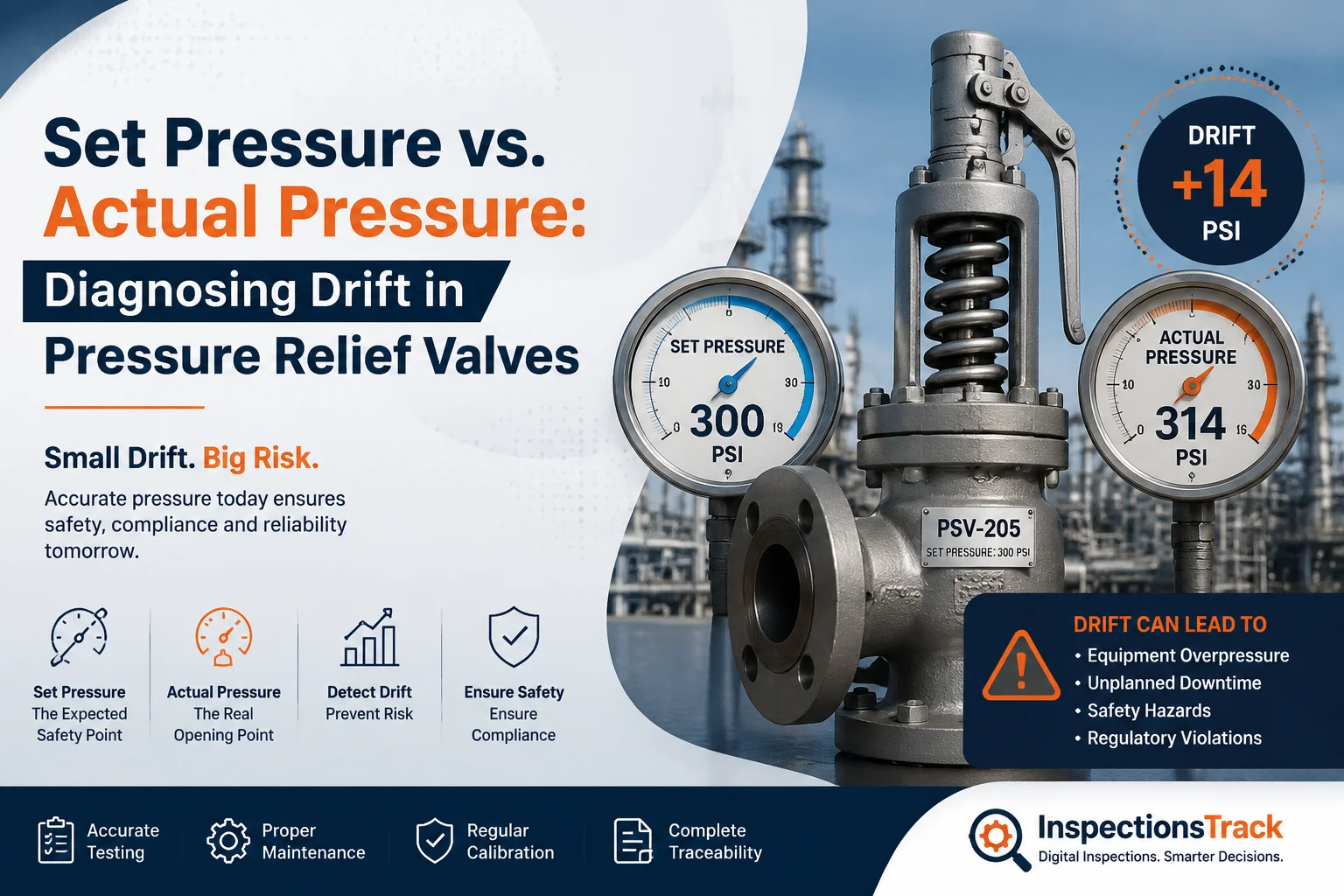
Pressure Relief Valve (PRV) drift is one of the most overlooked yet critical reliability issues in the oil and gas industry. While a valve may appear functional during routine checks, even a slight deviation between its set pressure and actual opening pressure can compromise equipment safety, regulatory compliance, and operational efficiency.
Therefore, maintenance teams, inspection companies, and asset integrity professionals must understand how pressure drift develops, how to diagnose it accurately, and how digital inspection software simplifies the entire process.
In this guide, we’ll explain the difference between set pressure and actual pressure, common causes of PRV drift, inspection best practices, and how InspectionsTrack helps inspection companies streamline pressure relief valve inspections with accurate reporting, digital records, and complete traceability.
Set pressure is the predetermined pressure at which a pressure relief valve is designed to begin opening. Manufacturers calibrate every valve according to industry standards such as:
For example:
| Valve Rating | Set Pressure |
|---|---|
| PSV-101 | 150 psi |
| PSV-205 | 300 psi |
| PSV-350 | 500 psi |
The set pressure acts as the safety threshold that protects equipment from excessive internal pressure.
Without an accurate set pressure, process equipment could experience catastrophic overpressure.
Actual pressure refers to the pressure at which the valve actually begins to lift during testing or operation.
Ideally:
Actual Opening Pressure = Set Pressure
However, this rarely remains true throughout the valve’s service life.
Instead, valves gradually experience pressure drift, causing them to open either too early or too late.
Pressure relief valve drift is the gradual deviation between the original calibrated set pressure and the valve’s current operating pressure.
For example:
| Original Set Pressure | Actual Opening Pressure | Drift |
|---|---|---|
| 150 psi | 145 psi | -5 psi |
| 300 psi | 312 psi | +12 psi |
| 500 psi | 482 psi | -18 psi |
Although these numbers may appear small, even minor deviations can significantly increase operational risk.
Several mechanical and environmental factors contribute to pressure relief valve drift.
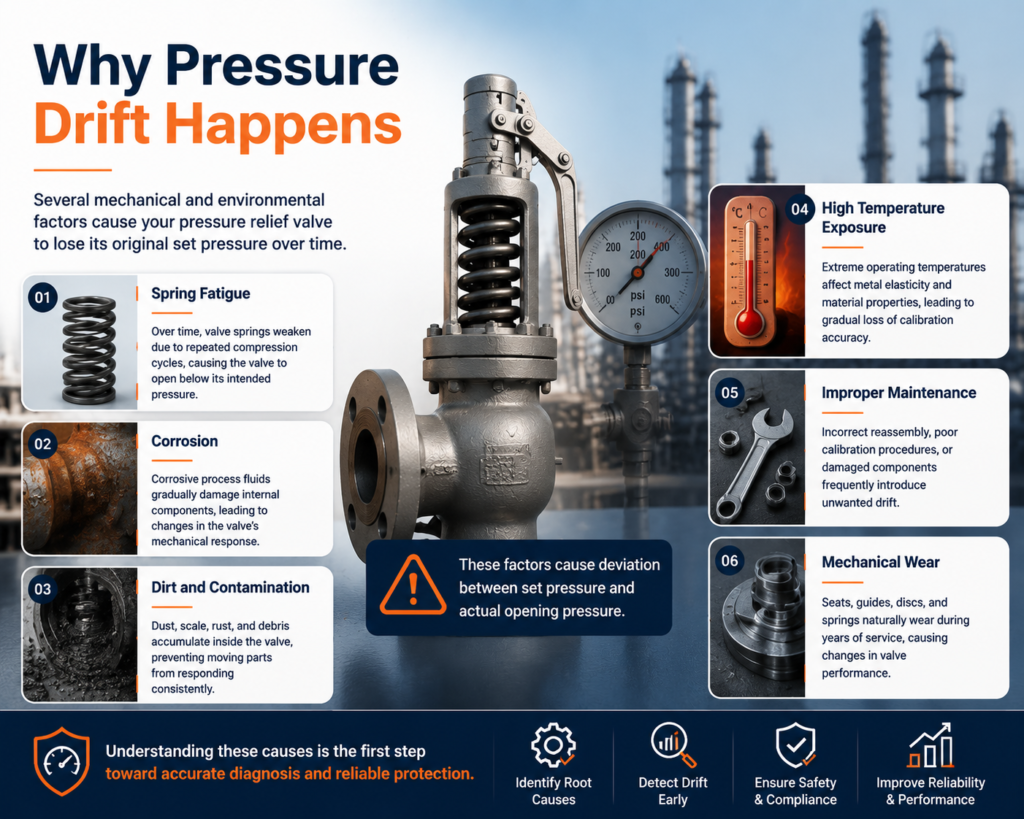
Over time, valve springs weaken due to repeated compression cycles.
As a result, the valve may open below its intended pressure.
Corrosive process fluids gradually damage internal components.
Consequently, corrosion changes the valve’s mechanical response.
Dust, scale, rust, and debris often accumulate inside valves.
Therefore, moving parts cannot respond consistently.
Extreme operating temperatures affect metal elasticity.
Eventually, calibration accuracy begins to deteriorate.
Incorrect reassembly, poor calibration procedures, or damaged components frequently introduce unwanted drift.
Seats, guides, discs, and springs naturally wear during years of service.
Accordingly, valve performance gradually changes.
Pressure relief valves exist to protect lives, equipment, and production assets.
When drift occurs, multiple risks increase.
Clearly, both scenarios create serious operational concerns.
Inspection teams should monitor several warning indicators.
Modern inspection programs use systematic testing procedures.
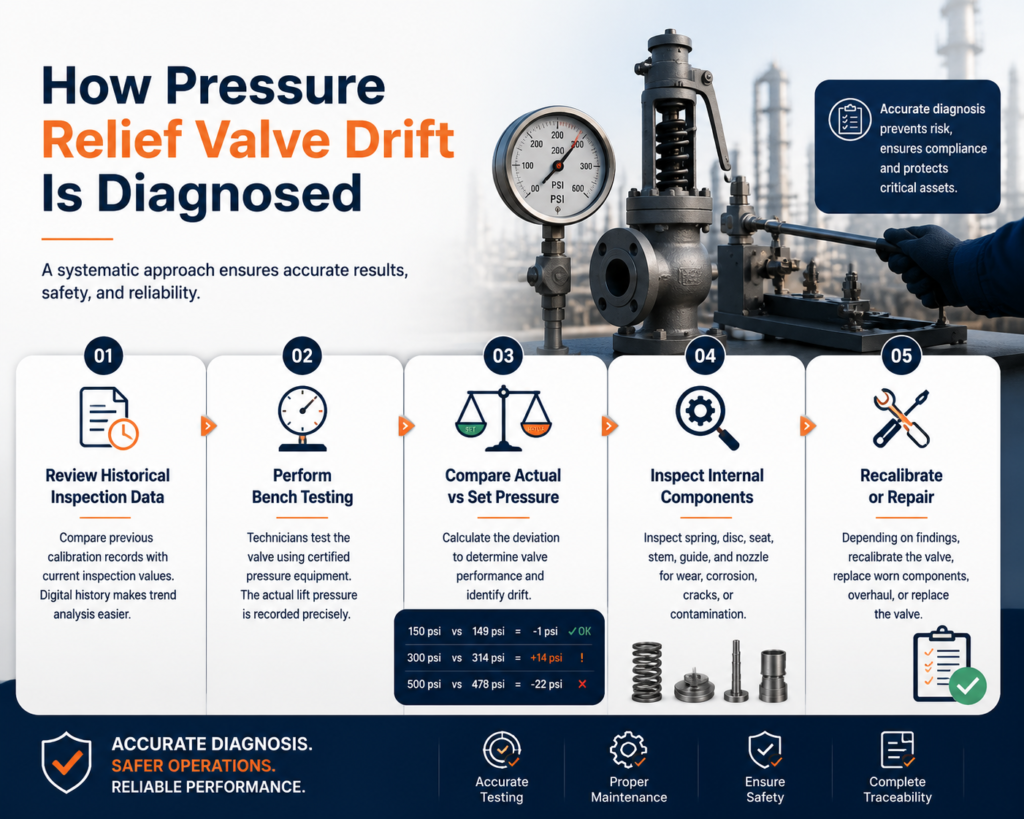
Compare previous calibration records with current inspection values.
Digital history makes trend analysis significantly easier.
Technicians test the valve using certified pressure equipment.
The actual lift pressure is recorded precisely.
Calculate the deviation.
Example:
| Set Pressure | Actual Pressure | Difference | Status |
|---|---|---|---|
| 150 psi | 149 psi | -1 psi | Acceptable |
| 300 psi | 314 psi | +14 psi | Investigate |
| 500 psi | 478 psi | -22 psi | Repair Required |
Inspect:
Look for wear, corrosion, cracks, or contamination.
Depending on inspection findings, technicians may:
Organizations that proactively inspect PRVs experience fewer failures and better compliance.
Recommended practices include:
Furthermore, maintaining consistent inspection documentation improves audit readiness.
Many inspection companies still rely on spreadsheets and paper forms.
Unfortunately, manual methods often create problems such as:
As inspection volumes grow, these inefficiencies become increasingly costly.
For oil and gas inspection companies, InspectionsTrack provides a comprehensive digital inspection platform that simplifies pressure relief valve inspections from planning to reporting.
Instead of managing disconnected spreadsheets, inspectors can capture, manage, and report inspection data in one centralized system.
Inspectors collect field data using standardized digital checklists, ensuring consistency across every inspection.
Store historical calibration data, certificates, and inspection records securely in one location.
Conduct inspections directly from tablets or mobile devices, even in remote field environments.
Generate professional inspection reports in minutes rather than hours.
Monitor every valve’s inspection history, calibration trends, maintenance activities, and repair records throughout its lifecycle.
Maintain complete documentation for audits and regulatory compliance with instant access to inspection evidence.
Managers gain immediate visibility into inspection status, overdue assets, and maintenance priorities.
Digital inspection platforms deliver measurable operational advantages.
| Manual Inspection | InspectionsTrack |
|---|---|
| Paper forms | Digital inspection forms |
| Manual calculations | Automated data validation |
| Delayed reports | Instant report generation |
| Separate files | Centralized asset history |
| Difficult audits | Complete compliance records |
| Limited trend analysis | Historical performance tracking |
As a result, organizations reduce administrative effort while improving inspection accuracy and decision-making.
Read more : Why Uncalibrated Pressure Gauges Are a Silent Safety Risk on Your Site
Acceptable tolerance depends on the valve type, applicable standards, and manufacturer recommendations. Always follow API, ASME, or site-specific requirements.
Inspection intervals vary based on service conditions, risk assessments, and regulatory requirements. Critical process equipment typically requires more frequent inspections.
Not entirely. However, routine inspections, preventive maintenance, proper calibration, and digital inspection tracking significantly reduce the likelihood and impact of pressure drift.
Historical records help identify gradual performance changes before they become safety risks, enabling predictive maintenance instead of reactive repairs.
Yes. Digital inspection software like InspectionsTrack centralizes inspection records, calibration certificates, photographs, corrective actions, and reports, making audits faster and more reliable.
Pressure relief valves are among the most important safety devices in oil and gas operations. Even small differences between set pressure and actual pressure can indicate developing problems that, if ignored, may lead to costly downtime, equipment damage, or serious safety incidents.
Therefore, organizations should combine regular calibration, preventive maintenance, and standardized inspection procedures with digital inspection management. By replacing paper-based processes with InspectionsTrack, inspection companies can improve inspection accuracy, maintain complete asset histories, accelerate reporting, and strengthen regulatory compliance.
Ultimately, proactive monitoring of pressure relief valve drift not only protects critical assets but also supports safer operations, higher reliability, and more informed maintenance decisions.

Working at height is one of the most demanding activities in industrial environments. For rope access teams, however, safety depends on more than having the right equipment. Fall protection equipment must also be inspected correctly,…

A flare stack may look like a simple vertical structure standing above a rig or production facility. In reality, it is one of the most important safety systems for handling flammable gases and relieving potentially…


