
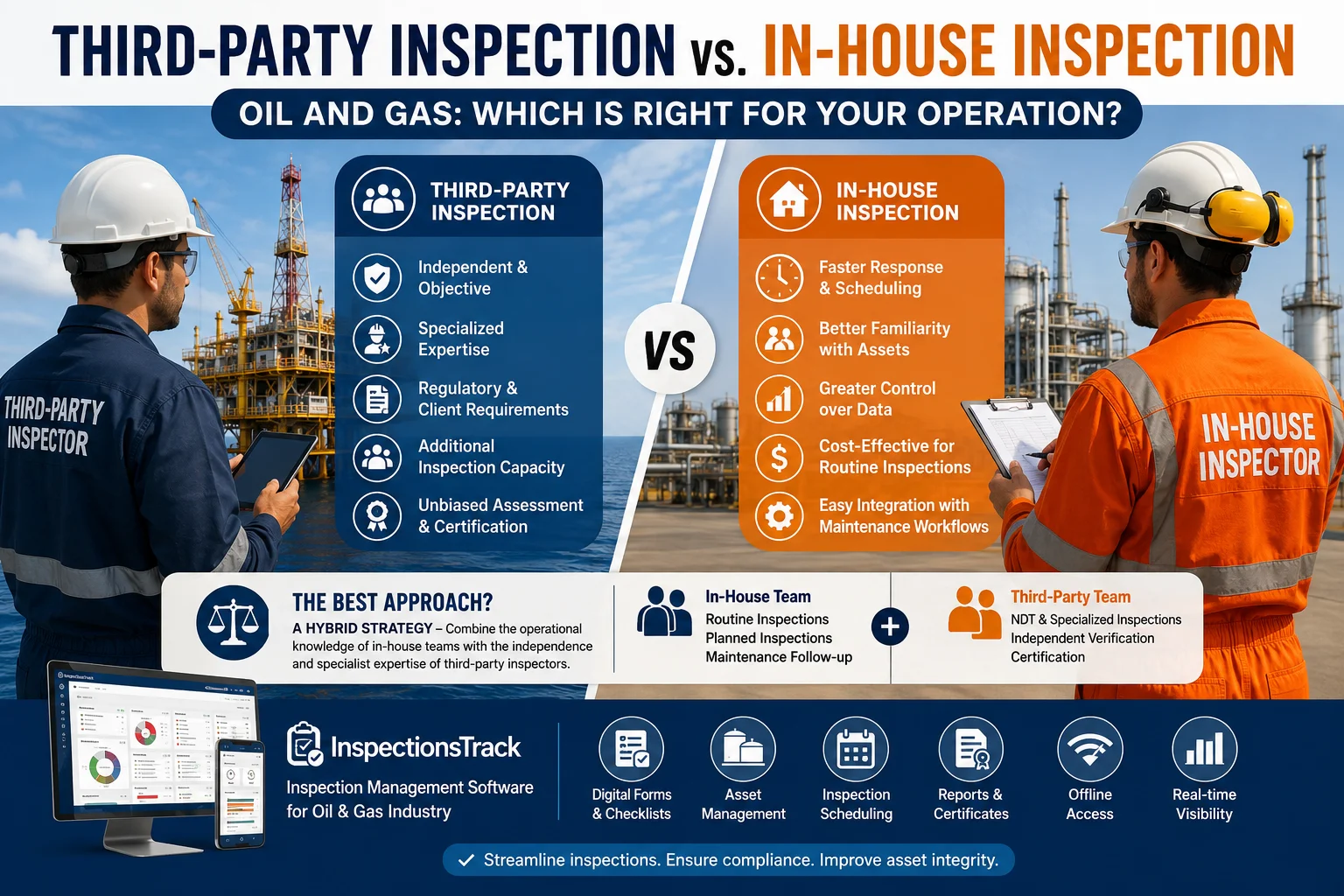
In the oil and gas industry, regular inspections are essential for maintaining equipment integrity, reducing operational risks, and meeting safety and compliance requirements. However, one important question often comes up: Should inspections be handled by an in-house team or a third-party inspection company?
Both approaches have advantages. In-house inspections provide greater control and faster access to internal teams, while third-party inspection services bring independent expertise, specialized knowledge, and an objective assessment.
So, which option is right for your operation?
The answer depends on your assets, inspection requirements, available expertise, regulatory obligations, and operational scale.
An in-house inspection is performed by employees or dedicated inspection personnel within an oil and gas company.
These teams typically understand the organization’s equipment, processes, maintenance history, and operational environment. As a result, they can often respond quickly when an inspection is required.
Common in-house inspection activities include:
The biggest advantage is control. Your inspection team works directly within your organization and can access asset information quickly.
Other benefits include:
However, in-house inspection can become challenging when specialized expertise, independent verification, or additional inspection capacity is required.
A third-party inspection is performed by an independent inspection company or certified inspection professional.
These specialists are commonly brought in when an operation requires specialized knowledge, independent verification, certification, or an objective assessment.
Third-party inspectors may support areas such as:
Because the inspector is independent of the operating company, third-party inspection can also provide greater confidence to clients, regulators, partners, and other stakeholders.
The right choice becomes clearer when you compare both approaches across important operational factors.
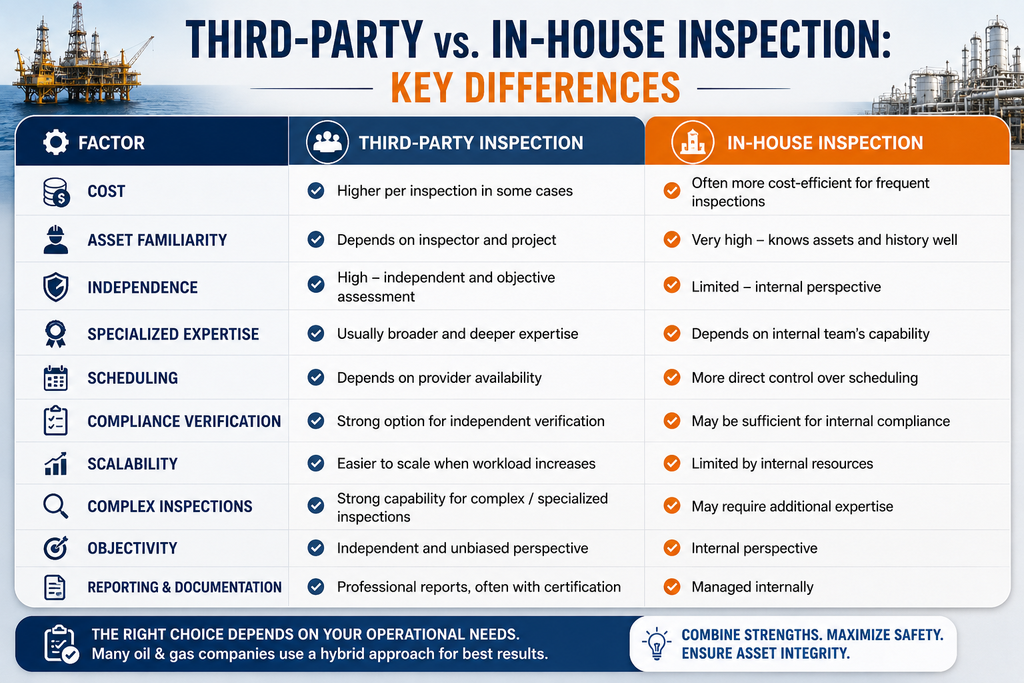
| Factor | In-House Inspection | Third-Party Inspection |
|---|---|---|
| Cost | Often efficient for frequent inspections | Higher per inspection in some cases |
| Asset familiarity | Very high | Depends on inspector and project |
| Independence | Limited | High |
| Specialized expertise | Depends on internal team | Usually broader |
| Scheduling | More direct control | Depends on provider availability |
| Compliance verification | May be sufficient internally | Strong option for independent verification |
| Scalability | Limited by internal resources | Easier to scale when workload increases |
| Complex inspections | May require additional expertise | Strong option |
| Inspection objectivity | Internal perspective | Independent perspective |
An in-house approach can be effective when your organization has experienced inspectors, established inspection procedures, and sufficient resources.
It is particularly suitable for routine and recurring inspections where your team already understands the equipment and inspection requirements.
Choose in-house inspection when:
However, relying exclusively on an internal team may create capacity issues when inspection workloads increase or specialized expertise is needed.
Third-party inspection is often the better choice when independence, certification, or specialist expertise is important.
For example, an oil and gas operator may use a third-party inspection company for a complex NDT inspection or an independent assessment before equipment is certified for operation.
Third-party inspection can be particularly useful when:
Absolutely.
In many cases, a hybrid inspection strategy provides the best balance.
Your internal team can manage routine inspections and continuous asset monitoring, while third-party specialists can handle complex, specialized, or independent inspections.
For example:
In-house team: Routine visual inspections → Planned inspections → Maintenance follow-up
Third-party team: NDT → Specialized equipment inspection → Independent verification → Certification
This approach allows companies to maintain operational control while bringing in external expertise when needed.
Whether inspections are performed internally or by third-party inspectors, inspection data management is critical.
Using spreadsheets, paper forms, emails, and disconnected documents can make it difficult to track inspection history, identify overdue inspections, manage certificates, and produce accurate reports.
This is where inspection management software can make a significant difference.
InspectionsTrack is an inspection management software platform designed for the oil and gas industry. It helps inspection teams manage inspection workflows, assets, reports, certificates, and inspection data from a centralized system.
The platform supports inspection activities including:
Moreover, teams can use digital forms and checklists, manage assets, generate reports, track certificates, and work offline when connectivity is limited.
This is particularly useful when an operation uses a combination of internal and third-party inspection teams.
Third-party inspections can create additional challenges because inspection information often comes from different companies, inspectors, and reporting systems.
A centralized platform can help standardize the process.
With InspectionsTrack, organizations can:
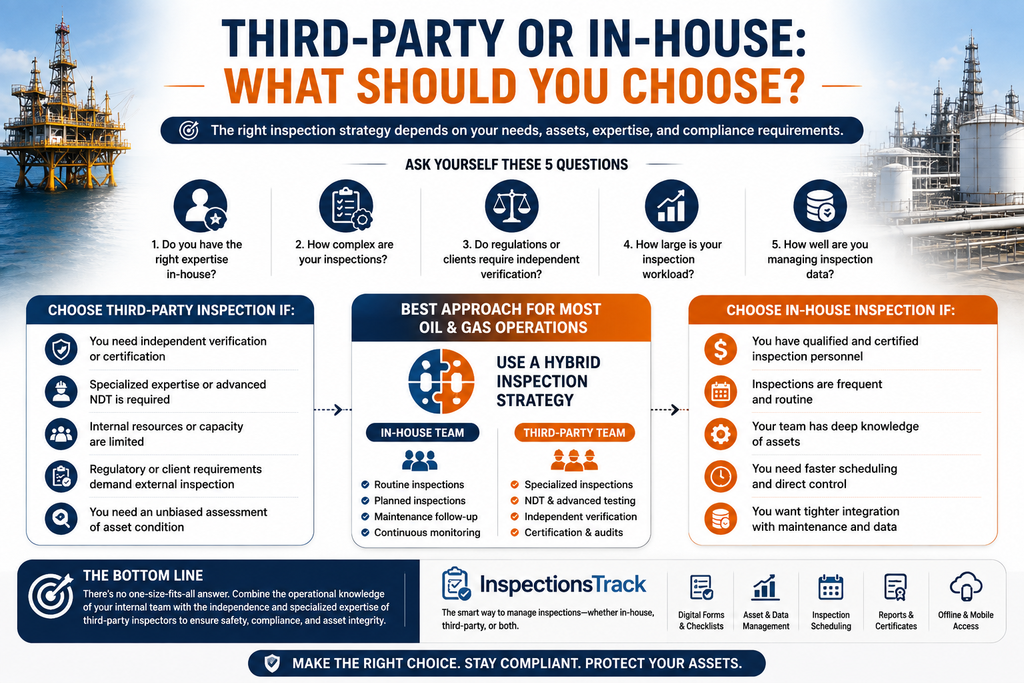
There is no universal answer.
Instead, consider these five questions:
If your internal team has the required certifications and technical expertise, in-house inspection may work well.
If not, third-party specialists can fill the gap.
Routine inspections can often be handled internally. However, complex NDT, specialized equipment inspections, and independent assessments may require external expertise.
Some projects, clients, or regulatory frameworks may require third-party involvement. In those cases, external inspection is not simply a preference; it can be a requirement.
A large inspection workload can put pressure on internal teams. Therefore, using third-party inspectors can provide additional capacity without permanently expanding your workforce.
Regardless of who performs the inspection, poor data management can undermine the entire process.
A centralized inspection management platform helps ensure that inspection records remain accessible, organized, and actionable.
In-house inspection is ideal for routine inspections, continuous asset monitoring, and operations with strong internal expertise. Third-party inspection is valuable when you need specialist knowledge, independent verification, certification, or additional inspection capacity.
For many oil and gas companies, however, the best solution is not choosing one over the other. A hybrid inspection strategy can combine the operational knowledge of internal teams with the independence and specialist expertise of third-party inspectors.
Most importantly, both teams need reliable inspection data.
With an inspection management platform such as InspectionsTrack, oil and gas companies can standardize inspection workflows, centralize asset and inspection records, automate reporting, track certificates, and improve visibility across internal and external inspection activities.
The goal is simple: make every inspection easier to manage, easier to verify, and more useful for maintaining asset integrity.
Read more : How Digital Drill Pipe Inspection Records Improve Traceability From Yard Inspection to Rig Deployment
Not necessarily. In-house inspection is often better for routine activities, while third-party inspection is useful for specialized work, independent verification, and certification requirements.
Third-party inspection provides independent assessment, specialized expertise, additional inspection capacity, and can support regulatory or client requirements.
In-house teams typically have strong knowledge of company assets and can manage routine inspections quickly while maintaining direct control over scheduling and inspection data.
Yes. A centralized inspection management platform can standardize forms, workflows, asset records, reports, and inspection history across internal and external teams.
InspectionsTrack is an inspection management platform designed for oil and gas inspection workflows. It supports multiple inspection types, digital forms, asset management, certificates, reporting, planned inspections, and offline field operations.
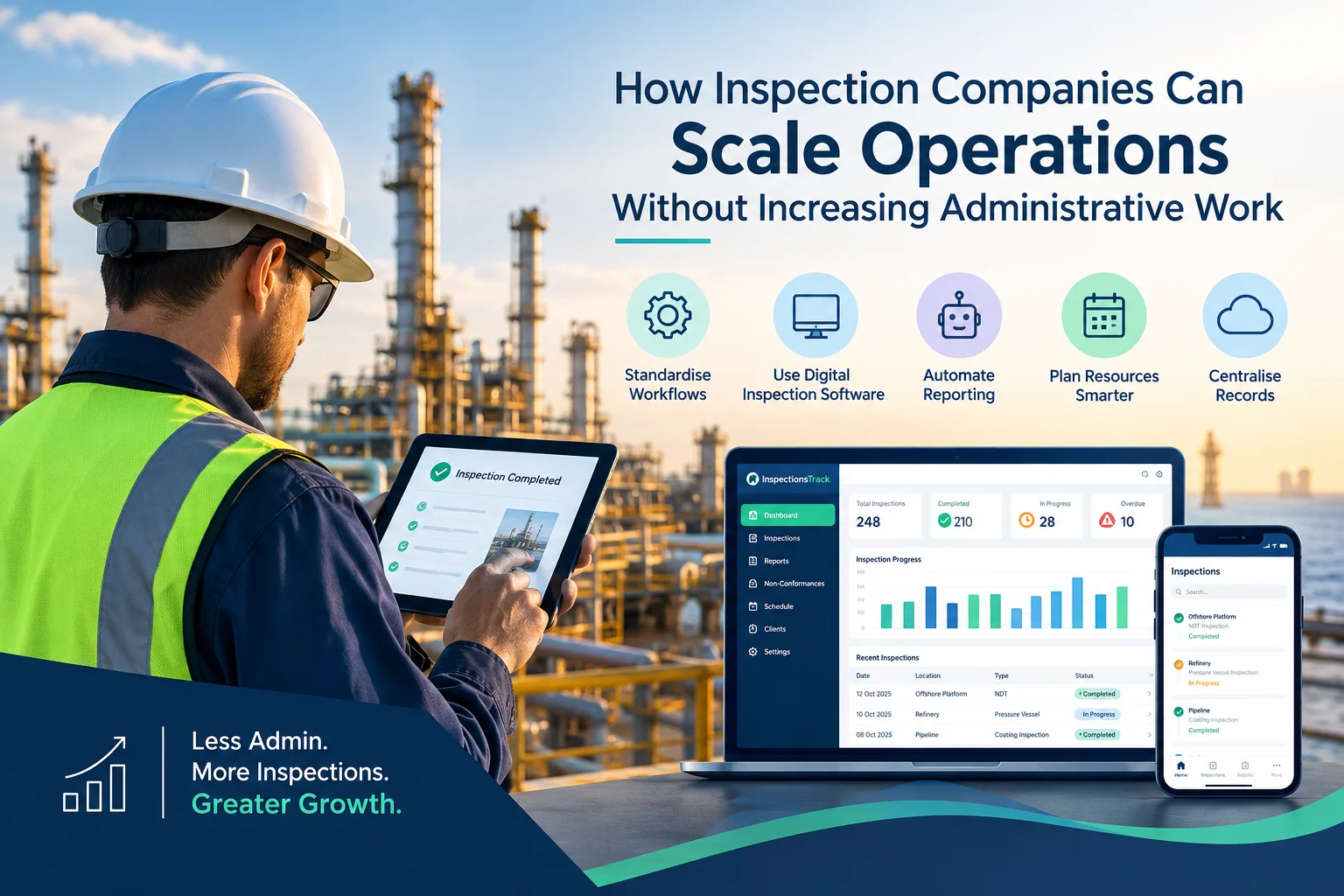
Inspection companies in the oil and gas industry face a common challenge: how to handle more inspections, manage larger projects, and meet client deadlines without increasing administrative workload. As businesses grow, inspection teams must manage…
Meeting client Service Level Agreements (SLAs) is essential for inspection companies working in demanding industries such as oil and gas, energy, and industrial maintenance. Clients expect inspections to be completed on time, reports to be…


Comment (1)
Risk-Based Calibration: Reduce Cost & Improve Accuracy - inspectionstrack
Aug 28, 2026[…] Read more : Third-Party Inspection vs. In-House Inspection in Oil and Gas: Which Is Right for Your Operation? […]
Comments are closed.