
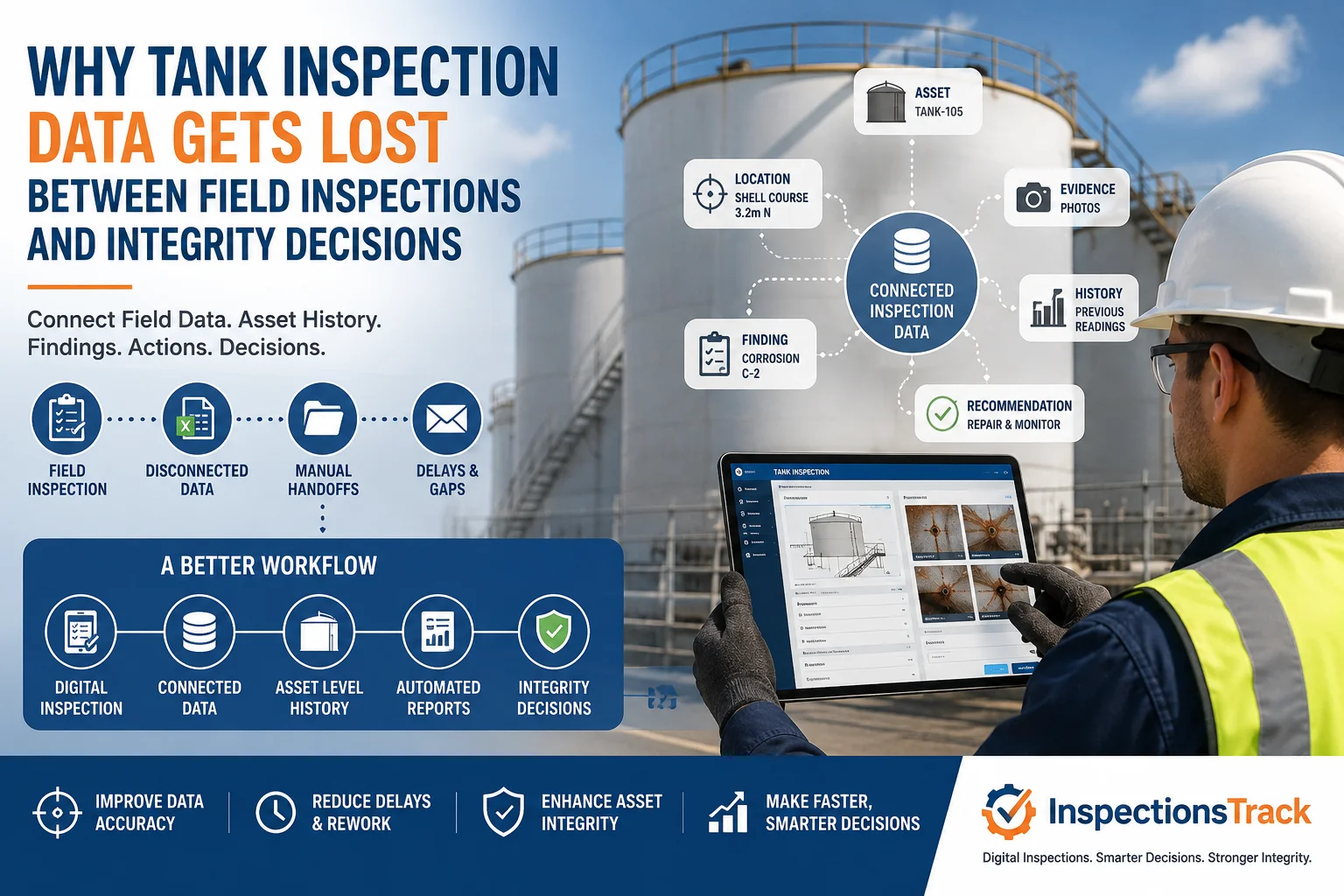
A tank inspection may be completed correctly in the field, yet the information can still lose its value before it reaches the people responsible for asset integrity decisions.
Photos sit in separate folders. Inspection findings remain inside spreadsheets. Reports arrive days later. Maintenance teams work from older records. Meanwhile, integrity managers need a clear answer: What is the condition of this tank, what changed, and what action should we take?
This gap between tank inspection data collection and integrity decision-making is one of the biggest challenges for oil and gas inspection teams.
The problem is not always the quality of the inspection itself. Instead, it is often the way inspection data moves through the organization.
A typical tank inspection workflow may involve inspectors, inspection coordinators, engineering teams, maintenance personnel and asset integrity managers.
However, each handoff creates an opportunity for information to become disconnected.
| Stage | Common Data Problem | Business Impact |
|---|---|---|
| Field inspection | Notes, measurements and photos stored separately | Important evidence becomes difficult to trace |
| Data entry | Paper forms or spreadsheets require re-entry | Errors and delays increase |
| Report preparation | Findings are manually compiled | Reports take longer to produce |
| Data storage | Records spread across folders and systems | Historical information becomes difficult to find |
| Integrity review | Engineers lack complete inspection context | Decisions take longer |
| Maintenance planning | Findings are not linked to assets or actions | Follow-up work can be missed |
As a result, the organization may have plenty of inspection data but still struggle to answer basic asset integrity questions.
Tank inspection data becomes less useful when individual pieces of information cannot be connected.
For example, an integrity engineer may see a corrosion measurement. But can they immediately determine:
If these answers require searching through emails, spreadsheets, PDFs and shared folders, the inspection workflow has a data continuity problem.
A measurement by itself is only one data point.
Its value increases when it is connected to the asset, component, inspection date, location, finding, photograph, recommendation and previous inspection history.
That context allows integrity teams to move from simply storing inspection records to actually using them for better decisions.
Spreadsheets can be useful for simple tracking. However, they become difficult to manage when inspection programs involve multiple tanks, inspectors, locations and inspection types.
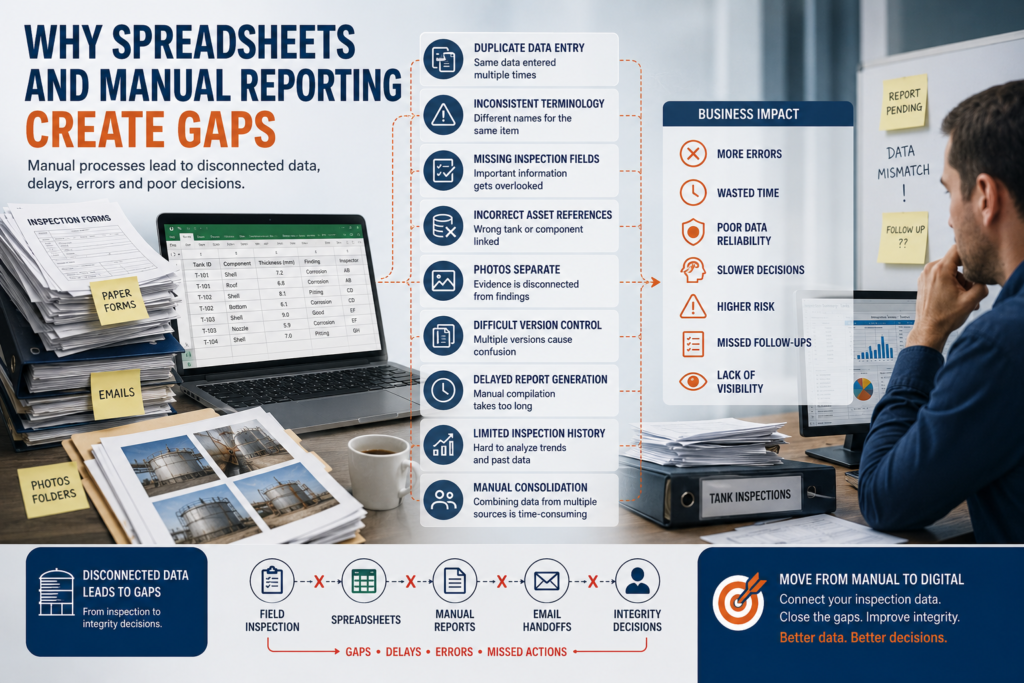
Manual workflows commonly create problems such as:
Furthermore, when field teams work offline or in remote oil and gas environments, collecting data and transferring it later can create additional delays.
The result is a workflow where inspection completion does not necessarily mean inspection information is immediately decision-ready.
Integrity teams do not simply need more data. They need reliable, traceable and accessible information.
A useful tank inspection data workflow should make it easy to connect:
Tank → Component → Inspection → Finding → Evidence → Recommendation → Action → History
This creates a much clearer chain between what an inspector discovers and what an integrity team ultimately decides.
Consider a corrosion finding.
A disconnected workflow may look like this:
Inspector → Excel file → Photos folder → PDF report → Email → Integrity engineer
A connected digital workflow can instead provide:
Inspector → Digital inspection record → Tank asset history → Finding + photos + measurements → Automated report → Integrity review
The second approach reduces unnecessary handoffs and makes the information easier to validate.
Modern tank inspection software for oil and gas can centralize inspection information while maintaining the connection between field data and asset history.
With a digital inspection platform, teams can capture information directly against the relevant asset and inspection checklist.
This can help organizations:
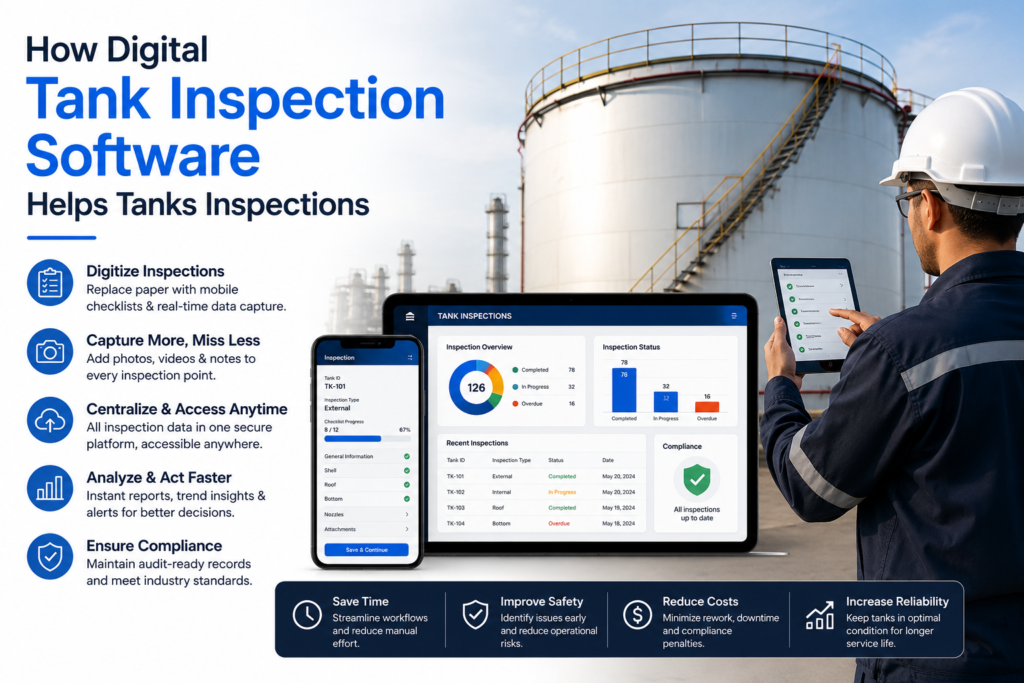
Inspectors can record measurements, observations, findings and photographs during the inspection instead of transferring information later.
Previous inspections can remain connected to the same tank or component. Therefore, teams can compare findings over time instead of reviewing isolated reports.
Digital forms and predefined checklists help inspectors follow consistent inspection procedures and reduce missing information.
Once inspection data is completed, automated reporting can reduce the manual effort involved in preparing final inspection reports.
Each finding can remain connected to its asset, inspection date, supporting evidence and recommendations.
For oil and gas companies managing tank inspections alongside other inspection programs, InspectionsTrack provides a centralized inspection management platform designed for industrial inspection workflows.
The platform supports digital inspections, asset management, checklists, reporting, certificates, photographs and inspection history. It can also support offline inspection workflows, which is particularly useful for teams working at remote facilities or offshore locations.
Instead of treating a tank inspection report as an isolated document, InspectionsTrack can help organizations maintain inspection information as part of the asset’s broader digital record.
This makes it easier for inspection coordinators, integrity teams and management to access the information they need without repeatedly searching through disconnected files.
A stronger workflow should follow five basic principles:
This approach reduces the distance between what happens in the field and what happens in the integrity office.
Tank inspection programs generate large amounts of information. However, data volume alone does not improve asset integrity.
The real value comes when inspection data remains accurate, traceable and connected from the moment it is collected until someone uses it to make a decision.
When inspection findings, measurements, photographs, recommendations and historical records remain connected, integrity teams can work with greater confidence.
Ultimately, better tank inspection data management means less time searching for information and more time acting on it.
For oil and gas inspection teams looking to replace fragmented spreadsheets, paper forms and manual reporting with a connected digital workflow, InspectionsTrack can help bring field inspections, asset records and reporting into one inspection management system.
Read more : How to Build a Complete Digital Chain of Custody for Drill Pipe Inspection Data
Tank inspection data often gets lost because teams rely on spreadsheets, paper forms, separate photo folders, emails, and manual reporting systems.
Digital inspection software connects findings, measurements, photos, reports, and asset history in one system, making inspection data easier to track and use.
Yes. InspectionsTrack helps oil and gas teams manage digital tank inspections, asset records, inspection findings, photographs, checklists, reports, and historical data in one platform.
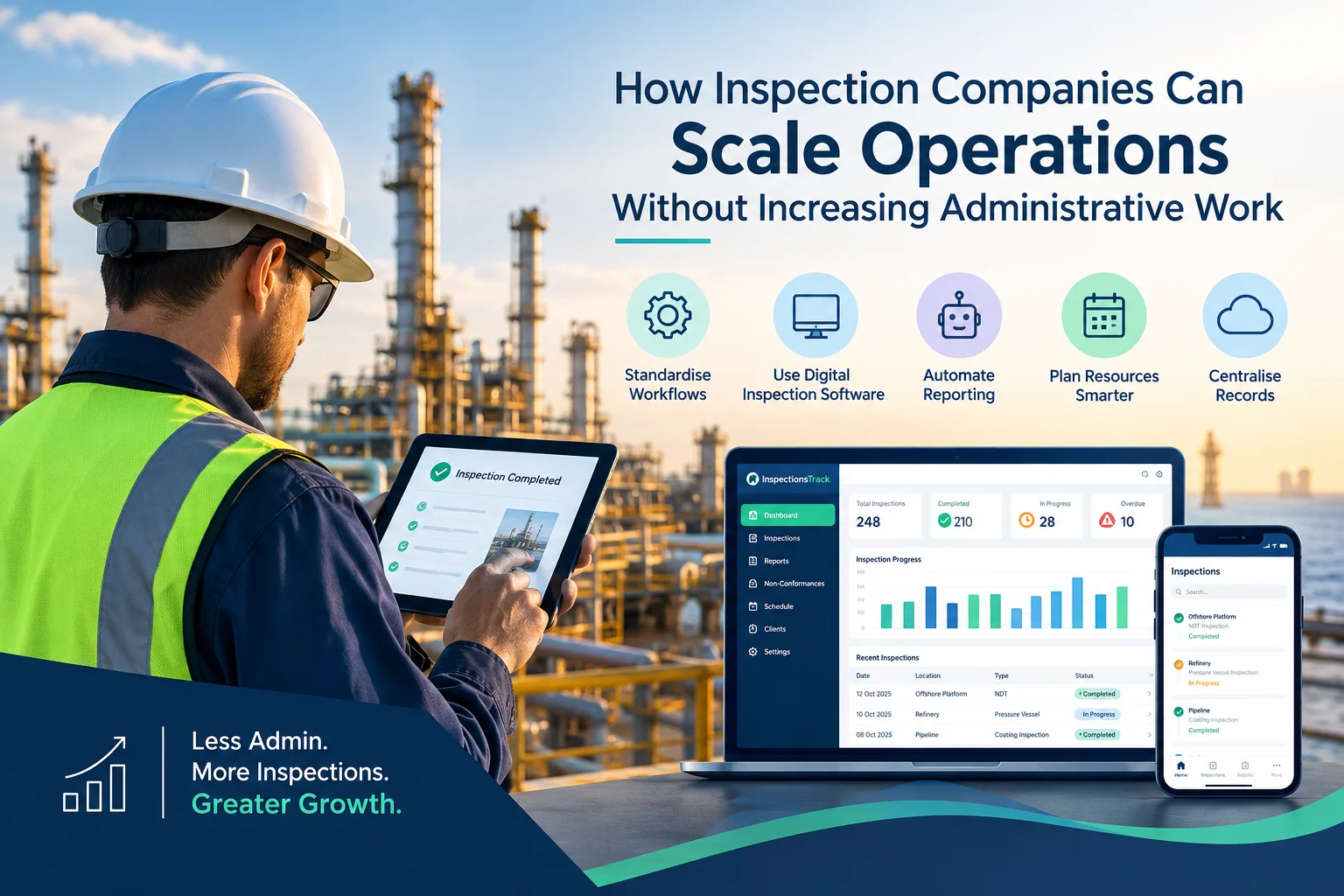
Inspection companies in the oil and gas industry face a common challenge: how to handle more inspections, manage larger projects, and meet client deadlines without increasing administrative workload. As businesses grow, inspection teams must manage…

Meeting client Service Level Agreements (SLAs) is essential for inspection companies working in demanding industries such as oil and gas, energy, and industrial maintenance. Clients expect inspections to be completed on time, reports to be…


Comment (1)
Digital Inspection History for Tank Integrity Management - inspectionstrack
Aug 20, 2026[…] Read more : Why Tank Inspection Data Gets Lost Between Field Inspections and Integrity Decisions […]
Comments are closed.