
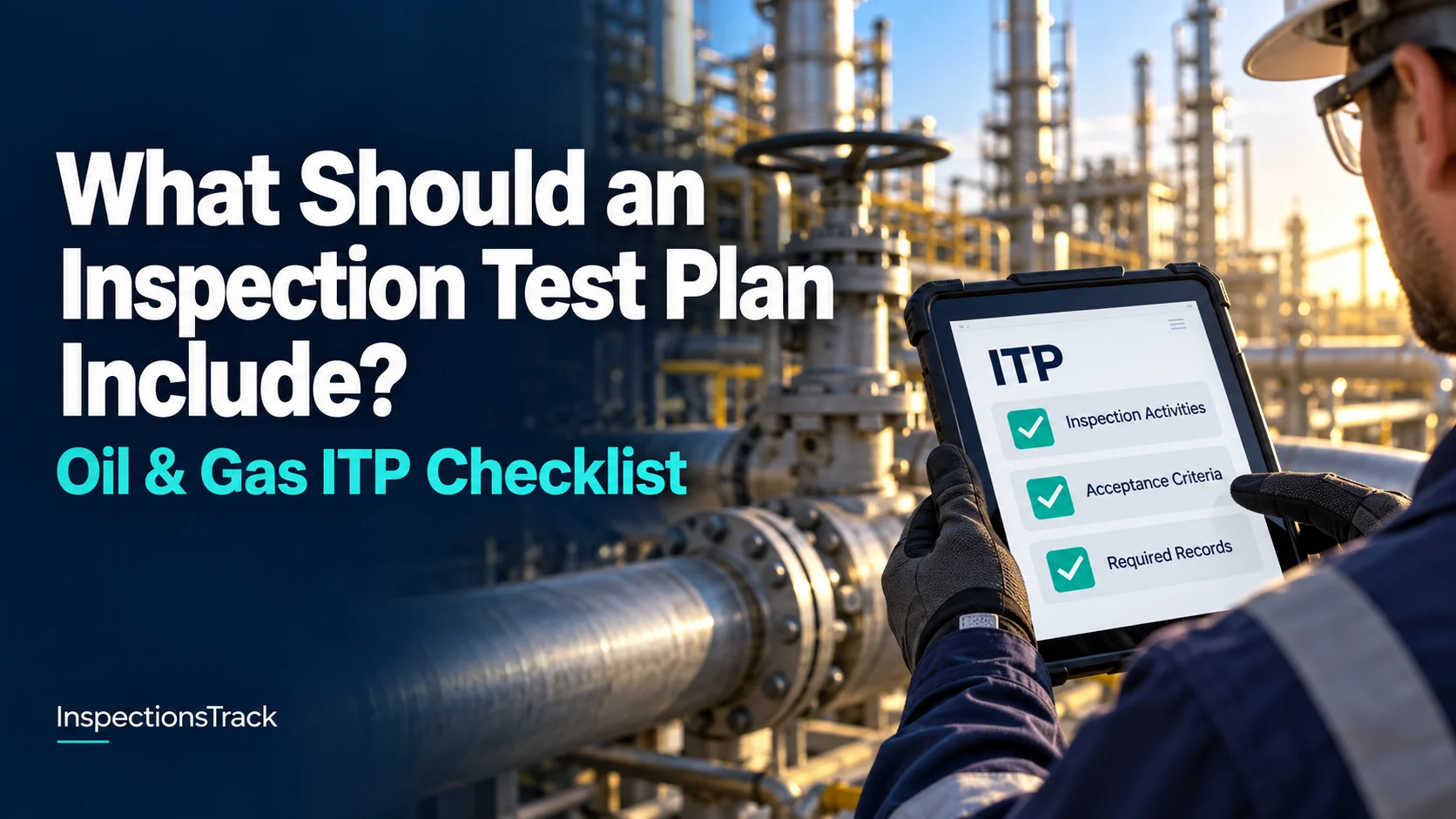
An Inspection Test Plan (ITP) defines how teams plan, perform, verify, and document inspection and testing activities during an oil and gas project.
For oil and gas companies, a well-prepared ITP helps inspection teams maintain quality standards, identify inspection points, assign responsibilities, and keep accurate records throughout the project lifecycle.
But what should an ITP actually include?
This guide explains the key components of an oil and gas Inspection Test Plan, provides a practical ITP checklist, and shows how digital inspection software can help teams manage inspection activities more efficiently.
An Inspection Test Plan (ITP) is a quality control document that outlines the inspections, tests, verification activities, acceptance criteria, and documentation required for a specific project, asset, equipment item, or work activity.
In oil and gas operations, an ITP may cover activities such as:
The exact contents can vary depending on the project, equipment, client requirements, applicable standards, and inspection scope.
Oil and gas projects involve complex equipment, strict quality requirements, multiple contractors, and significant safety risks. Therefore, inspection activities need to be clearly planned and documented.
An effective ITP helps teams:
As a result, an ITP provides a clear connection between project requirements, inspection activities, test results, and quality records.
Although ITP formats differ between projects, a comprehensive oil and gas ITP generally includes the following information.
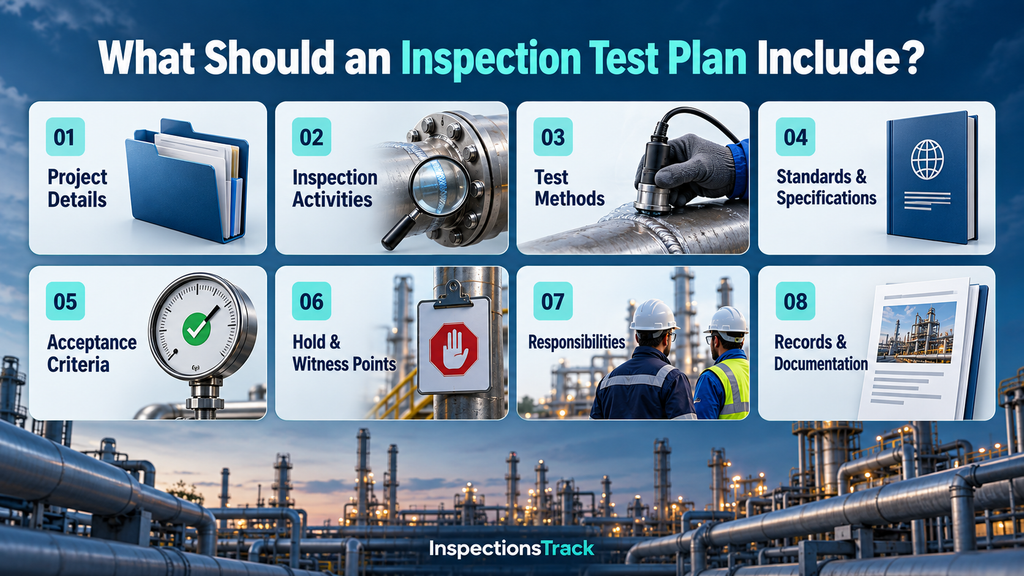
Start with basic information that identifies the ITP and its scope.
Typical details include:
These details help teams track the document and link inspection records to the correct project or asset.
The ITP should clearly identify which activity the team will inspect or test.
For example:
| Work Activity | Inspection / Test |
|---|---|
| Material receiving | Material certificate verification |
| Welding | Visual inspection |
| Weld completion | NDT examination |
| Pressure testing | Hydrostatic pressure test |
| Coating | Dry film thickness test |
| Equipment installation | Dimensional and installation inspection |
| Final completion | Final inspection and documentation review |
Breaking the work into individual inspection activities makes the plan easier for inspectors, contractors, and quality teams to follow.
The ITP should explain how the team will perform each inspection or test.
Depending on the activity, this may include:
The inspection method should correspond with the applicable specification, procedure, code, or standard.
An ITP should identify the documents used to establish inspection requirements and acceptance criteria.
Depending on the project, these may include:
Teams should control document references to ensure inspectors use the correct revision.
One of the most important parts of an ITP is the acceptance criteria.
Acceptance criteria define what constitutes an acceptable inspection or test result.
For example, an ITP may specify requirements related to:
Clear acceptance criteria help inspectors determine whether work meets the required specification instead of relying on subjective judgment.
An oil and gas ITP should identify important inspection control points.
Common designations include:
| Inspection Point | Meaning |
|---|---|
| Hold Point (H) | Work cannot proceed until the required inspection or approval is completed. |
| Witness Point (W) | A designated party is given the opportunity to witness the inspection or test. |
| Review Point (R) | Documentation or records are reviewed for compliance. |
| Surveillance (S) | Inspection or monitoring is performed without necessarily stopping the work. |
These points help coordinate activities between contractors, inspectors, clients, and quality representatives.
The ITP should identify who is responsible for performing, witnessing, reviewing, or approving each activity.
Typical parties include:
Clearly assigning responsibilities reduces confusion and helps prevent missed inspections.
Every inspection or test should produce appropriate evidence.
Depending on the activity, required records may include:
This documentation provides evidence that teams fulfilled the inspection requirements.
Before approving an Inspection Test Plan, inspection and quality teams can use the following checklist.
A checklist like this can help teams identify missing information before inspection work begins.
Traditional ITP management often relies on spreadsheets, Word documents, emails, paper forms, and manually maintained inspection records.
However, as projects grow, these methods can make it difficult to track inspection status, documentation, approvals, and asset history.
Digital inspection software can centralize inspection activities and connect field inspections with project and asset records.
For example, InspectionsTrack Software Suite is designed for oil and gas inspection companies and inspection teams. It supports inspection workflows across Windows desktop, Android mobile, and web portal environments, including online and offline inspection capabilities.
With InspectionsTrack, teams can manage areas such as:
Instead of keeping inspection information across disconnected files, teams can create a more centralized inspection record for each job or asset.
An ITP and an inspection checklist are related, but they serve different purposes.
| ITP | Inspection Checklist |
|---|---|
| Defines the overall inspection and testing plan | Guides the inspector through specific checks |
| Identifies inspection stages | Records individual inspection results |
| Defines hold and witness points | Captures field observations |
| Specifies standards and acceptance criteria | Helps confirm each requirement |
| Assigns responsibilities | Records completion |
| Defines required documentation | Provides inspection evidence |
In practice, an ITP can define what must happen and when, while a checklist helps the inspector record what was actually checked.
Even a well-designed ITP can become ineffective if important information is missing or poorly controlled.
Every project and asset has different requirements. Therefore, copying an old ITP without reviewing its scope can create gaps.
Inspectors need clear criteria to determine whether a result passes or fails.
Using outdated drawings, procedures, or specifications can create compliance problems. Always control document revisions.
If nobody knows who must inspect, witness, review, or approve an activity, important inspection points can be missed.
Inspection records should connect back to the relevant asset, equipment, job, component, or inspection activity.
Paper records can be difficult to search, share, update, and connect with historical inspection data. Digital workflows can provide better visibility as inspection volumes increase.
A practical approach is to build the ITP around the actual inspection workflow.
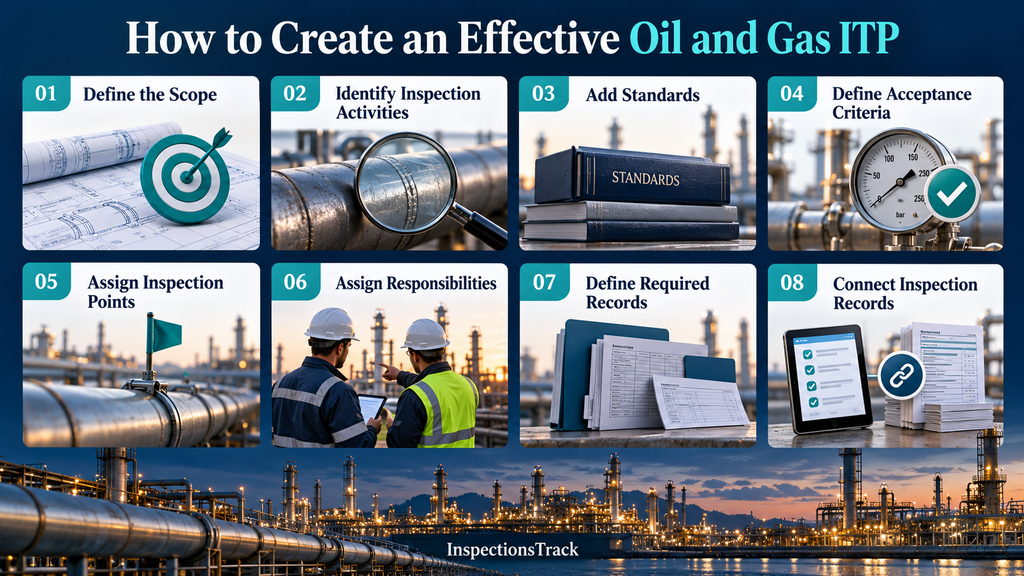
Identify the equipment, asset, work package, or project covered by the ITP.
List each inspection and testing activity that must be completed.
Reference the applicable specifications, procedures, drawings, codes, and standards.
Specify the requirements that determine whether each activity passes or fails.
Identify Hold, Witness, Review, and Surveillance points.
Clearly identify the parties responsible for inspection, witnessing, reviewing, and approval.
Specify the reports, certificates, photographs, test results, and other evidence that must be retained.
Where possible, connect the ITP to digital inspection checklists, reports, photographs, certificates, and asset history.
Read more : Inspection Backlog Management: How Oil & Gas Teams Prioritize Critical Assets
An Inspection Test Plan normally includes inspection activities, test methods, applicable standards, acceptance criteria, inspection points, responsibilities, and required documentation.
An ITP is commonly prepared by the contractor, quality team, engineering team, or responsible inspection organization. The exact responsibility depends on the project’s contractual and quality requirements.
A Hold Point is a defined stage where work must not continue until the required inspection, verification, or approval has been completed.
An ITP defines the overall inspection and testing requirements, while an inspection checklist helps an inspector perform and record specific field checks.
ITPs help establish a structured inspection process, define quality requirements, clarify responsibilities, and maintain evidence that required inspections and tests have been completed.
A strong Inspection Test Plan for oil and gas projects does more than list inspections. It creates a structured quality framework connecting inspection activities, standards, acceptance criteria, responsibilities, approvals, and evidence.
Most importantly, the ITP should work together with the actual inspection workflow. When inspection teams combine well-defined ITPs with digital checklists, asset history, photographs, certificates, reports, and audit trails, they can create more traceable and organized inspection records.
For oil and gas inspection companies looking to move beyond disconnected spreadsheets and paper-based workflows, InspectionsTrack provides a digital environment for managing inspection jobs, field inspections, reports, certificates, asset records, and supporting evidence in one system.

Your inspectors identify equipment defects, while your maintenance team plans the repairs. However, when both teams rely on disconnected spreadsheets and reports, important findings can lose their connection to the actions they require. Choose inspection…
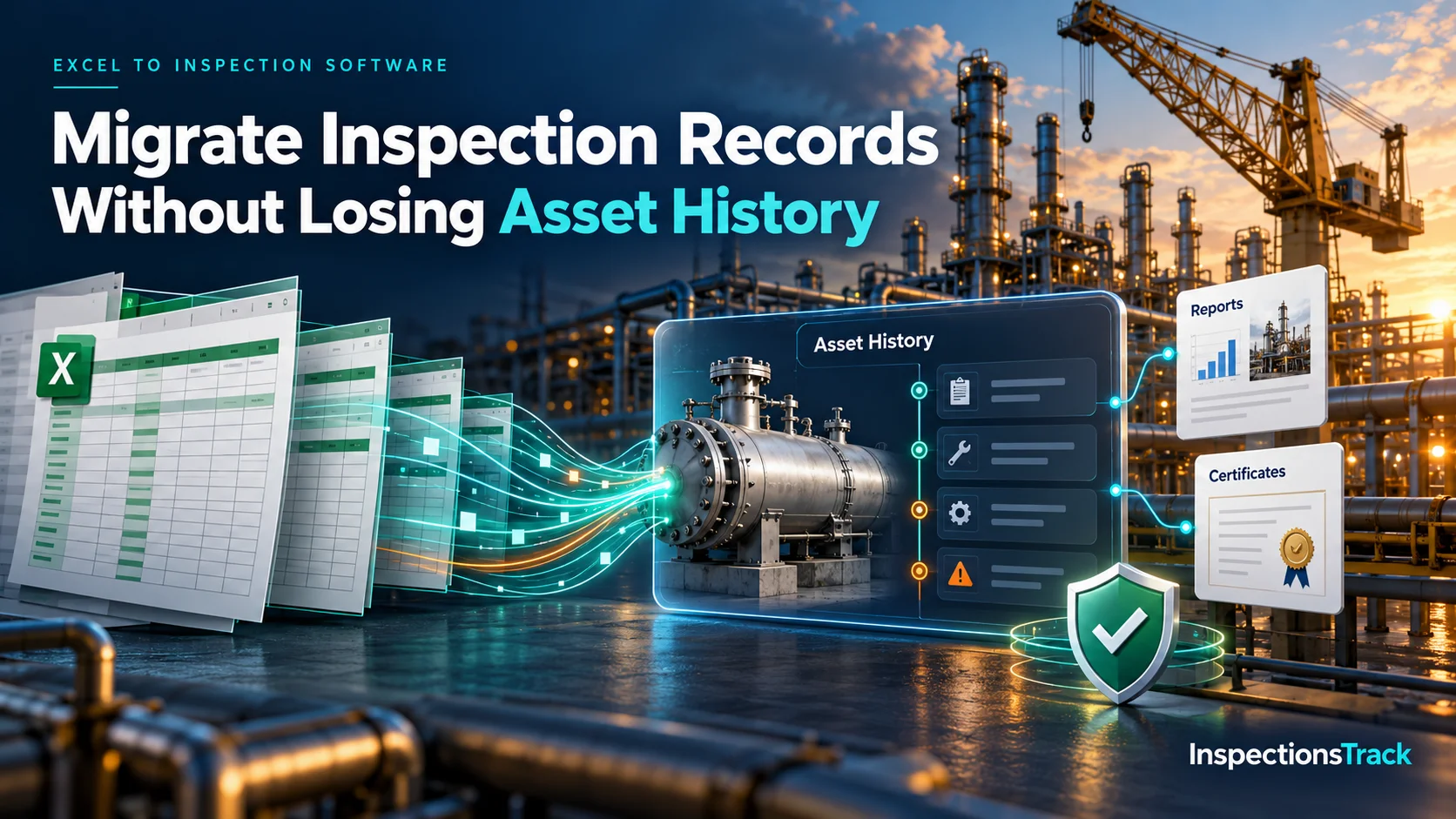
Moving inspection records from Excel into dedicated inspection management software can improve data accuracy, reporting, and asset visibility. However, a poorly planned migration can also create duplicate assets, missing inspection dates, broken certificate links, and…


Comment (1)
Inspection Report Revision Control Best Practices - inspectionstrack
Sep 29, 2026[…] Read more : What Should an Inspection Test Plan Include? An Oil & Gas ITP Checklist […]
Comments are closed.