
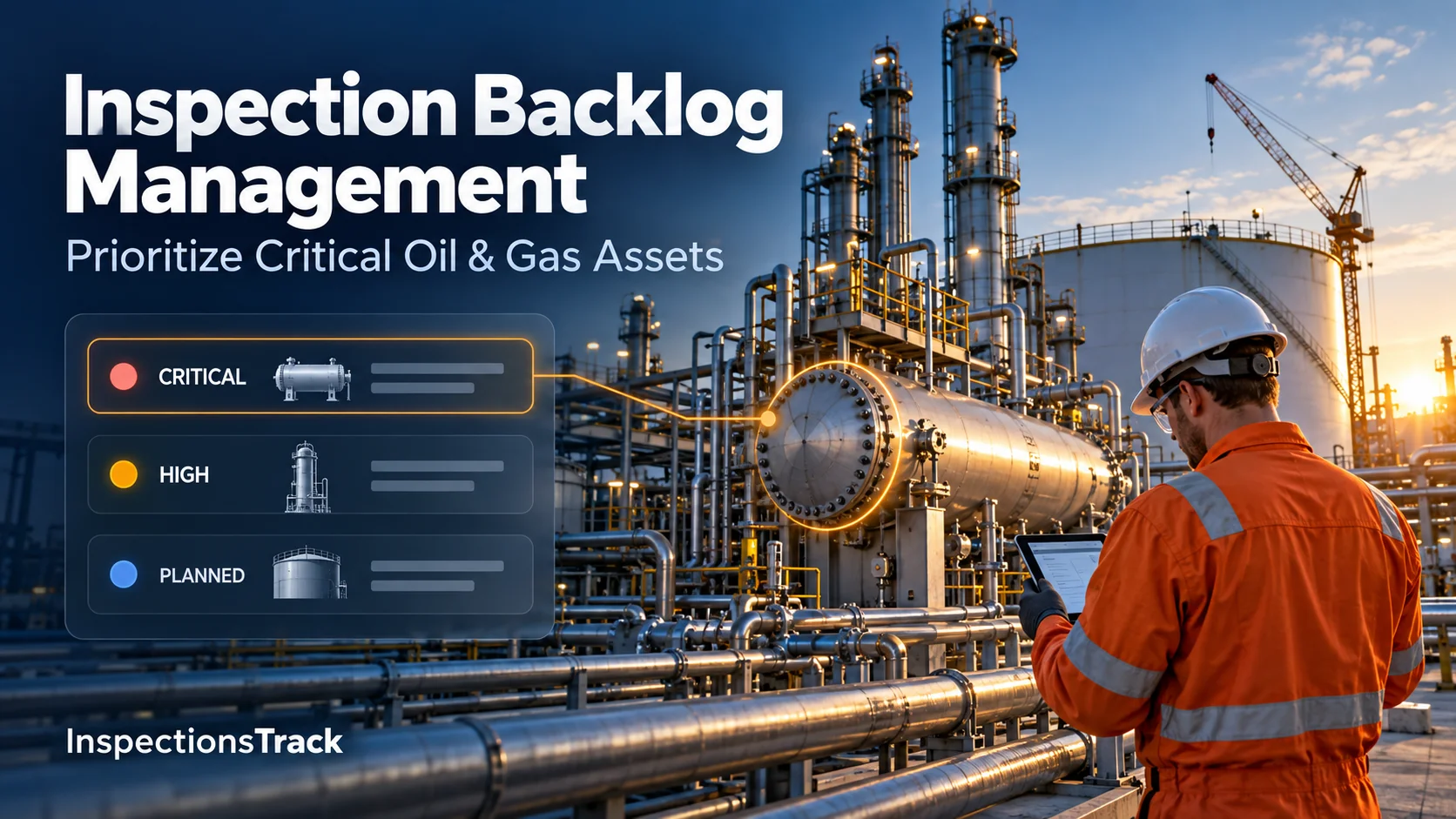
Oil and gas companies manage thousands of inspection activities across pipelines, pressure vessels, tanks, cranes, drilling equipment, offshore assets, and other safety-critical systems. However, keeping every inspection on schedule can be challenging.
When inspections are delayed, they quickly become an inspection backlog. If teams treat every overdue inspection equally, critical assets may not receive the attention they need first.
That is why effective inspection backlog management focuses on risk, asset criticality, inspection history, and operational impact.
With the right inspection management process and digital inspection software, oil and gas teams can identify overdue work, prioritize critical assets, and maintain better visibility across their inspection programs.
An inspection backlog is a collection of inspections that are planned, overdue, incomplete, or awaiting action.
A backlog can include:
A small backlog may be manageable. However, when inspection records are spread across spreadsheets, emails, paper forms, and disconnected systems, teams can struggle to identify which inspections require immediate attention.
Not every overdue inspection presents the same level of risk.
For example, an overdue inspection for a low-risk asset may have a different priority than an overdue inspection involving critical pressure equipment or lifting equipment.
Therefore, oil and gas teams should prioritize inspection work based on risk and asset criticality rather than simply the age of the backlog.
Effective backlog management helps organizations:
A practical approach is to combine several risk factors instead of using a single priority rule.
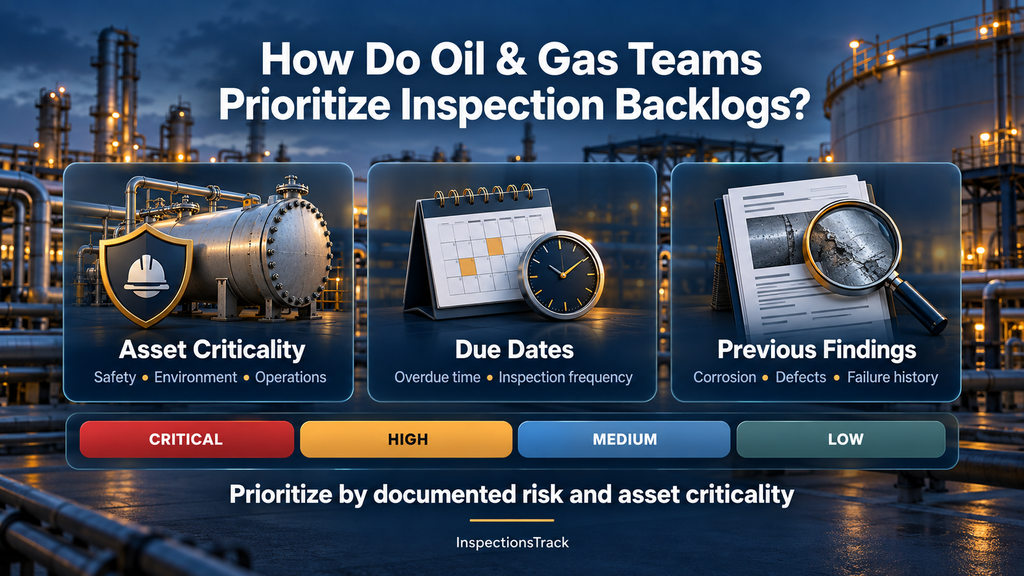
Start by classifying assets according to their potential operational and safety impact.
For example:
| Asset Factor | Example Priority Consideration |
|---|---|
| Safety criticality | Could failure cause serious injury or harm? |
| Production impact | Could failure stop or reduce production? |
| Environmental risk | Could failure result in a spill or release? |
| Regulatory importance | Is inspection required by regulation or certification? |
| Failure history | Has the asset experienced previous defects? |
| Operating conditions | Is the equipment exposed to harsh conditions? |
This allows inspection coordinators to distinguish between routine backlog items and inspections that require immediate attention.
Due dates still matter. However, they should be considered alongside risk.
An inspection that is only slightly overdue may still be more urgent than an inspection that has been overdue for a longer period if the associated asset has a much higher criticality.
Therefore, teams should review:
Inspection history provides valuable context.
For instance, an asset with repeated corrosion findings, cracks, leaks, abnormal readings, or previous failures may require closer attention.
Consequently, inspection teams should connect current backlog items with historical inspection data instead of reviewing each inspection in isolation.
A useful backlog management process separates inspections into categories such as:
Critical: Immediate attention required because of high safety, regulatory, environmental, or operational risk.
High: Requires prompt scheduling and management review.
Medium: Should be scheduled within the normal inspection planning cycle.
Low: Can be planned around higher-priority work without creating significant additional risk.
The exact criteria should be defined according to the company’s inspection procedures, asset integrity strategy, regulatory requirements, and risk assessment process.
A useful backlog should provide more than an inspection name and due date.
Ideally, each record should contain:
Having this information in one place makes it easier for coordinators and managers to decide what needs attention first.
Managing an oil and gas inspection backlog manually can become difficult as the number of assets and inspection activities increases.
Inspection management software provides a centralized way to organize inspection schedules, asset information, inspection history, reports, findings, and supporting evidence.
For oil and gas inspection companies, InspectionsTrack helps teams manage inspection activities across desktop, web, and mobile environments.
With InspectionsTrack, teams can manage areas such as:
Because inspection information can be connected to the relevant asset and job, teams can build a clearer picture of what has been completed, what is overdue, and what requires follow-up.
Reducing backlog is not simply about completing as many inspections as possible. Instead, teams should focus on completing the right inspections in the right order.
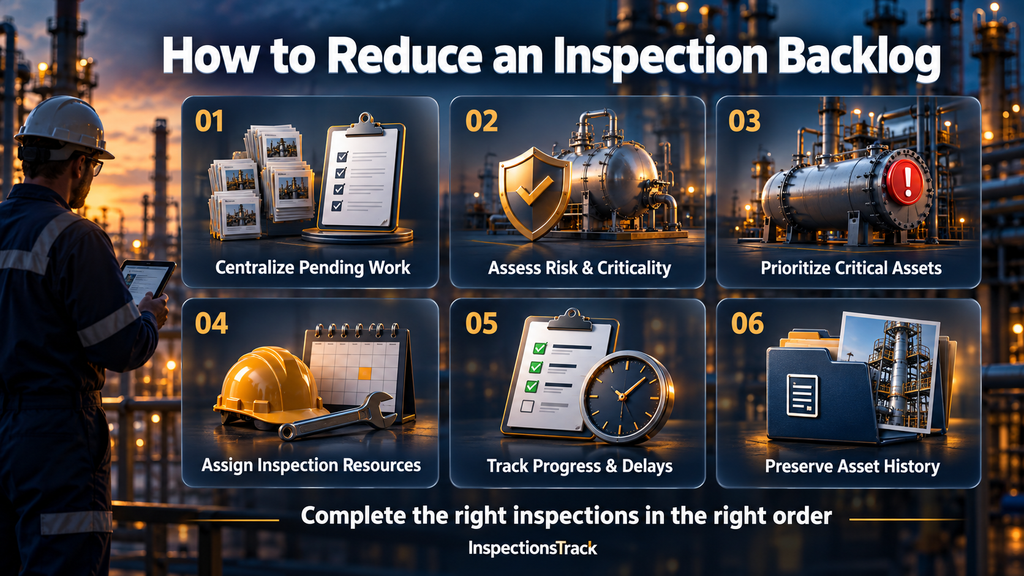
A practical process includes:
Bring overdue, upcoming, incomplete, and follow-up inspections into one centralized view.
Assign appropriate criticality and risk categories based on established company procedures.
Highlight inspections involving safety-critical, production-critical, environmental, or regulatory-sensitive assets.
Match inspectors, equipment, locations, and available time with the highest-priority inspection work.
Monitor scheduled, in-progress, completed, reviewed, and overdue inspections.
Look for common causes such as resource shortages, access issues, incomplete information, equipment availability, or reporting delays.
Keep completed reports, findings, certificates, photographs, and corrective actions connected to the asset record.
Oil and gas organizations can strengthen their inspection planning by following a few practical principles:
The simplest answer is: prioritize inspections according to documented risk, asset criticality, regulatory requirements, inspection history, and operational impact.
An inspection should not automatically become the highest priority simply because it is the oldest item in the backlog.
Instead, inspection coordinators should ask:
This creates a more structured approach to backlog management.
Read more : How to Build a Digital Inspection Workflow for Oil & Gas Operations
An inspection backlog is not simply a list of overdue tasks. It is a source of information that can help oil and gas teams understand where inspection resources are needed most.
By combining asset criticality, inspection history, risk, due dates, findings, and operational impact, organizations can create a more structured inspection prioritization process.
Digital inspection management platforms such as InspectionsTrack can further simplify this process by connecting inspection jobs, assets, reports, evidence, findings, and history in one system.
The result is better visibility, more organized inspection planning, and a stronger foundation for managing critical oil and gas assets.
Inspection backlog management is the process of identifying, reviewing, prioritizing, scheduling, and tracking overdue or pending inspections based on risk, asset criticality, due dates, and operational requirements.
Companies should consider asset criticality, safety and environmental risk, regulatory requirements, inspection history, previous findings, operational impact, and how long the inspection has been overdue.
Yes. Inspection software can centralize inspection schedules, asset history, findings, reports, corrective actions, and inspection evidence, making it easier to identify and manage outstanding work.
A useful dashboard can show overdue inspections, upcoming inspections, critical assets, inspection status, outstanding findings, corrective actions, assigned inspectors, and completion trends.

Your inspectors identify equipment defects, while your maintenance team plans the repairs. However, when both teams rely on disconnected spreadsheets and reports, important findings can lose their connection to the actions they require. Choose inspection…
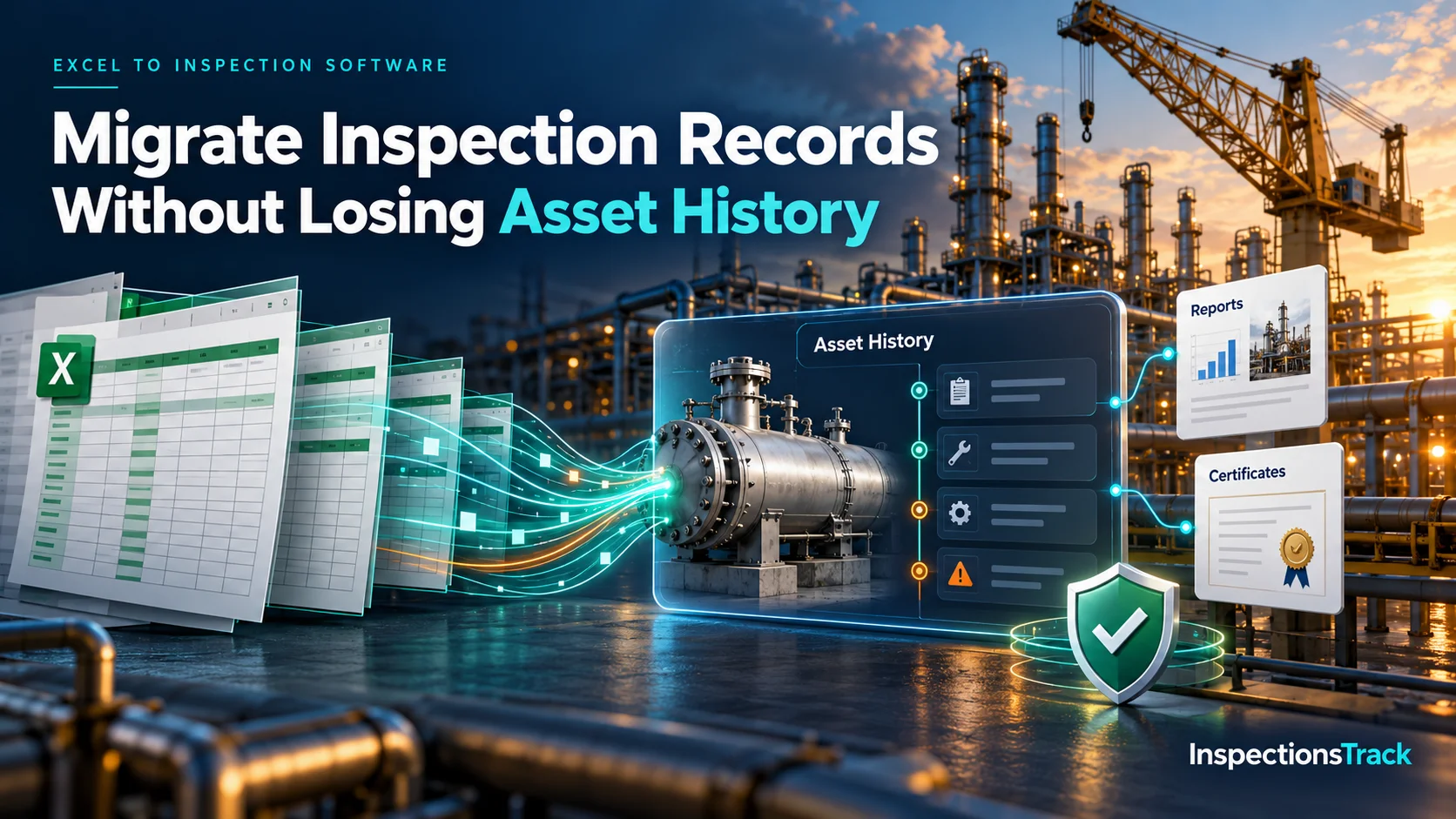
Moving inspection records from Excel into dedicated inspection management software can improve data accuracy, reporting, and asset visibility. However, a poorly planned migration can also create duplicate assets, missing inspection dates, broken certificate links, and…


