
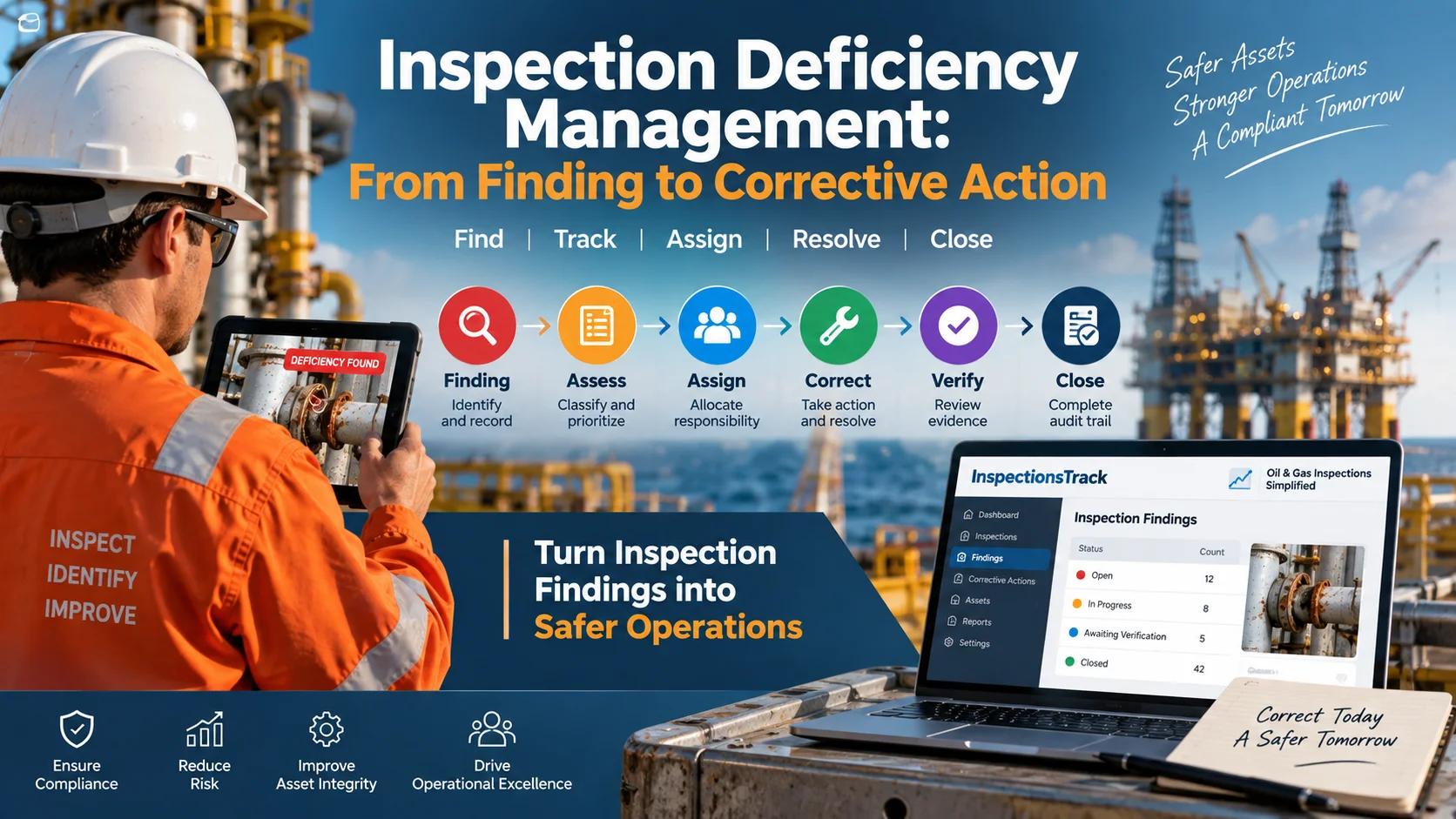
Finding a deficiency during an oil and gas inspection is only the beginning. The real challenge is ensuring that every issue is documented, assigned, corrected, verified, and formally closed.
Without a structured inspection deficiency management process, findings can remain buried in spreadsheets, emails, PDFs, or handwritten reports. As a result, corrective actions may be delayed, responsibilities can become unclear, and inspection teams may struggle to demonstrate that deficiencies were properly resolved.
A digital deficiency management process creates a clear path from inspection finding to corrective action and final closure. Moreover, it gives inspection teams better visibility, accountability, and traceability throughout the entire process.
Inspection deficiency management is the structured process used to record, assess, track, correct, verify, and close issues identified during an inspection.
Depending on the inspection type, a deficiency could include:
However, simply recording these findings is not enough.
A strong deficiency management system should answer five important questions:
What was found? Who is responsible? What corrective action is required? When should it be completed? Has the action been verified and closed?
Oil and gas inspection environments can involve large equipment inventories, multiple inspection disciplines, different teams, remote sites, and significant amounts of supporting evidence.
Therefore, even a relatively small inspection campaign can generate numerous findings requiring follow-up.
When deficiencies are managed manually, several problems can occur. For example, an issue may be identified in the field but recorded in a report that is not immediately shared with the responsible team. Alternatively, corrective action may take place, but the evidence proving completion may not be linked back to the original finding.
Consequently, inspection teams need more than a list of open issues. They need a connected workflow.
An effective process should maintain traceability from the moment a deficiency is discovered until its corrective action has been verified.
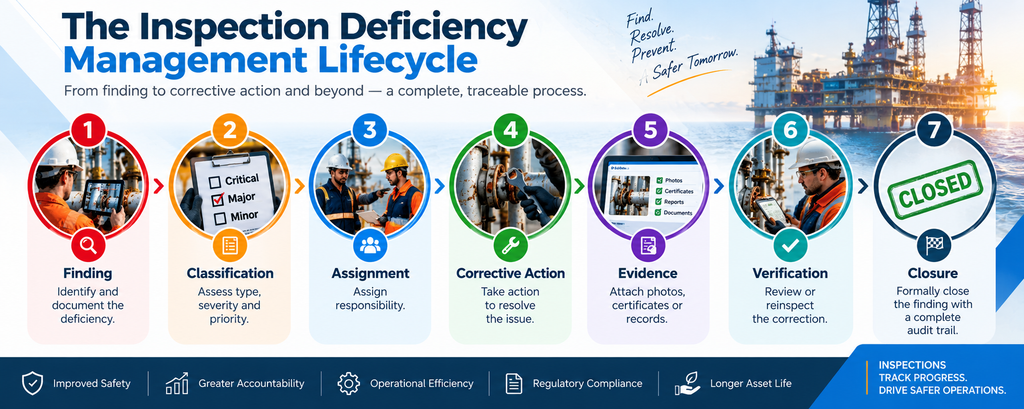
| Stage | Key Activity | Desired Outcome |
|---|---|---|
| 1. Finding | Identify and document the deficiency | Clear record of the issue |
| 2. Classification | Assess type, severity and priority | Appropriate response |
| 3. Assignment | Assign responsibility | Clear ownership |
| 4. Corrective Action | Repair, replace or resolve the issue | Deficiency addressed |
| 5. Evidence | Attach photos, certificates or records | Proof of action |
| 6. Verification | Review or reinspect the correction | Resolution confirmed |
| 7. Closure | Formally close the finding | Complete audit trail |
The process begins when an inspector identifies a deficiency.
At this stage, the finding should contain enough information for another person to understand exactly what was discovered. Therefore, records should typically include the equipment or asset, inspection date, location, finding description, inspector details, photographs, and other supporting evidence.
Where applicable, the finding should also reference the relevant inspection criteria or requirement.
Accurate data at this stage reduces confusion later in the corrective action process.
Not every inspection finding has the same level of importance.
Therefore, organizations may classify deficiencies according to factors such as:
A clear classification structure helps teams focus attention on the issues requiring the fastest response.
However, organizations should use their own approved risk and inspection procedures when determining severity and corrective-action requirements.
Once a deficiency has been recorded and reviewed, someone needs to own the next action.
The responsible person or team might need to conduct a repair, replace equipment, provide documentation, arrange additional testing, or perform another defined corrective action.
Clear ownership is essential because vague responsibility often leads to delayed closure.
Instead of simply marking an issue as Open, a better workflow can record:
Finding → Responsible Person → Required Action → Target Date → Current Status
This structure makes accountability much easier to track.
Corrective action should address the actual issue identified during the inspection rather than simply changing its status.
For example, if an inspector identifies damaged lifting equipment, closing the deficiency may require documented repair, replacement, additional inspection, certification, or another action based on the organization’s approved procedures.
Furthermore, the corrective action record should explain what was done.
A useful corrective action record can include:
As a result, inspectors and managers can understand both the original problem and how it was resolved.
One of the biggest weaknesses in manual deficiency tracking is the gap between “action completed” and “action verified.”
A status update alone may not provide enough evidence.
Instead, inspection teams may need supporting information such as before-and-after photographs, updated certificates, repair records, test results, inspection forms, or other documentation.
This creates a more complete audit trail.
More importantly, it allows reviewers to trace the entire history:
Finding → Action → Evidence → Verification → Closure
Therefore, supporting evidence should remain connected to the deficiency rather than being stored separately in email inboxes, folders, or disconnected systems.
Spreadsheets and email can work for small volumes of information. However, they become increasingly difficult to manage as inspection operations expand.
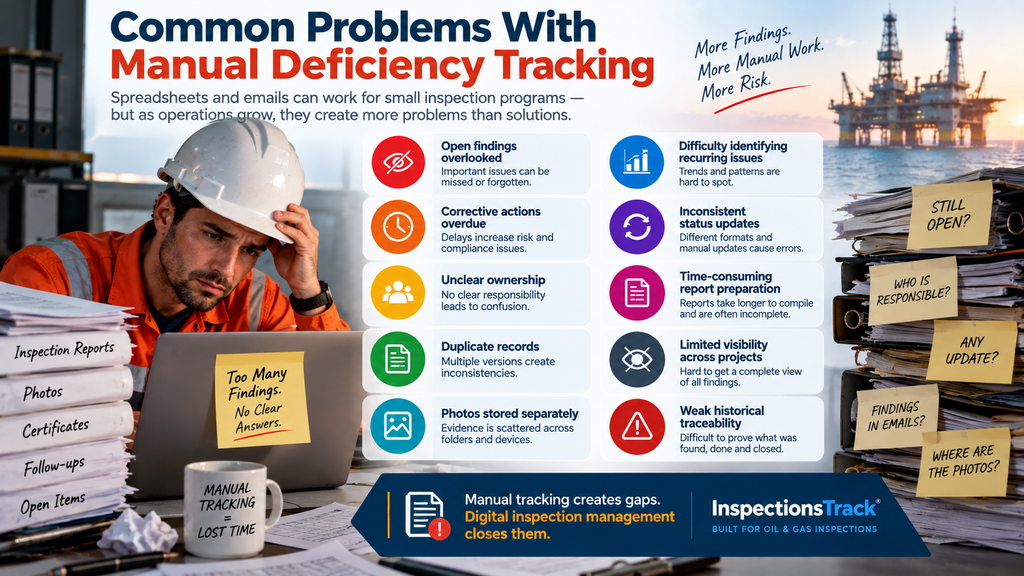
Common problems include:
For example, a manager may know that 30 deficiencies were recorded but may struggle to quickly determine which are overdue, which are awaiting evidence, and which have been verified.
That is where digital inspection deficiency management becomes valuable.
Digital inspection software can connect inspection findings, equipment records, corrective actions, evidence, and reporting within a more structured workflow.
Instead of manually transferring findings between documents, teams can maintain a continuous digital record.
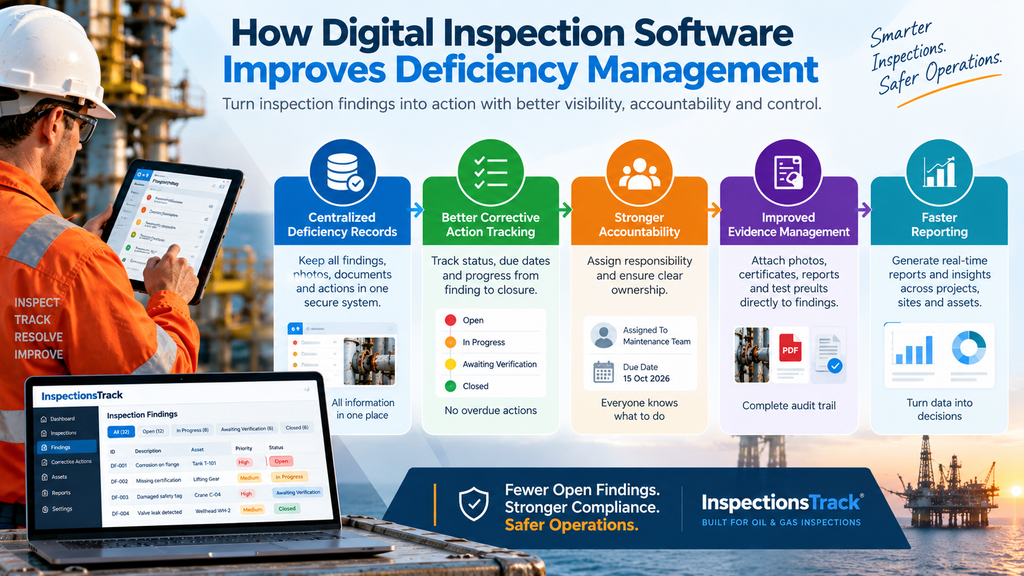
Centralized records make it easier to view findings alongside relevant inspection and asset information.
Consequently, teams spend less time searching through separate files.
Digital workflows can make the status of each deficiency easier to follow, including whether it is open, under review, awaiting action, ready for verification, or closed.
When responsibility is clearly assigned, managers can more easily understand who owns each corrective action and which tasks remain outstanding.
Inspection photos, reports, certificates, and supporting documents can remain associated with the relevant inspection record instead of being scattered across different storage locations.
Structured inspection data can also simplify reporting.
Rather than manually rebuilding deficiency lists for every report, teams can work from standardized records and current inspection information.
InspectionsTrack is inspection management software designed for organizations working across oil and gas inspection activities.
The platform supports multiple inspection workflows, helping inspection companies move away from fragmented spreadsheets, paperwork, and disconnected inspection records.
InspectionsTrack includes solutions for areas such as:
By bringing inspection information into a structured digital environment, organizations can maintain better visibility over inspection findings and the records associated with corrective action.
In addition, InspectionsTrack’s reporting capabilities help inspection teams turn structured field information into professional inspection documentation.
Technology alone does not create an effective corrective action process. Organizations also need clear procedures.
A practical workflow should:
This approach transforms deficiency management from a simple reporting exercise into a structured improvement process.
Deficiency data can provide value beyond individual corrective actions.
Over time, structured inspection records may help organizations identify recurring findings across particular asset types, locations, equipment categories, or inspection periods.
For example, teams can ask:
Therefore, historical deficiency information can support better maintenance planning and operational decision-making when combined with appropriate engineering and inspection expertise.
An inspection deficiency is an issue, defect, non-conformity, missing requirement, or other condition identified during an inspection that may require review or corrective action.
Corrective action is the documented response taken to address an inspection finding. Depending on the issue, this could involve repair, replacement, additional testing, documentation updates, or another approved action.
Identifying a deficiency records the original problem. Closing it normally involves completing the required corrective action, providing relevant evidence, and verifying that the issue has been appropriately resolved according to the organization’s procedures.
Inspection software can centralize findings, corrective actions, evidence, status information, and inspection records. As a result, teams can improve traceability and reduce reliance on disconnected spreadsheets, emails, and paperwork.
Yes. When findings are captured consistently, historical inspection data can be reviewed for recurring issues involving particular equipment, locations, inspection types, or other relevant categories.
Effective inspection deficiency management does not end when an inspector discovers a problem.
Instead, every significant finding should follow a controlled path from identification and classification to ownership, corrective action, evidence, verification, and closure.
For oil and gas inspection organizations, a structured digital process can make that journey easier to manage while improving visibility, accountability, and traceability.
With InspectionsTrack, inspection companies can bring field inspections, inspection records, supporting evidence, reporting, and related workflows into a more connected digital environment.
Turn inspection findings into traceable action. Explore InspectionsTrack and discover how digital inspection management can support your oil and gas inspection operations.

Your inspectors identify equipment defects, while your maintenance team plans the repairs. However, when both teams rely on disconnected spreadsheets and reports, important findings can lose their connection to the actions they require. Choose inspection…
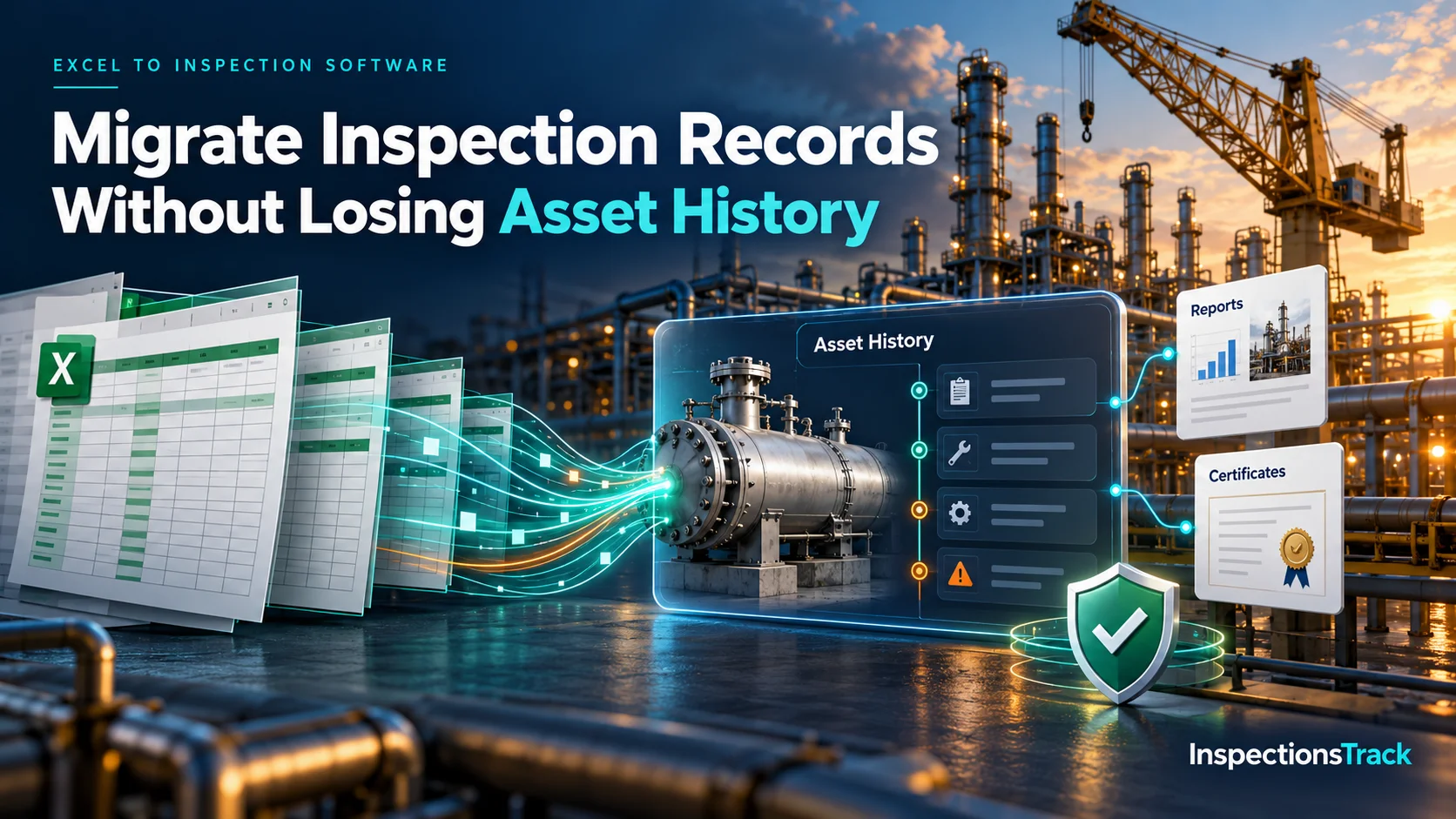
Moving inspection records from Excel into dedicated inspection management software can improve data accuracy, reporting, and asset visibility. However, a poorly planned migration can also create duplicate assets, missing inspection dates, broken certificate links, and…


Comments (2)
Digital Inspection Workflow for Oil & Gas Operations - inspectionstrack
Sep 24, 2026[…] Read more : Inspection Deficiency Management: From Finding to Corrective Action […]
Inspection Backlog Management for Oil & Gas Teams - inspectionstrack
Sep 25, 2026[…] Read more : How to Build a Digital Inspection Workflow for Oil & Gas Operations […]
Comments are closed.