
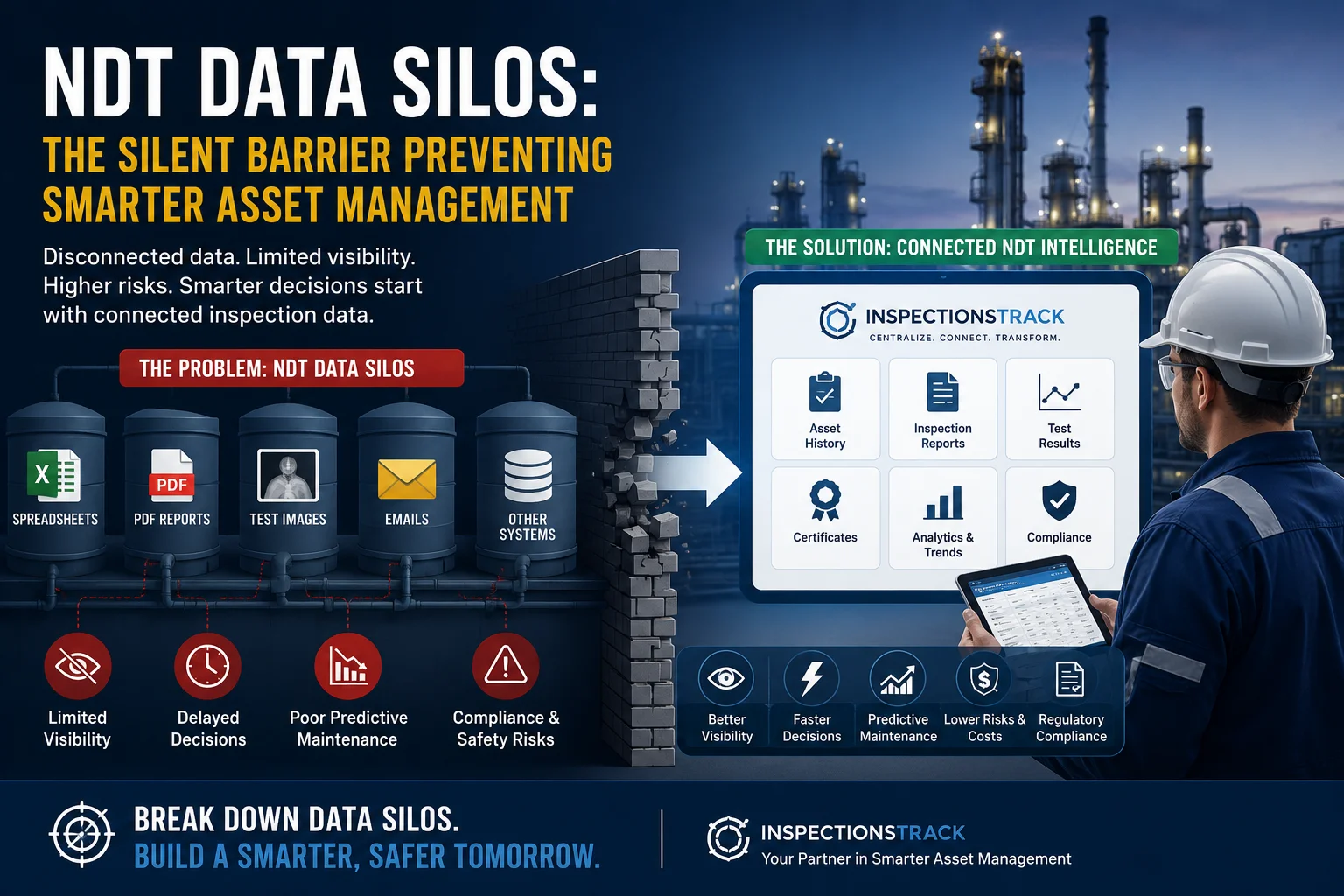
In the oil and gas industry, asset reliability depends heavily on accurate inspection data. Non-Destructive Testing (NDT) inspections generate valuable information about equipment condition, structural integrity, corrosion risks, and maintenance requirements. However, many organizations still struggle with a hidden challenge: NDT data silos.
Although companies collect massive amounts of inspection data, this information often remains scattered across spreadsheets, PDFs, emails, local drives, and disconnected systems. As a result, engineering teams cannot access complete asset histories, maintenance decisions become reactive, and organizations lose opportunities to improve operational efficiency.
Therefore, breaking down NDT data silos has become essential for companies looking to achieve smarter asset management, predictive maintenance, and improved regulatory compliance.
Modern digital inspection platforms like InspectionsTrack Software help oil and gas inspection companies eliminate fragmented data by centralizing NDT records, inspection reports, asset information, certificates, and maintenance insights into one connected platform.
NDT data silos occur when inspection information is stored separately across different departments, systems, or locations without proper integration.
For example, an inspection company may store:
While each dataset may be valuable individually, the lack of connection between them prevents organizations from gaining a complete view of asset health.
Simply collecting data is not enough. Companies need accessible, connected, and actionable inspection intelligence.
Oil and gas facilities operate thousands of critical assets, including:
Because these assets operate in harsh environments, regular inspections are required to identify defects before failures occur.
However, when NDT data is trapped inside isolated systems, companies face several challenges.
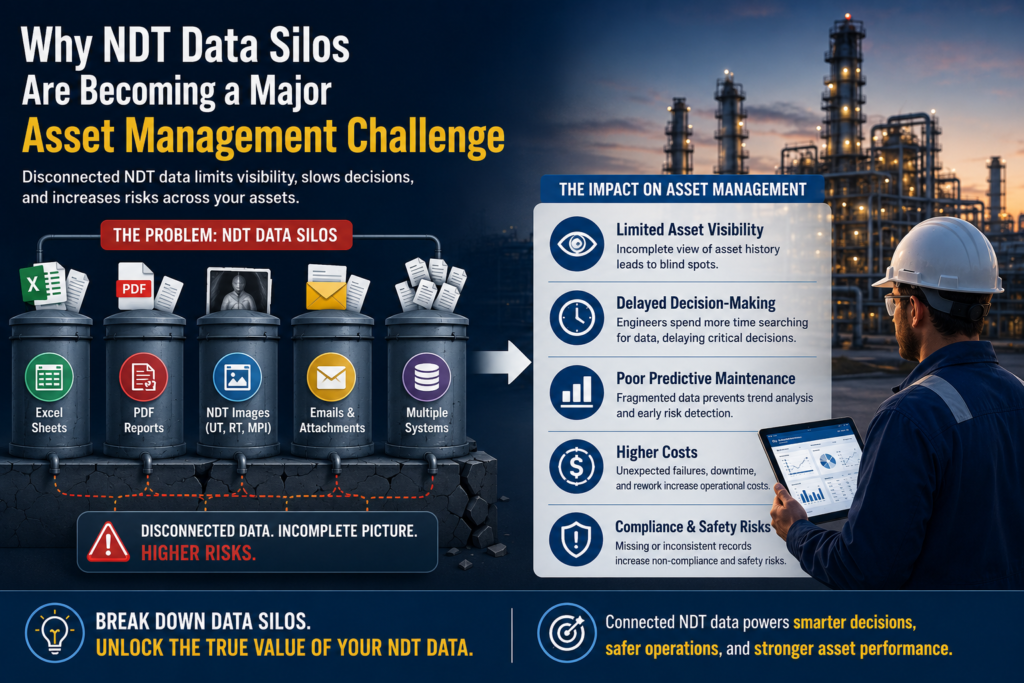
One of the biggest problems caused by NDT data silos is incomplete asset visibility.
Maintenance teams often need answers to questions like:
Unfortunately, when inspection records are stored across multiple platforms, finding accurate answers becomes time-consuming.
A centralized inspection management system allows teams to view complete asset histories instantly and make informed maintenance decisions.
In the oil and gas industry, delayed decisions can lead to:
However, disconnected inspection data slows down analysis.
For example, an engineer may need to review multiple spreadsheets and reports before determining whether equipment is safe for continued operation.
By integrating NDT inspection data into a single platform, organizations can quickly identify risks and prioritize maintenance activities.
Predictive maintenance depends on historical data.
When NDT records are fragmented, organizations cannot effectively analyze:
As a result, companies often rely on preventive schedules instead of actual asset conditions.
Connected NDT data enables smarter maintenance strategies by helping teams predict potential failures before they happen.
Several operational issues contribute to disconnected inspection data.
| Cause | Impact on Asset Management |
|---|---|
| Manual Excel reporting | Increased errors and duplicate records |
| Paper-based inspection forms | Difficult data retrieval and storage issues |
| Multiple software systems | Lack of communication between platforms |
| Email-based approvals | Delayed inspection workflows |
| Limited mobile connectivity | Field data collection challenges |
| Poor data standardization | Inconsistent reporting formats |
Furthermore, as inspection volumes continue increasing, these traditional methods become harder to manage.
NDT inspection companies depend on accurate reporting, compliance documentation, and timely delivery of inspection results.
However, fragmented data creates challenges throughout the inspection lifecycle.
Inspectors often work in remote locations where accessing previous inspection history is difficult.
Without connected systems, technicians may struggle with:
Generating final inspection reports manually requires significant effort.
Teams often spend hours:
Consequently, report delivery becomes slower and increases administrative workload.
Regulatory bodies and clients require accurate inspection documentation.
However, scattered records make it difficult to:
A structured digital inspection system improves traceability and compliance readiness.
Digital transformation is changing how oil and gas companies manage inspection data.
A modern inspection management platform connects:
into one unified ecosystem.
Instead of managing separate files and systems, organizations can create a single source of truth for all inspection activities.
InspectionsTrack Software is designed specifically for oil and gas inspection companies to simplify inspection management and eliminate disconnected data.
The platform helps organizations manage NDT and other inspection activities through a centralized digital solution.
Inspectors can complete standardized inspection forms digitally using mobile or desktop applications.
This improves:
InspectionsTrack maintains complete asset inspection histories, allowing teams to quickly access:
Instead of manually creating reports, teams can generate professional inspection documentation faster.
This helps reduce administrative work while improving report quality.
Field teams can collect inspection data directly from inspection locations.
The mobile-friendly system supports:
Even in challenging environments, inspectors can capture critical information efficiently.
Many oil and gas inspection sites have limited connectivity.
Therefore, offline functionality is essential.
InspectionsTrack enables inspectors to continue working without internet access and synchronize data when connectivity becomes available.
| Traditional Approach | Digital Inspection Approach |
|---|---|
| Data stored in multiple locations | Centralized inspection database |
| Manual report creation | Automated reporting |
| Limited asset visibility | Complete asset history |
| Slow decision-making | Real-time insights |
| Paper and spreadsheet dependency | Digital workflows |
| Reactive maintenance | Predictive maintenance opportunities |
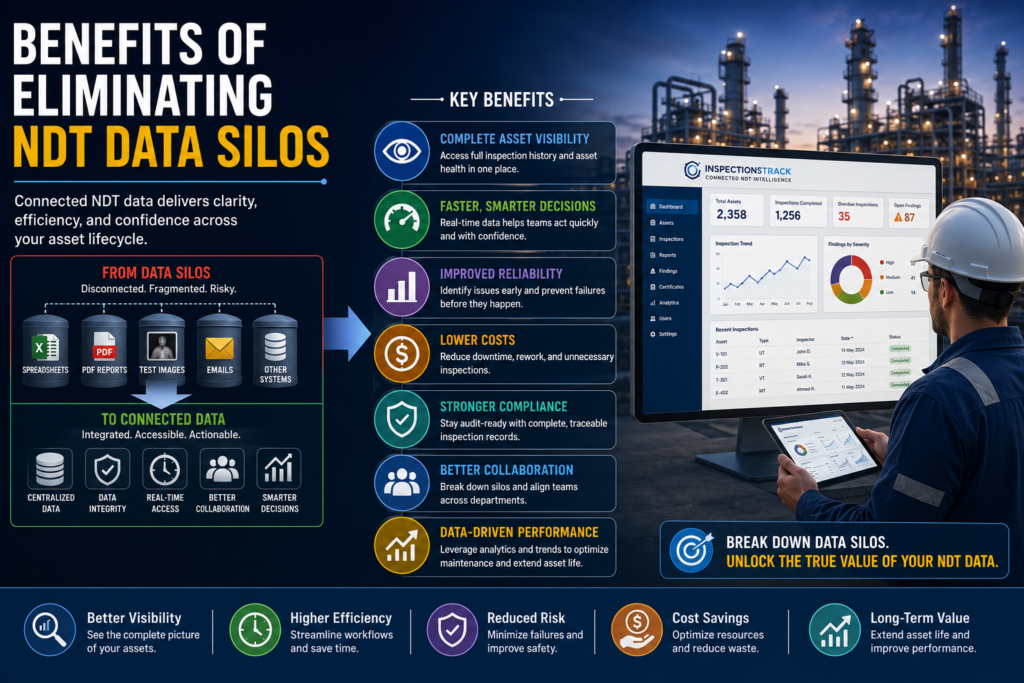
Organizations that connect their inspection data can achieve significant improvements.
Centralized inspection information helps teams identify risks earlier and maintain equipment more effectively.
Digital processes reduce manual tasks and allow inspection teams to complete projects faster.
Complete digital records improve audit preparation and demonstrate compliance with industry requirements.
By improving efficiency and reducing errors, companies can lower unnecessary maintenance expenses.
Connected NDT data provides valuable insights for:
The future of NDT is not just about collecting inspection results. It is about transforming inspection data into actionable intelligence.
With advancements in:
companies can move from reactive maintenance toward proactive asset management.
However, these technologies depend on clean, connected, and accessible data.
Therefore, eliminating NDT data silos is the first step toward building smarter industrial operations.
Read more : The Hidden Data Problem in NDT Inspections: Why Inspection Reports Are Becoming a Liability
NDT data silos occur when inspection information is stored separately across spreadsheets, documents, software systems, or departments without proper integration.
NDT data silos reduce asset visibility, delay decision-making, increase compliance risks, and prevent organizations from using inspection data for predictive maintenance.
Companies can eliminate data silos by adopting centralized inspection management software that connects inspection records, asset information, reports, and maintenance data.
InspectionsTrack centralizes NDT inspection workflows, digital forms, asset records, reports, certificates, and inspection history to help oil and gas companies manage inspections more efficiently.
NDT data silos are one of the biggest obstacles preventing oil and gas companies from achieving smarter asset management. Although organizations collect large volumes of inspection information, disconnected systems prevent them from unlocking its full value.
By adopting a centralized digital inspection management platform like InspectionsTrack, inspection companies can eliminate fragmented workflows, improve asset visibility, automate reporting, and make better maintenance decisions.
Ultimately, the future of asset management depends not only on collecting inspection data but also on connecting, analyzing, and transforming that data into actionable insights.
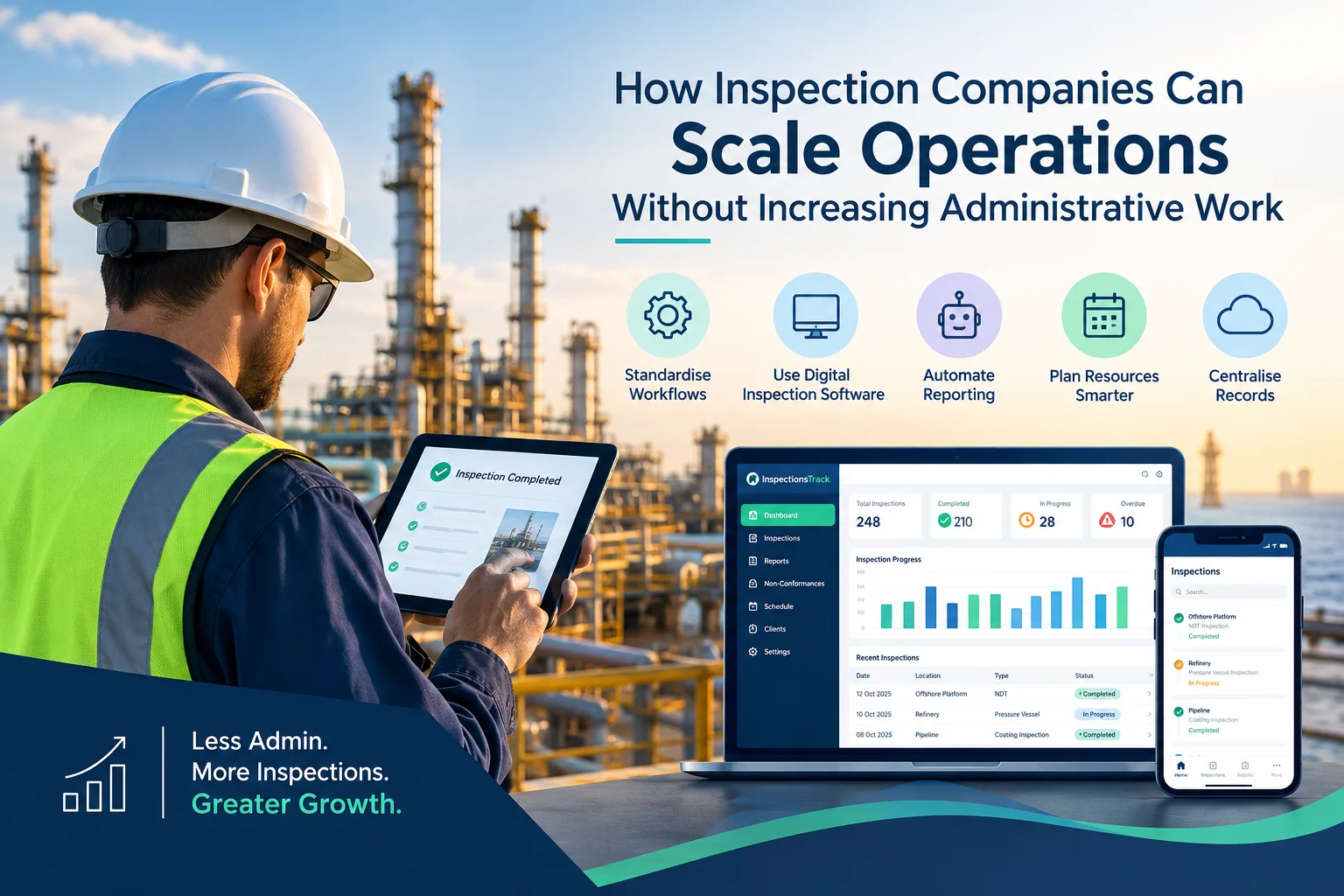
Inspection companies in the oil and gas industry face a common challenge: how to handle more inspections, manage larger projects, and meet client deadlines without increasing administrative workload. As businesses grow, inspection teams must manage…

Meeting client Service Level Agreements (SLAs) is essential for inspection companies working in demanding industries such as oil and gas, energy, and industrial maintenance. Clients expect inspections to be completed on time, reports to be…


