
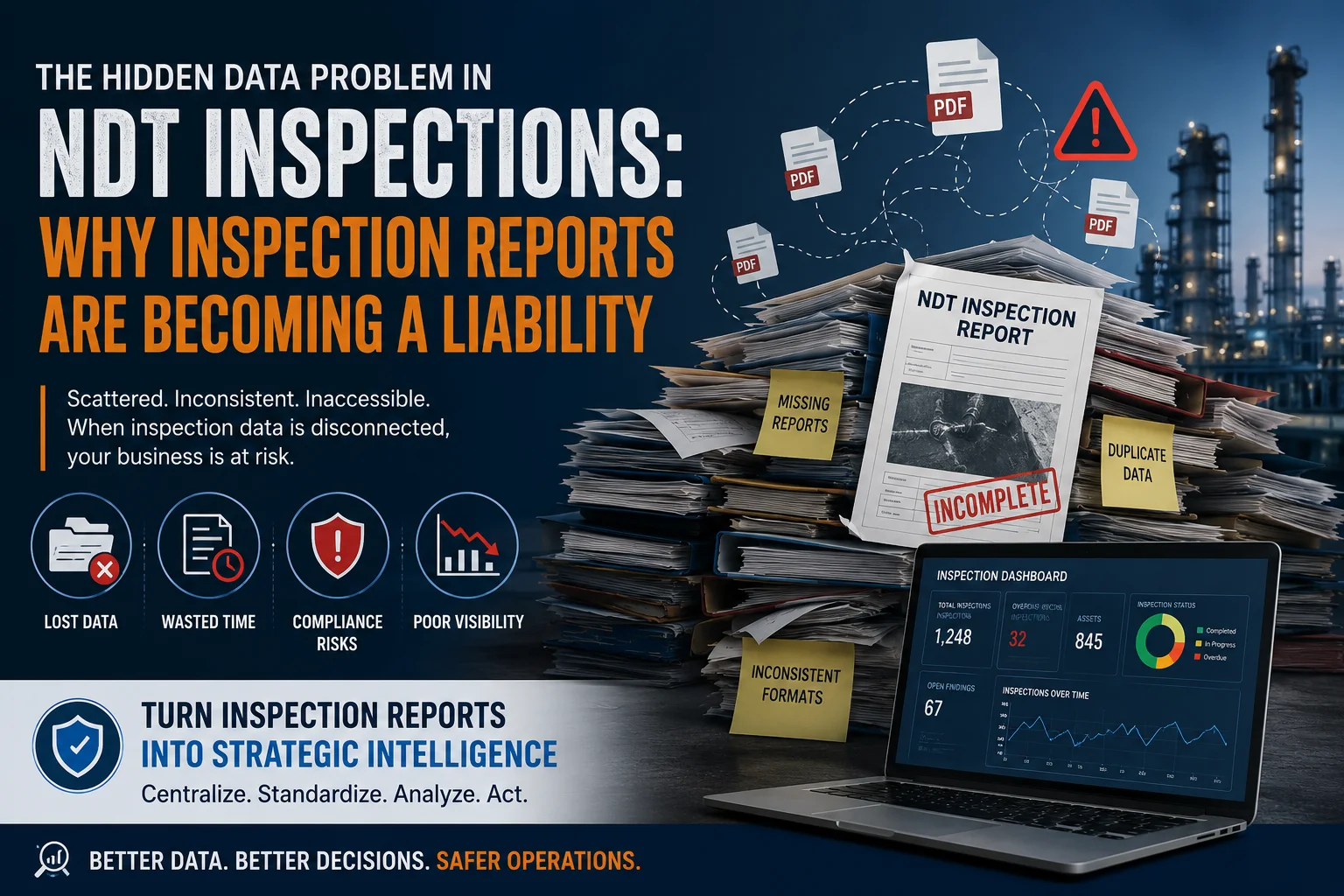
Non-Destructive Testing (NDT) inspections are essential for maintaining safety, regulatory compliance, and operational reliability across the oil and gas industry. However, while companies continue investing in advanced inspection technologies, many overlook a critical issue hiding in plain sight—the inspection data itself.
Ironically, inspection reports designed to reduce operational risk are increasingly becoming a liability. Scattered documents, inconsistent reporting formats, missing historical records, and disconnected data make it difficult to prove compliance, identify trends, or make informed maintenance decisions.
As inspection volumes continue growing, this hidden data problem becomes even more expensive.
This article explores why traditional NDT reporting creates unnecessary business risk and how digital inspection management platforms like InspectionsTrack help inspection companies transform reports into strategic business intelligence.
Every NDT inspection generates valuable technical information.
Yet many organizations still manage reports through:
Initially, this approach seems manageable.
However, once thousands of inspection reports accumulate over multiple years, finding accurate information becomes increasingly difficult.
Instead of supporting decisions, inspection reports become disconnected pieces of information that nobody fully trusts.
The biggest challenge isn’t collecting inspection data.
The real challenge is managing it.
Organizations commonly experience:
| Traditional Reporting Challenge | Business Impact |
|---|---|
| Reports stored across multiple folders | Lost inspection history |
| Manual report preparation | Delayed project completion |
| Duplicate inspection records | Data inconsistency |
| No centralized asset history | Difficult trend analysis |
| Missing inspection certificates | Compliance risks |
| Limited report search capability | Time wasted locating records |
| Human data entry errors | Reduced report accuracy |
| No live dashboards | Poor management visibility |
Over time, these issues increase operational costs while reducing confidence in inspection results.
Many companies assume reports only matter during audits.
Unfortunately, that’s no longer true.
Today’s inspection data supports:
When inspection data is incomplete, inaccurate, or inaccessible, every one of these business functions suffers.
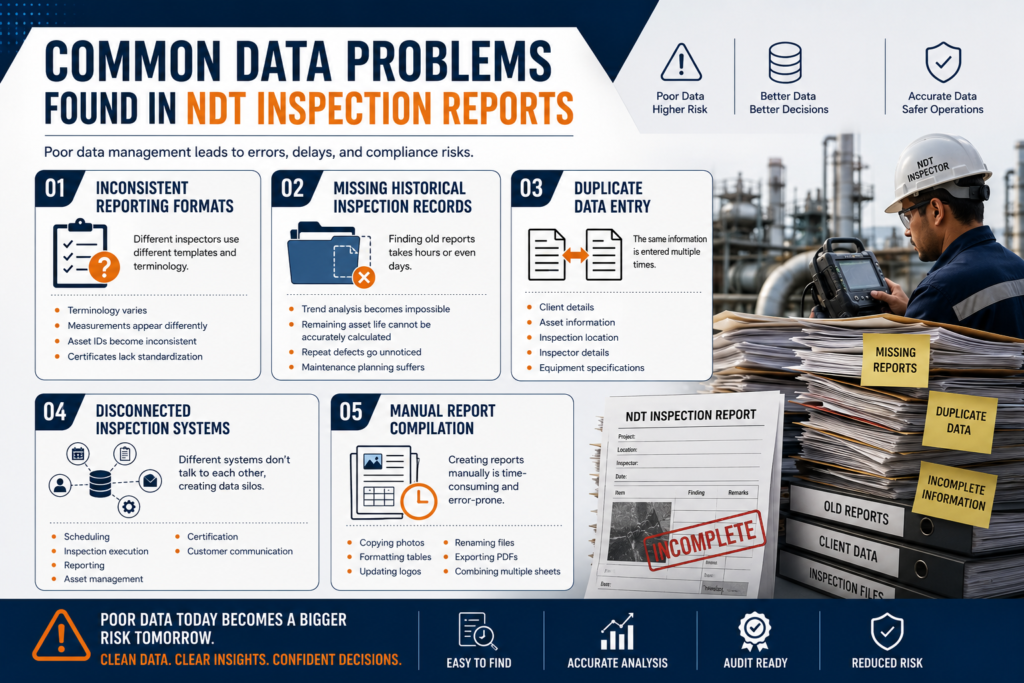
Different inspectors often use different templates.
As a result:
Consequently, comparing inspections over time becomes extremely difficult.
Finding reports from inspections completed several years ago can take hours—or even days.
Without historical records:
Inspection teams frequently enter identical information multiple times.
For example:
Besides consuming valuable time, duplicate entry significantly increases the likelihood of errors.
Many organizations rely on separate systems for:
Since these systems rarely communicate with one another, valuable information remains trapped in isolated data silos.
Creating professional inspection reports often involves:
As inspection workloads grow, manual reporting becomes a major productivity bottleneck.
The oil and gas industry is generating more inspection data than ever before.
Today’s inspections include:
Without a centralized inspection platform, this valuable information quickly becomes overwhelming.
Forward-thinking inspection companies are moving beyond static PDF reports.
Instead, they manage inspection information as structured digital data.
This allows organizations to:
Most importantly, data becomes actionable rather than archival.
InspectionsTrack is a cloud-based inspection management software built specifically for the oil and gas inspection industry.
Rather than simply generating reports, it creates a centralized inspection intelligence platform.
Every inspection record is securely stored within one searchable system.
This includes:
As a result, teams spend less time searching and more time analyzing.
Inspectors complete inspections using mobile devices or desktop applications.
Benefits include:
Instead of manually assembling reports, users can generate professional inspection reports with just a few clicks.
Reports automatically include:
This dramatically reduces reporting time.
Each asset maintains its own inspection timeline.
Users can immediately access:
This enables smarter maintenance decisions.
Instead of opening hundreds of PDFs, users can instantly search by:
Finding critical information takes seconds instead of hours.
Organizations implementing InspectionsTrack experience significant operational improvements.
| Feature | Traditional Reports | InspectionsTrack |
|---|---|---|
| Report Creation | Manual | Automated |
| Data Storage | Multiple folders | Centralized cloud platform |
| Asset History | Difficult to locate | Instantly available |
| Compliance Tracking | Manual | Automated |
| Search Capability | Limited | Advanced filters |
| Reporting Speed | Slow | Minutes |
| Data Accuracy | Human dependent | Standardized |
| Management Dashboard | Not available | Real-time visibility |
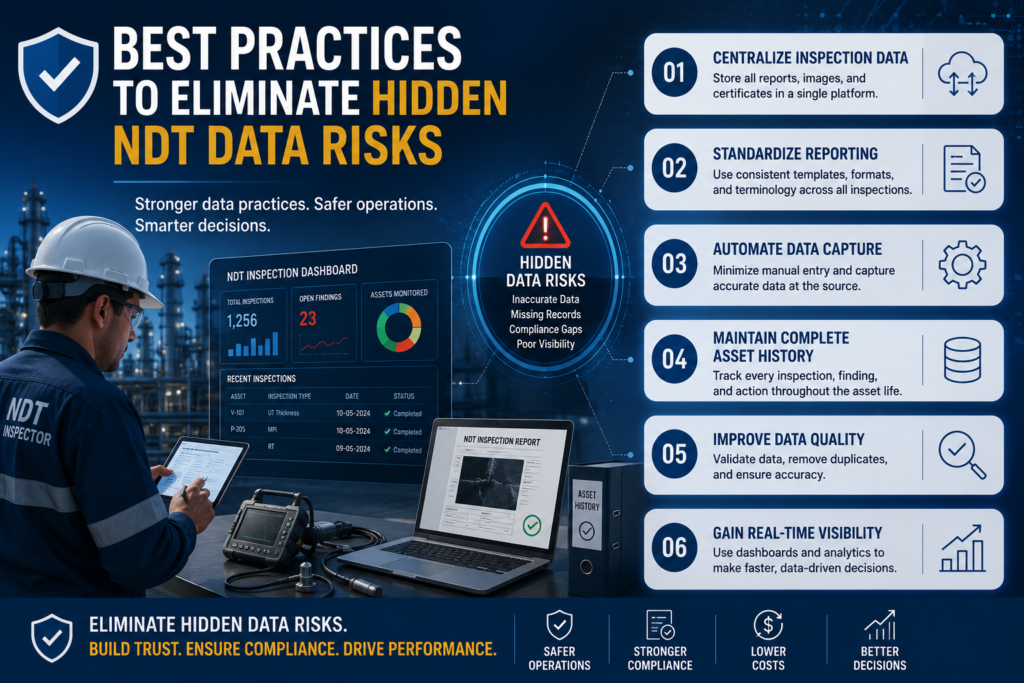
Organizations should adopt several best practices:
Consistent reporting improves data quality and simplifies comparisons.
Capture information directly on-site instead of transferring handwritten notes later.
Store every inspection in one secure location.
Reduce manual work while improving consistency.
Maintain a complete inspection lifecycle for every asset.
Transform inspection data into actionable business insights.
Read more : The NDT Compliance Gap: Why Inspection Records Often Fail During Audits
Because many reports are stored in disconnected systems, making them difficult to access, analyze, and verify during audits or maintenance planning.
The biggest challenge is organizing thousands of inspection records into a centralized, searchable system that supports compliance and decision-making.
Digital inspection software standardizes data collection, automates report generation, stores complete asset histories, and improves reporting accuracy.
Yes. InspectionsTrack is purpose-built for oil and gas inspection companies, supporting NDT inspections, lifting gear inspections, DROPS surveys, asset management, automated reporting, compliance tracking, and inspection lifecycle management.
Inspection reports should protect your business not expose it to unnecessary risk.
As inspection volumes continue to grow, relying on spreadsheets, scattered PDFs, and manual reporting creates hidden operational liabilities that affect compliance, productivity, and decision-making.
Modern inspection organizations need more than digital documents they need connected inspection intelligence.
By centralizing inspection data, automating reporting, maintaining complete asset histories, and providing real-time visibility, InspectionsTrack empowers oil and gas inspection companies to transform raw inspection records into reliable, actionable insights.
If your team spends more time searching for reports than using them, it’s time to rethink how inspection data is managed. With the right digital inspection platform, your reports become a competitive advantage instead of a growing liability.
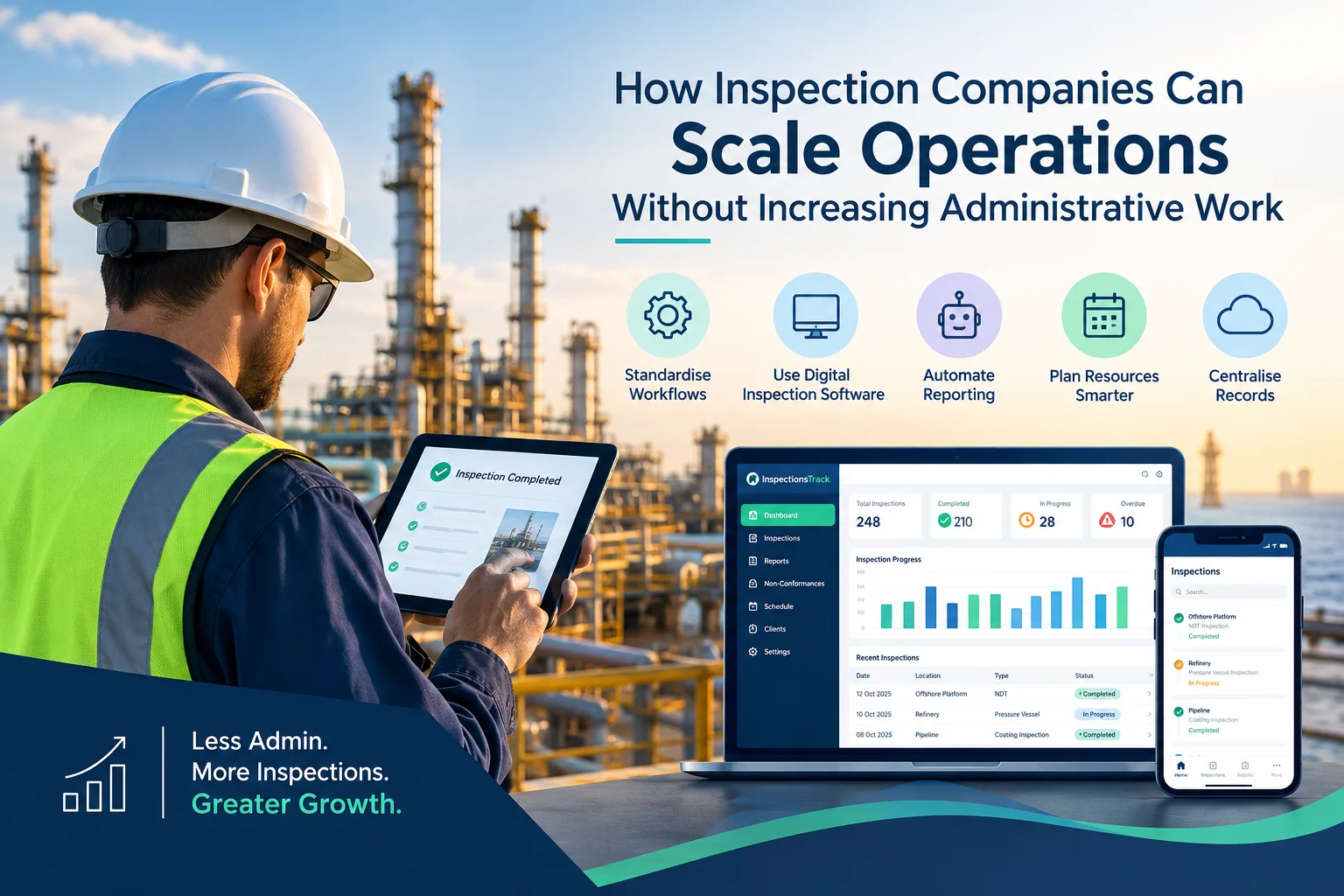
Inspection companies in the oil and gas industry face a common challenge: how to handle more inspections, manage larger projects, and meet client deadlines without increasing administrative workload. As businesses grow, inspection teams must manage…

Meeting client Service Level Agreements (SLAs) is essential for inspection companies working in demanding industries such as oil and gas, energy, and industrial maintenance. Clients expect inspections to be completed on time, reports to be…


