
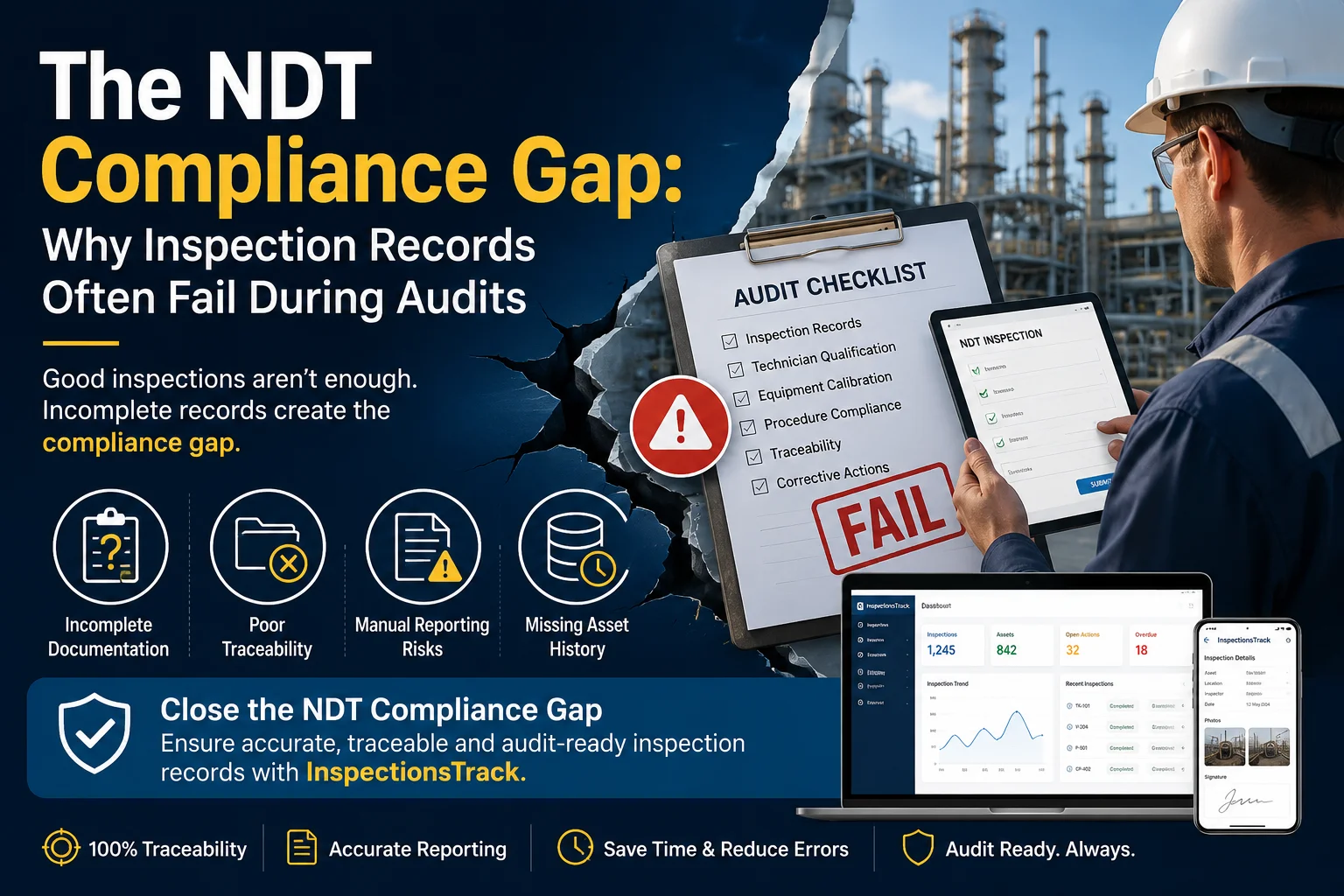
Non-Destructive Testing (NDT) plays a critical role in ensuring asset integrity, operational safety, and regulatory compliance across industries such as oil & gas, petrochemicals, offshore, and energy.
However, many organizations still face a hidden challenge: the NDT compliance gap.
Inspection teams may complete thousands of inspections every year, yet their records often fail during internal audits, client reviews, or regulatory inspections. The problem is not always the quality of the inspection itself. Instead, the failure usually comes from incomplete documentation, poor data management, missing traceability, and disconnected reporting systems.
As compliance requirements become stricter, companies need more than inspection expertise. They need reliable NDT inspection record management systems that provide accurate, accessible, and audit-ready data.
Modern digital inspection platforms like InspectionsTrack help oil and gas inspection companies manage NDT workflows, inspection records, certificates, asset history, and compliance documentation from one centralized platform.
The NDT compliance gap refers to the difference between completing an inspection correctly and maintaining inspection records that fully satisfy industry standards, client requirements, and regulatory expectations.
In simple terms:
An inspection may be technically correct, but if the records cannot prove it, compliance can still fail.
During audits, inspectors and operators are not only reviewing inspection results. They are also checking whether organizations can demonstrate:
Therefore, documentation quality is just as important as inspection quality.
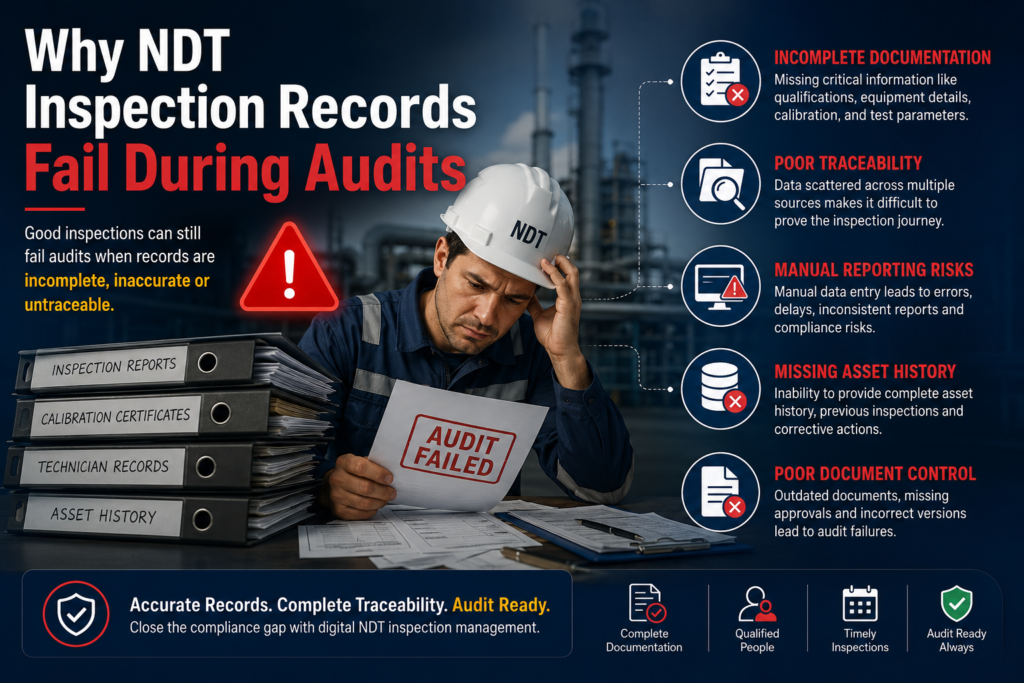
One of the most common reasons NDT records fail audits is incomplete documentation.
Many inspection companies still rely on spreadsheets, paper forms, or manually created reports. Consequently, important information can easily be missed.
Common missing data includes:
Moreover, when information is stored across multiple systems, retrieving complete inspection history becomes difficult.
Audit teams require complete traceability. They need to understand the entire inspection journey from planning to final reporting.
However, many organizations struggle because inspection information is scattered across:
As a result, teams spend hours searching for records instead of focusing on inspection improvements.
A strong NDT data management system should provide a clear audit trail showing:
| Audit Requirement | Common Problem | Digital Solution |
|---|---|---|
| Inspection date & location | Missing manual entries | Automated inspection timestamps |
| Inspector details | Records stored separately | Technician profile management |
| Asset history | Limited tracking | Digital asset database |
| Inspection reports | Manual formatting errors | Automated reporting |
| Certificates | Difficult retrieval | Centralized document storage |
Traditional NDT reporting processes often involve significant manual work.
Inspectors may complete field inspections, transfer information into spreadsheets, create reports manually, and then send documents through email.
This process creates several risks:
Manual copying increases the chance of:
Additionally, manual report preparation slows down project completion. Clients often expect inspection reports immediately, especially for offshore and shutdown projects.
Different inspectors may create reports differently, making compliance reviews more difficult.
Therefore, automated inspection reporting helps maintain consistency across every project.
Asset history is essential for effective maintenance planning.
During audits, companies are often asked:
Unfortunately, many organizations cannot answer quickly because inspection history is not centralized.
A proper NDT asset management system allows companies to maintain complete lifecycle records for:
Large oil and gas operations involve multiple stakeholders, including:
However, when each department manages information separately, visibility decreases.
Consequently, organizations may experience:
A centralized inspection management platform improves collaboration by giving authorized users real-time access to accurate information.
During compliance audits, organizations are commonly required to provide:
| Record Type | Purpose |
|---|---|
| Inspection reports | Verify inspection results |
| Technician certifications | Confirm inspector competency |
| Equipment calibration records | Ensure measurement accuracy |
| Inspection procedures | Confirm approved methods were followed |
| Defect reports | Track identified issues |
| Corrective actions | Verify problems were resolved |
| Asset history | Review inspection lifecycle |
| Photos and evidence | Validate inspection findings |
Keeping these records organized is essential for passing audits successfully.
Digital transformation is changing how inspection companies manage compliance.
Instead of relying on disconnected spreadsheets and manual processes, organizations are adopting specialized inspection management software.
InspectionsTrack is designed specifically for the oil and gas inspection industry, helping companies digitize inspection workflows and maintain audit-ready records.
The platform supports multiple inspection activities, including:
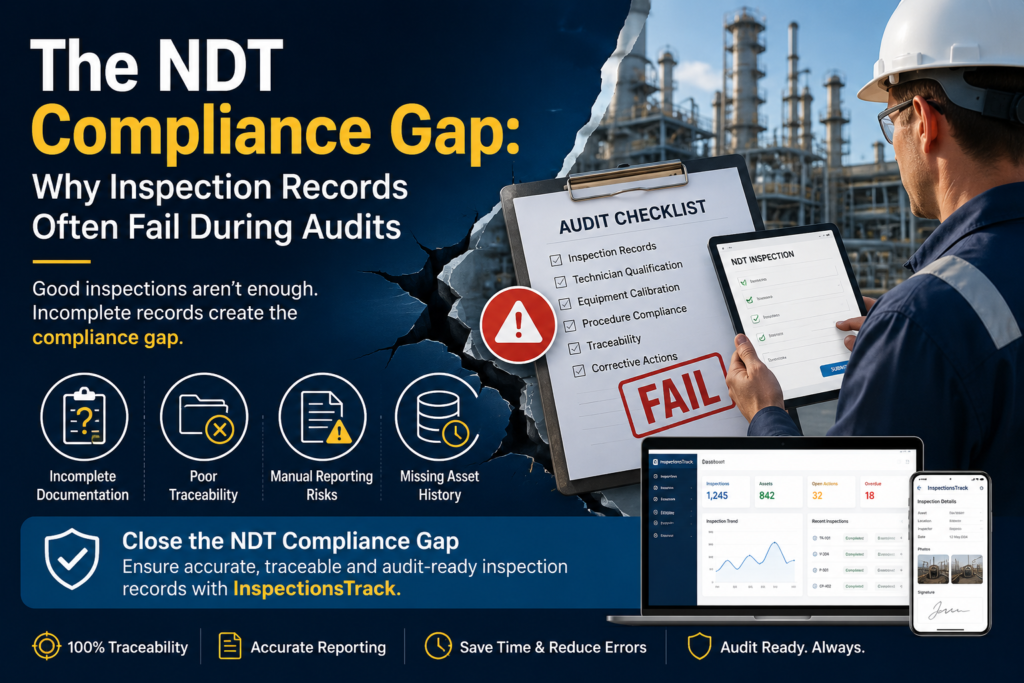
Standardized digital forms ensure inspectors capture all required information during field inspections.
Benefits include:
Instead of searching through multiple systems, teams can access inspection history from one platform.
This improves:
InspectionsTrack enables teams to generate professional inspection reports faster.
Therefore, inspection companies can:
Field inspectors can capture inspection data directly from mobile devices.
This allows teams to:
With organized inspection data and complete traceability, companies can respond faster during audits.
Instead of manually collecting documents, teams can quickly access:
| Feature | Manual Process | Digital Inspection System |
|---|---|---|
| Data collection | Paper/Excel based | Mobile digital forms |
| Reporting | Manual creation | Automated reports |
| Asset tracking | Difficult | Centralized database |
| Audit preparation | Time-consuming | Faster retrieval |
| Data accuracy | Higher error risk | Improved validation |
| Collaboration | Limited visibility | Real-time access |
| Compliance monitoring | Reactive | Proactive |
Organizations can reduce compliance risks by following these practices:
Create consistent procedures for:
Store all inspection information in a secure centralized system.
Perform periodic checks to identify:
Inspection findings should always have:
Technology can help identify potential compliance issues before audits occur.
The future of inspection management is moving toward intelligent, connected, and data-driven operations.
With digital inspection platforms, organizations can move beyond simply storing reports. They can analyze inspection trends, predict risks, and improve asset reliability.
Furthermore, technologies such as:
will continue improving how companies maintain compliance.
Read more : Thousands of NDT Reports, Zero Visibility: The Data Challenge Facing Inspection Teams
The biggest reason is incomplete or inaccurate documentation. Even when inspections are performed correctly, missing records, poor traceability, and inconsistent reporting can create compliance failures.
Companies can improve record management by adopting digital inspection software, standardizing inspection processes, maintaining centralized databases, and automating reporting workflows.
Digital inspection software helps oil and gas companies manage complex inspection activities, improve asset visibility, reduce manual errors, and maintain audit-ready compliance records.
Yes. InspectionsTrack supports multiple oil and gas inspection workflows, including NDT, lifting inspections, DROPS surveys, EX inspections, pressure equipment inspections, and asset integrity management.
The NDT compliance gap is rarely caused by poor inspection practices alone. Instead, it often results from weak documentation processes, disconnected systems, and limited data visibility.
As regulatory expectations continue increasing, inspection companies must focus on creating accurate, traceable, and easily accessible records.
By adopting digital inspection management solutions like InspectionsTrack, oil and gas organizations can improve compliance, simplify audits, and build a stronger foundation for asset integrity management.
The goal is simple: perform better inspections, maintain better records, and stay audit-ready at all times.
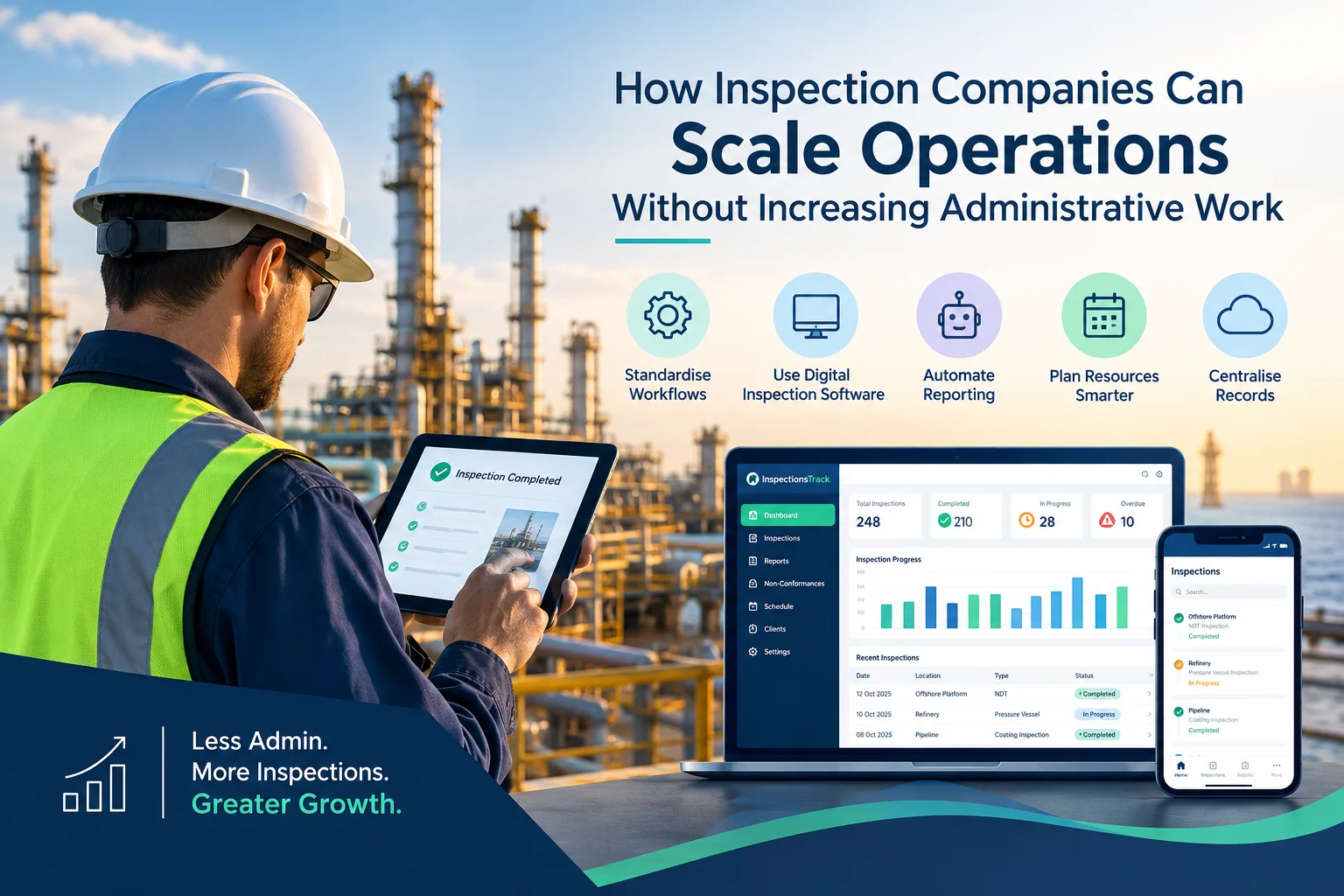
Inspection companies in the oil and gas industry face a common challenge: how to handle more inspections, manage larger projects, and meet client deadlines without increasing administrative workload. As businesses grow, inspection teams must manage…

Meeting client Service Level Agreements (SLAs) is essential for inspection companies working in demanding industries such as oil and gas, energy, and industrial maintenance. Clients expect inspections to be completed on time, reports to be…


