

Tank floor integrity is critical in the oil and gas industry. Even a small defect can lead to costly leaks, environmental hazards, and compliance issues. That’s exactly where Magnetic Flux Leakage (MFL) testing becomes essential.
In this guide, you’ll learn how MFL testing works, why it matters for tank floor inspections, and how modern tools like Inspectionstrack software help streamline the entire inspection process.
Magnetic Flux Leakage (MFL) is a non-destructive testing (NDT) method used to detect corrosion, pitting, and metal loss in steel structures—especially tank floors.
As a result, inspectors can quickly identify damaged areas without cutting or damaging the tank.
Storage tanks, especially in oil and gas facilities, are exposed to:
Therefore, regular inspections are not optional—they are essential.
Because of these risks, industries rely heavily on MFL testing for tank floors.
MFL testing is widely used because it offers a balance of speed, accuracy, and cost-effectiveness.
Moreover, MFL can scan the entire tank floor efficiently, which makes it ideal for large storage tanks.
To better understand its value, let’s compare MFL with other common inspection techniques:
| Method | Speed | Accuracy | Coverage Area | Cost Efficiency |
|---|---|---|---|---|
| MFL Testing | High | High | Large | High |
| Ultrasonic Testing | Medium | Very High | Small | Medium |
| Visual Inspection | Low | Low | Limited | Low |
| Radiographic Testing | Low | High | Medium | Expensive |
Clearly, MFL stands out for large-scale tank floor inspections.
Understanding the workflow helps improve planning and execution.
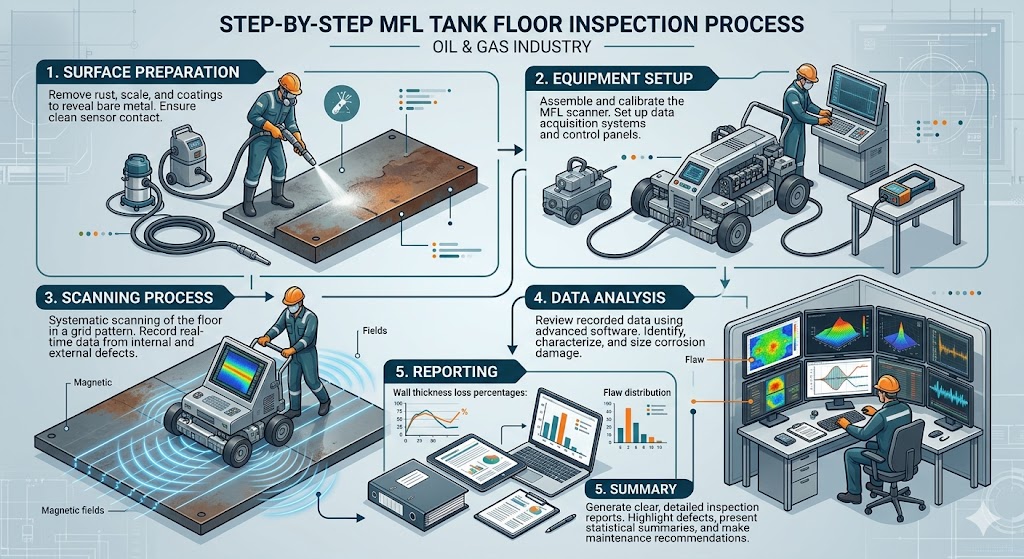
MFL testing is particularly effective at identifying:
However, it’s important to note that MFL is often combined with other NDT methods for complete accuracy.
Although MFL is powerful, it does come with some challenges:
That’s exactly why digital inspection solutions are becoming essential.
Modern inspections are no longer just about data collection—they’re about data management, accuracy, and efficiency.
Inspectionstrack is designed specifically for the oil and gas inspection industry.
As a result, companies can move from manual processes to a fully digital inspection workflow.
To get the most out of MFL testing, follow these best practices:
The industry is evolving rapidly. Therefore, companies are adopting smarter technologies.
Consequently, integrating tools like Inspectionstrack is becoming a competitive advantage.
Magnetic Flux Leakage (MFL) testing is one of the most effective methods for tank floor inspections in the oil and gas industry. It offers speed, accuracy, and comprehensive coverage—making it a preferred choice for large-scale inspections.
However, to truly maximize its potential, companies must go beyond traditional methods. By integrating Inspectionstrack software, organizations can streamline workflows, improve accuracy, and make smarter maintenance decisions.
Read more : prv testing equipment for calibration and safety
MFL testing is used to detect corrosion, pitting, and metal loss in tank floors without damaging the structure.
MFL is faster for large areas, while ultrasonic testing is more precise for thickness measurement. Both are often used together.
It digitizes the inspection process, improves reporting accuracy, and helps manage large volumes of inspection data efficiently.

Working at height is one of the most demanding activities in industrial environments. For rope access teams, however, safety depends on more than having the right equipment. Fall protection equipment must also be inspected correctly,…

A flare stack may look like a simple vertical structure standing above a rig or production facility. In reality, it is one of the most important safety systems for handling flammable gases and relieving potentially…


