
Rope access equipment inspection is a critical safety requirement in oil & gas, construction, offshore, and industrial maintenance environments. Because technicians work at height in high-risk conditions, even a minor equipment fault can lead to serious incidents.
In this guide, you’ll learn how to inspect rope access equipment properly, what standards to follow, common inspection mistakes to avoid, and how digital inspection software like InspectionsTrack helps oil & gas companies stay compliant and audit-ready.
Table of contents
- Why Rope Access Equipment Inspection Is So Important
- Rope Access Equipment That Must Be Inspected
- Types of Rope Access Equipment Inspections
- Step-by-Step Process to Inspect Rope Access Equipment
- Rope Access Equipment Inspection Checklist (Table)
- Common Mistakes to Avoid During Rope Access Inspections
- How InspectionsTrack Improves Rope Access Equipment Inspections
- Best Practices for Rope Access Equipment Inspection
- Final Thoughts
- FAQ’s
Why Rope Access Equipment Inspection Is So Important
Rope access systems operate under extreme loads and harsh environments. Therefore, regular inspections are not optional — they are mandatory under international safety standards.
More importantly, inspections help to:
- Prevent falls and equipment failure
- Ensure compliance with safety regulations
- Extend equipment lifespan
- Protect workers and company liability
As a result, inspection quality directly impacts operational safety and business continuity.
Rope Access Equipment That Must Be Inspected
Before starting, it’s important to know what equipment requires inspection.
Common Rope Access Equipment Includes:
- Harnesses
- Kernmantle ropes
- Descenders and ascenders
- Connectors (carabiners, shackles)
- Anchors and anchor slings
- Lanyards and fall arrest devices
- Helmets and PPE
Each component must be inspected individually, not as a single system.
Types of Rope Access Equipment Inspections
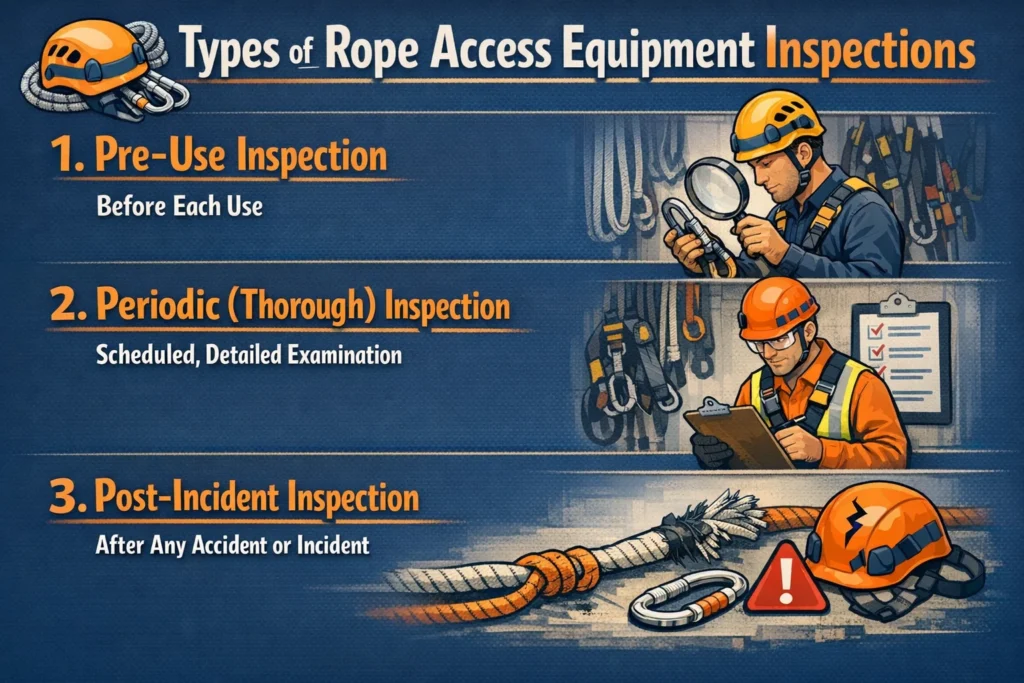
To meet safety and compliance requirements, rope access equipment inspections are usually divided into three categories.
1. Pre-Use Inspection
This inspection is carried out before every use by the rope access technician.
It focuses on:
- Visible damage
- Proper function
- Signs of wear or contamination
Although quick, it is the first line of defense against failure.
2. Periodic (Thorough) Inspection
This is a formal inspection conducted by a competent person at defined intervals (usually every 6 or 12 months).
It includes:
- Detailed examination
- Measurements and testing
- Inspection records and tagging
Most regulatory bodies require documented proof of this inspection.
3. Post-Incident Inspection
If equipment has been:
- Shock loaded
- Dropped from height
- Exposed to chemicals or extreme heat
Then it must be immediately removed from service and re-inspected.
Step-by-Step Process to Inspect Rope Access Equipment
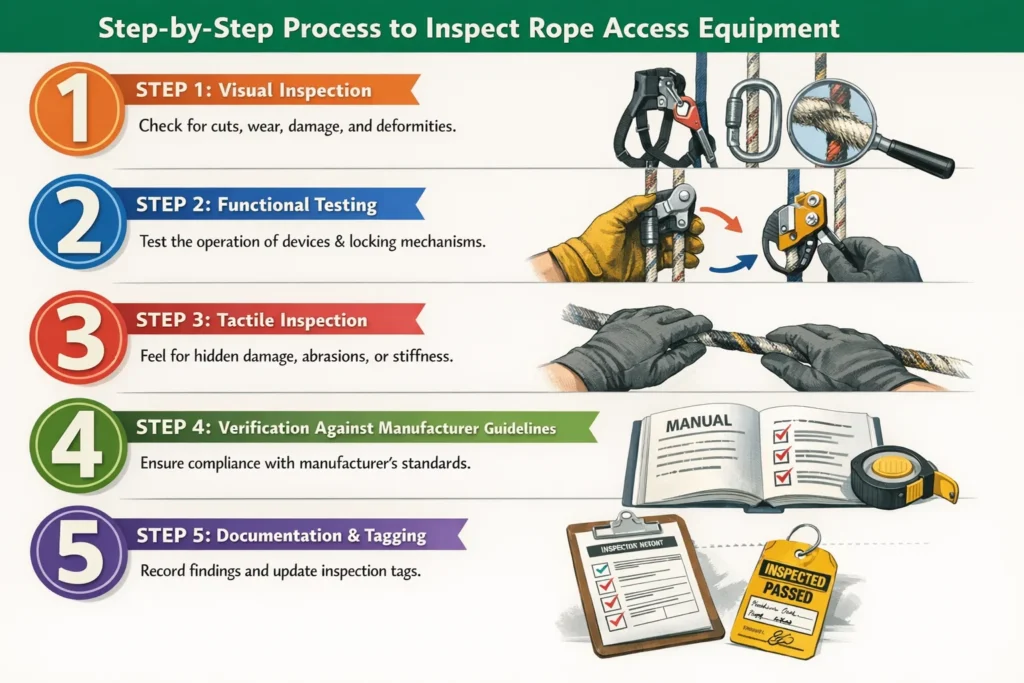
Step 1: Visual Inspection
Start by visually checking for:
- Cuts, abrasions, or fraying
- Corrosion or rust
- Deformation or cracks
- Missing labels or serial numbers
If identification markings are unreadable, the equipment should be rejected.
Step 2: Functional Testing
Next, test moving parts:
- Ascenders should grip smoothly
- Descenders should control movement consistently
- Connectors must lock and unlock properly
Any stiffness, slippage, or delay is a warning sign.
Step 3: Tactile Inspection
Run your hands along ropes and webbing to feel:
- Hard spots
- Soft or flattened sections
- Internal rope damage
This step is often overlooked, yet it reveals hidden faults.
Step 4: Verification Against Manufacturer Guidelines
Always compare findings with:
- Manufacturer’s instructions
- Load ratings
- Expiry dates
Using equipment beyond its recommended lifespan is a major compliance violation.
Step 5: Documentation & Tagging
Finally, record:
- Inspection date
- Inspector name
- Equipment condition
- Pass / fail status
Without documentation, the inspection legally does not exist.
Rope Access Equipment Inspection Checklist (Table)
| Equipment Type | Key Inspection Points | Action if Defective |
|---|---|---|
| Harness | Webbing wear, stitching, buckles | Remove from service |
| Rope | Cuts, glazing, chemical damage | Discard immediately |
| Carabiner | Locking action, cracks | Replace |
| Descender | Smooth operation, wear | Service or replace |
| Anchor Slings | Abrasion, label visibility | Reject if damaged |
Common Mistakes to Avoid During Rope Access Inspections
Even experienced teams make errors. However, these mistakes can be costly.
Avoid the following:
- Skipping tactile inspections
- Ignoring manufacturer expiry dates
- Poor or missing inspection records
- Relying on paper checklists
- Using unqualified inspectors
Fortunately, digital inspection systems help eliminate many of these issues.
How InspectionsTrack Improves Rope Access Equipment Inspections
For oil & gas inspection companies, managing rope access inspections manually is inefficient and risky. This is where InspectionsTrack software becomes essential.
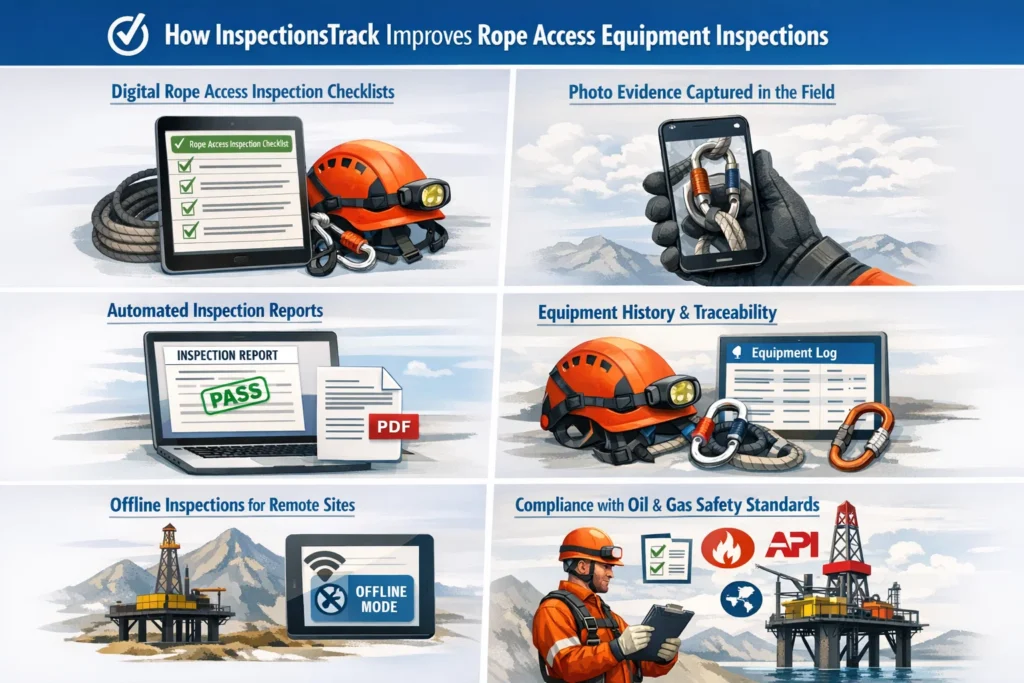
Key Benefits of InspectionsTrack:
- Digital rope access inspection checklists
- Photo evidence captured in the field
- Automated inspection reports
- Equipment history and traceability
- Offline inspections for remote sites
- Compliance with oil & gas safety standards
As a result, inspections become faster, more accurate, and audit-ready.
Why Oil & Gas Companies Prefer Digital Rope Access Inspections
In oil & gas environments, inspections often take place:
- Offshore
- In deserts
- At remote facilities
InspectionsTrack allows inspectors to record inspections in real time, even without internet access. Once connected, data syncs automatically reducing delays and errors.
Best Practices for Rope Access Equipment Inspection
To maintain high safety standards, follow these best practices:
- Train inspectors regularly
- Use standardized digital checklists
- Schedule automatic inspection reminders
- Maintain full inspection history
- Remove failed equipment immediately
Consistency is the key to long-term safety and compliance.
Final Thoughts
Inspecting rope access equipment is not just about ticking boxes — it’s about protecting lives, assets, and operations. When inspections are done correctly and documented digitally, companies reduce risks and improve efficiency.
By combining proper inspection procedures with a digital inspection platform like InspectionsTrack, oil & gas companies can confidently meet safety regulations and operational demands.
Want to modernize your rope access inspections?
Inspections Track helps oil & gas inspection companies digitize rope access inspections, improve compliance, and simplify reporting all from one platform.
Read more : managing inspections in remote areas oil fields
FAQ’s
Rope access equipment should be visually inspected before each use and thoroughly inspected by a competent person every 6 or 12 months, depending on regulations and manufacturer guidelines.
Only a trained and competent inspector with knowledge of rope access systems, safety standards, and manufacturer instructions should perform formal equipment inspections.
Common signs include frayed ropes, damaged stitching, corrosion on metal components, malfunctioning connectors, and missing or unreadable identification labels.
Digital inspection software like InspectionsTrack allows inspectors to record findings digitally, attach photos, track equipment history, and generate compliant reports instantly, improving accuracy and safety.