
Drill pipe failures rarely happen without warning. In most cases, fatigue cracks, wall loss, thread damage, or excessive wear develop long before a catastrophic failure occurs. However, when inspection records are inconsistent or grading criteria vary between inspectors, drilling operations face unnecessary safety risks, unexpected downtime, and expensive equipment replacement.
Understanding DS-1 drill pipe inspection categories helps inspection companies and drilling contractors make consistent decisions about whether a pipe should remain in service, require repair, or be removed from operation. Even more importantly, digital inspection management platforms such as InspectionsTrack Software Suite by Sky Soft Connections ensure that every inspection result, measurement, repair recommendation, and certification remains traceable throughout the asset lifecycle.
This guide explains DS-1 inspection categories, grading principles, inspection workflows, and how digital inspection software improves operational reliability.
DS-1 (Drill String Inspection Standard) is an internationally recognized inspection standard used throughout the oil and gas industry to evaluate the condition of drill string components. It defines inspection methods, acceptance criteria, grading requirements, and documentation standards that help prevent drill string failures.
Unlike basic visual inspections, DS-1 establishes consistent procedures for identifying defects that may compromise structural integrity.
Typical components include:
DS-1 inspections typically involve multiple Non-Destructive Testing (NDT) methods depending on the component and service history.
Every drilling operation depends on accurate equipment condition assessment.
Incorrect grading can result in:
Conversely, overly conservative grading removes usable assets from service unnecessarily, increasing operational expenses.
A standardized grading process balances safety and asset utilization.
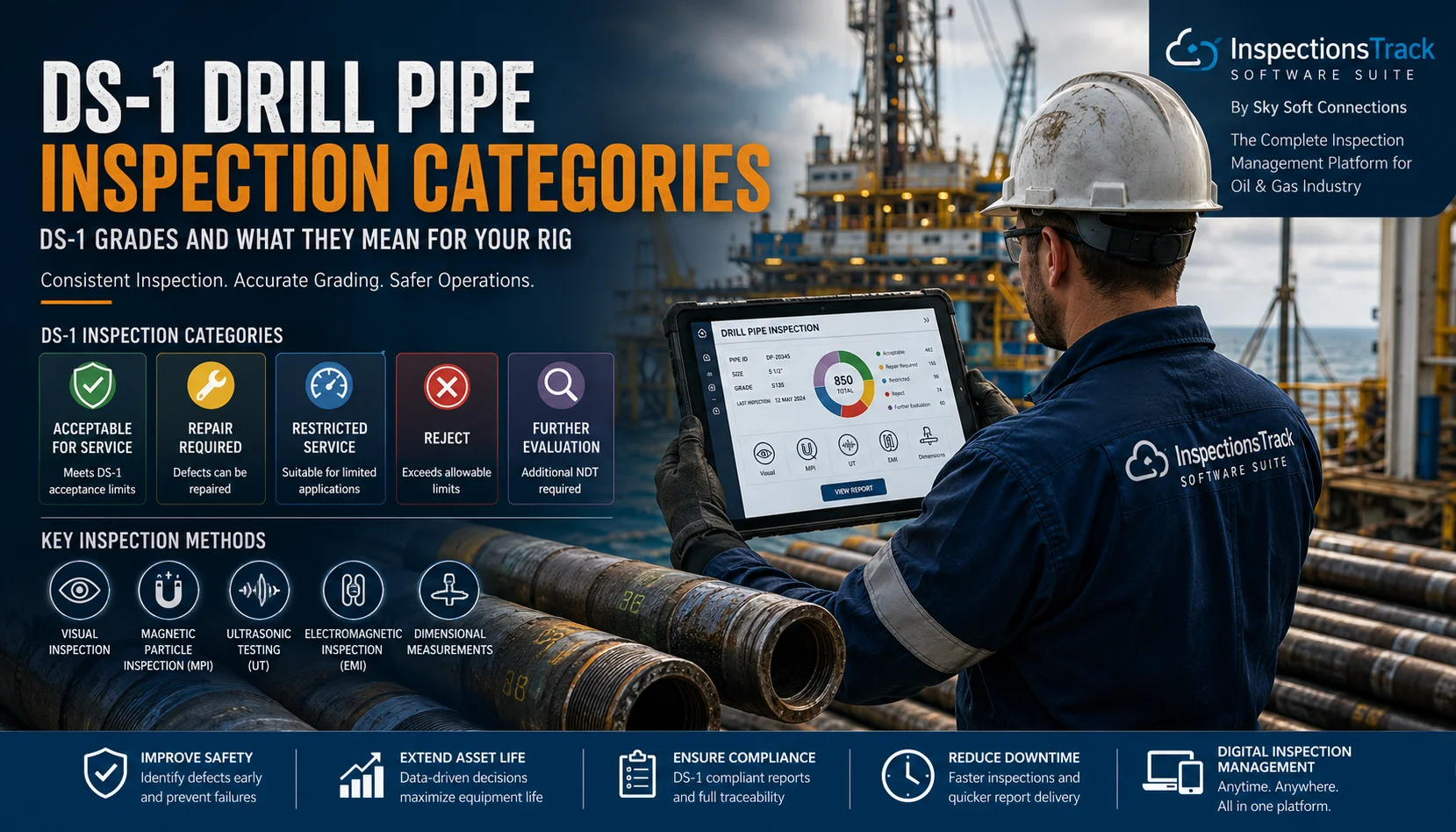
A DS-1 grade represents the condition of a drill string component after inspection.
Instead of simply labeling equipment as “Pass” or “Fail,” inspectors classify components according to measurable acceptance criteria including:
Each inspection result determines whether the pipe:
Although inspection companies may use different reporting formats, most DS-1 workflows classify equipment into operational categories.
| Inspection Category | Operational Meaning | Typical Action |
|---|---|---|
| Acceptable for Service | Meets DS-1 acceptance limits | Return to operation |
| Repair Required | Defects can be repaired | Send for repair before reuse |
| Restricted Service | Suitable only for limited applications | Monitor closely |
| Reject | Exceeds allowable limits | Remove permanently |
| Further Evaluation | Additional NDT required | Perform advanced inspection |
Digital inspection software helps ensure these decisions remain standardized across inspectors and locations.
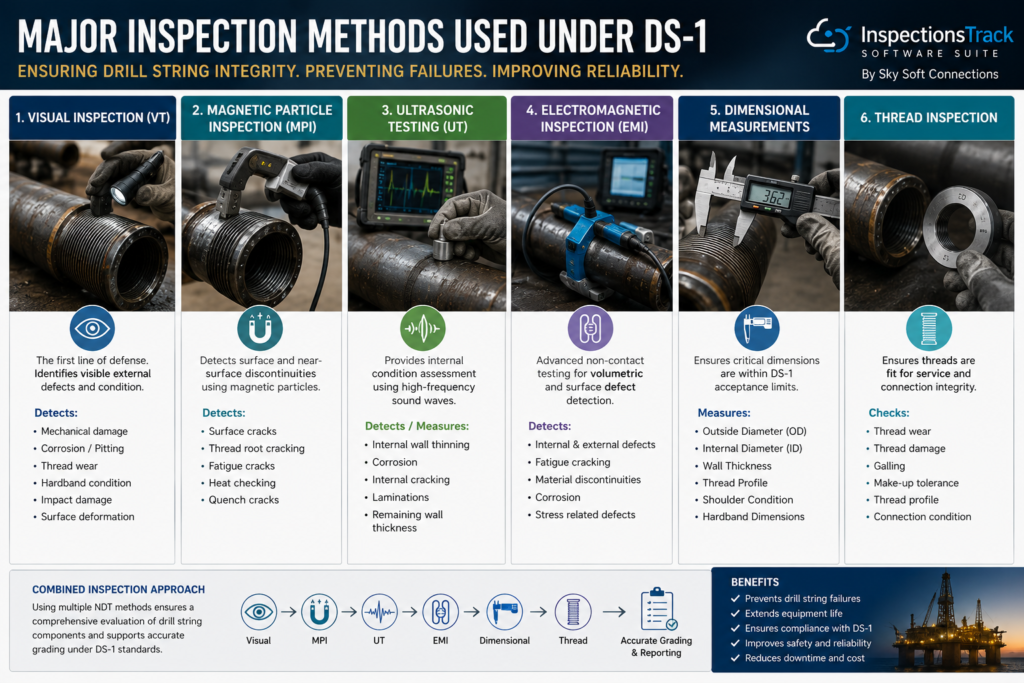
A complete DS-1 inspection rarely relies on one testing method.
Instead, inspectors combine several techniques.
The first inspection stage identifies:
Although simple, visual inspection often identifies problems requiring further NDT.
MPI detects:
This method remains one of the most widely used techniques for drill string inspections.
Ultrasonic inspection evaluates:
UT provides quantitative measurements that support grading decisions.
EMI identifies:
It allows rapid inspection of large drill pipe inventories.
Inspectors also verify:
These measurements determine remaining service life.
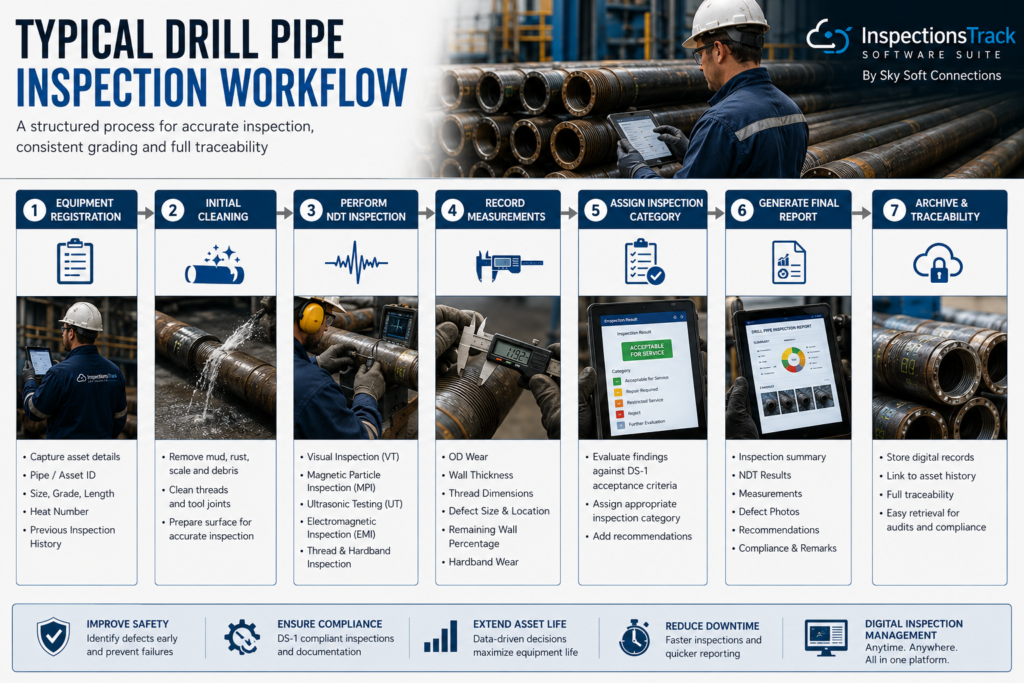
A standardized workflow improves inspection quality and reporting consistency.
Capture:
With InspectionsTrack Software Suite, inspectors can retrieve historical inspection records instantly instead of searching spreadsheets or paper files.
Before inspection:
Proper cleaning improves defect detection accuracy.
Depending on customer requirements:
Inspection data is recorded digitally during field operations.
Measurements include:
Instead of handwritten notes, digital inspection forms reduce transcription errors.
Inspectors evaluate findings against DS-1 acceptance criteria.
The software automatically links:
Digital reporting includes:
Clients receive reports significantly faster than manual reporting methods.
| Manual Process | Digital Process with InspectionsTrack Software Suite |
|---|---|
| Paper forms | Mobile digital inspection forms |
| Manual measurements | Structured data capture |
| Spreadsheet tracking | Centralized asset database |
| Delayed reporting | Instant report generation |
| Difficult asset history lookup | Complete inspection history |
| Duplicate data entry | Single data source |
| Limited traceability | Full audit trail |
Inspection companies commonly experience:
These issues affect both inspection quality and customer confidence.
InspectionsTrack Software Suite by Sky Soft Connections supports inspection companies throughout the complete asset lifecycle.
Key capabilities include:
Instead of managing disconnected spreadsheets, emails, and paper reports, inspection teams operate from one centralized inspection platform.
An offshore inspection contractor receives 850 drill pipes returning from a drilling campaign.
Without digital software:
Using InspectionsTrack Software Suite:
This streamlined process reduces administrative effort while improving consistency and traceability.
Organizations can improve inspection quality by following these practices:
Read more : From Quote to Final Report: How Job Management Software Streamlines the Inspection Workflow
A DS-1 drill pipe inspection is a standardized evaluation of drill string components using visual inspection, dimensional checks, and non-destructive testing methods to determine whether equipment remains fit for service.
Inspection categories provide a consistent basis for deciding whether drill pipe should remain in service, undergo repair, receive further evaluation, or be permanently removed. This consistency improves safety, reliability, and compliance.
Common methods include:
Visual Inspection (VT)
Magnetic Particle Inspection (MPI)
Ultrasonic Testing (UT)
Electromagnetic Inspection (EMI)
Dimensional inspection
Thread inspection
The exact methods depend on the asset type, service conditions, and inspection scope.
Digital platforms such as InspectionsTrack Software Suite standardize inspection forms, centralize asset histories, automate report generation, improve traceability, and reduce manual data entry. This helps inspection companies maintain consistent grading and demonstrate compliance more efficiently.
DS-1 drill pipe inspection is more than a compliance exercise it is a critical process for protecting personnel, extending asset life, and minimizing costly drilling interruptions. Consistent grading depends on accurate measurements, standardized workflows, and complete inspection records.
As inspection programs scale, manual systems often become a bottleneck. By digitizing inspections with InspectionsTrack Software Suite by Sky Soft Connections, organizations can streamline field operations, maintain comprehensive asset histories, automate reporting, and make faster, evidence-based decisions that support safer and more efficient drilling operations.
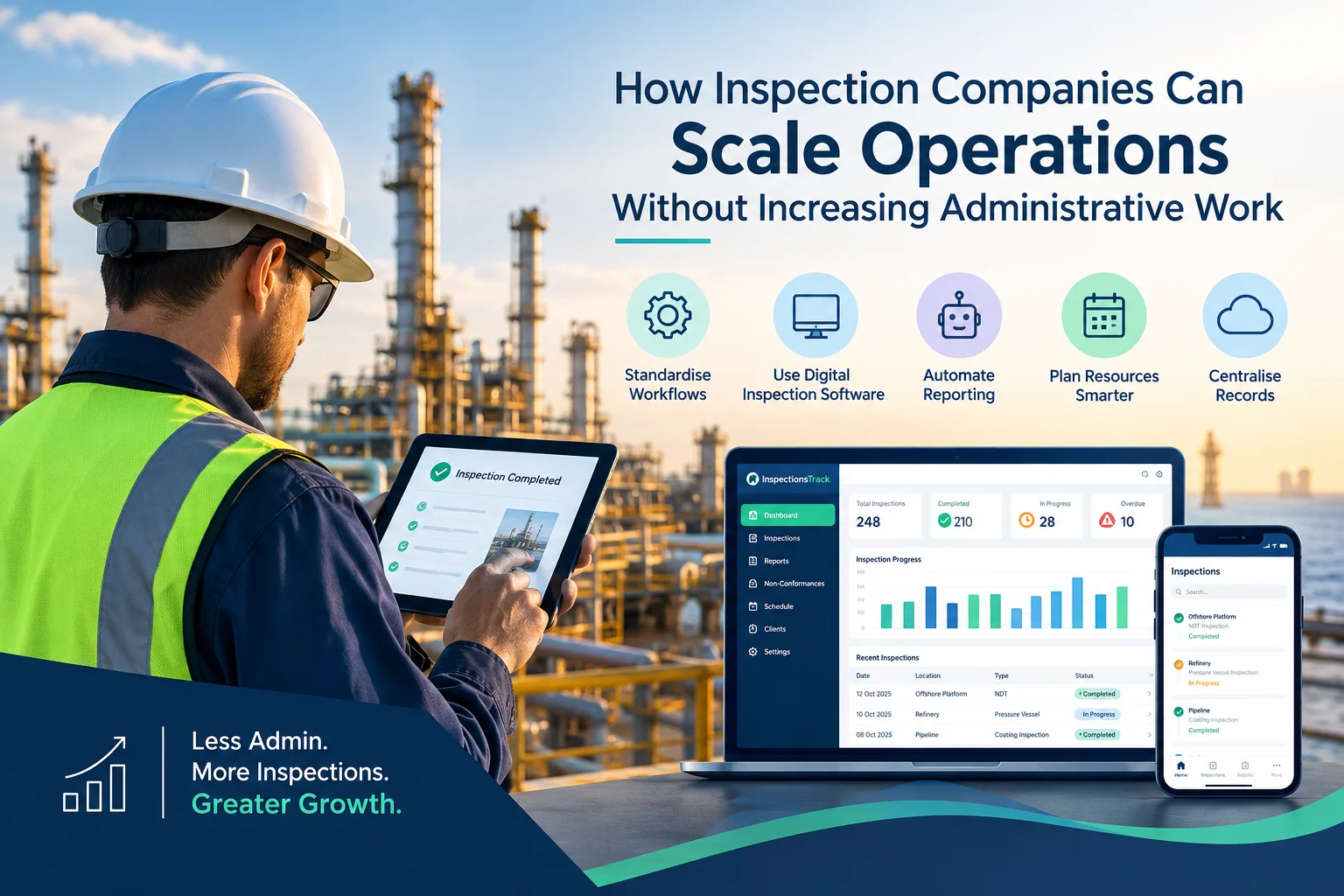
Inspection companies in the oil and gas industry face a common challenge: how to handle more inspections, manage larger projects, and meet client deadlines without increasing administrative workload. As businesses grow, inspection teams must manage…
Meeting client Service Level Agreements (SLAs) is essential for inspection companies working in demanding industries such as oil and gas, energy, and industrial maintenance. Clients expect inspections to be completed on time, reports to be…


