
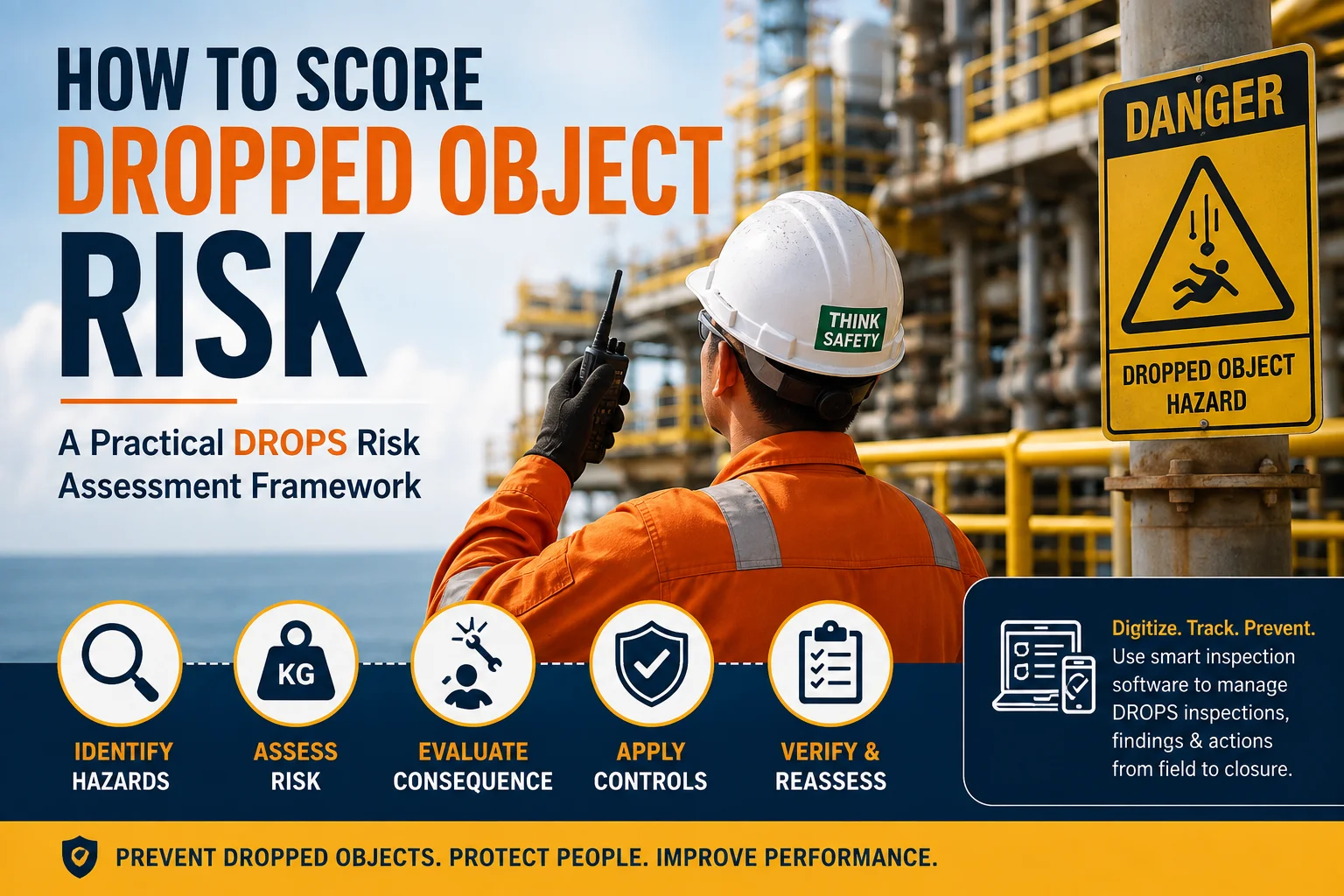
Dropped objects are one of the most serious hazards in oil and gas operations. A loose bolt, unsecured tool, damaged clamp, or poorly secured component can fall from a platform, derrick, crane, pipe rack, or other elevated location and cause serious injury, equipment damage, or operational disruption.
That is why a DROPS risk assessment should do more than identify objects that could fall. It should help teams understand the potential consequence, prioritize hazards, apply effective controls, and verify that those controls remain in place.
The DROPS initiative provides industry-recognized guidance for dropped object prevention, including risk assessment, inspection, reliable securing, working at height, zone management, and assurance.
In this guide, we will explain how to score dropped object risk using a practical framework that inspection teams, HSE professionals, supervisors, and asset integrity managers can apply in the field.
A DROPS risk assessment identifies objects that could fall, evaluates their potential consequences, and determines the controls needed to prevent or reduce the risk.
DROPS stands for Dropped Objects Prevention Scheme. Organizations widely use this approach across oil and gas operations to integrate dropped object prevention into their broader safety management systems.
A typical assessment considers factors such as:
Importantly, the DROPS Calculator is a guide for estimating potential consequence, not a substitute for a detailed site-specific risk assessment.
Oil and gas facilities contain thousands of components installed at height.
For example, consider:
Even a relatively small object can become dangerous when it falls from an elevated position.
Moreover, dropped object hazards are not limited to major offshore structures. DROPS guidance also highlights the importance of lower-level dropped objects, because objects falling from relatively modest heights can still cause injuries.
Therefore, a good DROPS program should focus on both high-consequence hazards and overlooked everyday hazards.
A useful DROPS risk assessment can be broken into seven practical steps:
Let’s examine each step.
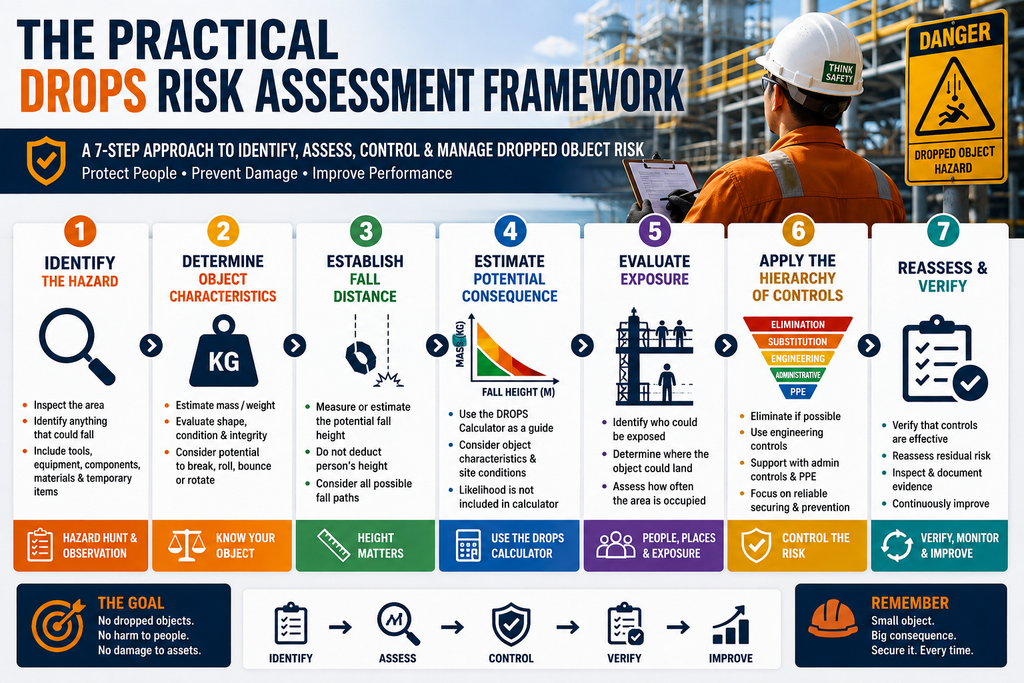
The first step is to inspect the work area and identify anything that could become a dropped object.
Look beyond obvious loose tools.
Inspect:
A useful question is:
“If this component fails, loosens, breaks, or is disturbed, could it fall to a lower level?”
If the answer is yes, it should be evaluated.
DROPS also provides hazard hunt and pre-task guidance to help personnel identify uncontrolled or unnecessary objects that could fall.
Once the object is identified, determine its approximate mass.
For example:
| Object | Approx. Mass | Location | Potential Hazard |
|---|---|---|---|
| Small bolt | 0.1 kg | Derrick | Personnel injury |
| Hand tool | 2 kg | Platform | Head/body injury |
| Valve component | 8 kg | Pipe rack | Personnel/equipment damage |
| Large bracket | 20 kg | Structural area | Serious injury/equipment damage |
However, weight alone does not determine the complete risk.
The object’s shape and condition also matter.
Consider whether the object is:
The standard DROPS Calculator is based on assumptions including a blunt object and standard PPE. Therefore, unusual object characteristics require additional professional judgment.
Next, establish how far the object could fall.
Measure or estimate the distance between the object and the potential impact surface.
For example:
Object: 5 kg inspection component
Fall height: 10 metres
Potential exposure: Personnel working directly below
The greater the height, the greater the potential energy and potential consequence.
However, do not assume that a low height automatically means low risk.
The DROPS Calculator guidance specifically states that you should not deduct the person’s height from the fall height because the object can strike the head, shoulder, leg, or another part of the body.
The DROPS Calculator provides a common benchmark by plotting the mass of a dropped object against its fall distance to estimate potential consequence. It can support planning and risk assessment and help teams prioritize corrective actions.
The outcome can generally be considered across consequence categories such as:
| Potential Consequence | Meaning |
|---|---|
| FA | First Aid |
| MTC | Medical Treatment Case |
| LTI | Lost Time Incident |
| FAT | Fatality |
For example, imagine a component weighing several kilograms positioned several metres above an area where personnel regularly work.
The DROPS Calculator can provide an initial indication of potential consequence. The assessment should then consider actual site conditions, exposure, object characteristics, and existing controls.
Do not treat the DROPS Calculator as an exact prediction of injury severity.
DROPS itself describes the calculator as a guide that provides a general indication of potential severity. A detailed risk assessment provides a more specific evaluation.
This is where a basic dropped object calculation becomes a real-world risk assessment.
Ask:
A component above a permanently restricted area presents a different exposure profile from one directly above a busy walkway.
Therefore, the assessment should consider both:
Potential consequence + exposure
rather than relying only on object mass and height.
Once the hazard has been assessed, controls should be selected.
The objective should not simply be to “monitor” the object.
Instead, ask:
Can the dropped object hazard be eliminated or physically controlled?
A practical control hierarchy is:
| Control Level | Example |
|---|---|
| Elimination | Remove unnecessary equipment at height |
| Substitution | Replace heavy component with a safer design |
| Engineering | Install secondary retention or safety securing |
| Administrative | Inspection schedules and restricted access |
| PPE | Hard hats and other required protective equipment |
Engineering controls are particularly important for equipment installed at height.
DROPS Recommended Practice requires teams to inspect and maintain equipment at height and securely fasten any equipment that does not form part of the primary structure.
Risk assessment should not end after a control is identified.
For example:
Initial condition
A 4 kg component is located 8 metres above an active work area.
Control
Install an engineered secondary securing system and establish a restricted access zone.
Verification
Inspect the securing arrangement and confirm that the area controls are implemented.
Residual risk
Recalculate or reassess the remaining risk based on the new conditions.
This creates a continuous improvement cycle:
Identify → Assess → Control → Verify → Reassess
Consider an offshore platform where an unsecured component is located above a maintenance area.
DROPS Calculator can be used to estimate the potential consequence based on mass and fall height.
However, the overall assessment should also consider exposure and site conditions.
This approach prevents the risk assessment from becoming just another form.
A useful distinction in DROPS management is between static and dynamic dropped objects.
These are objects that are already positioned at height and may fall because of:
These involve objects that are moved or handled during work.
Examples include:
Both categories require attention.
However, dynamic activities often require additional pre-task controls because the hazard can change as the job progresses.
DROPS guidance includes pre-task assessment and worksite checklist resources specifically to support this type of planning.
Before closing a dropped object assessment, ask the following:
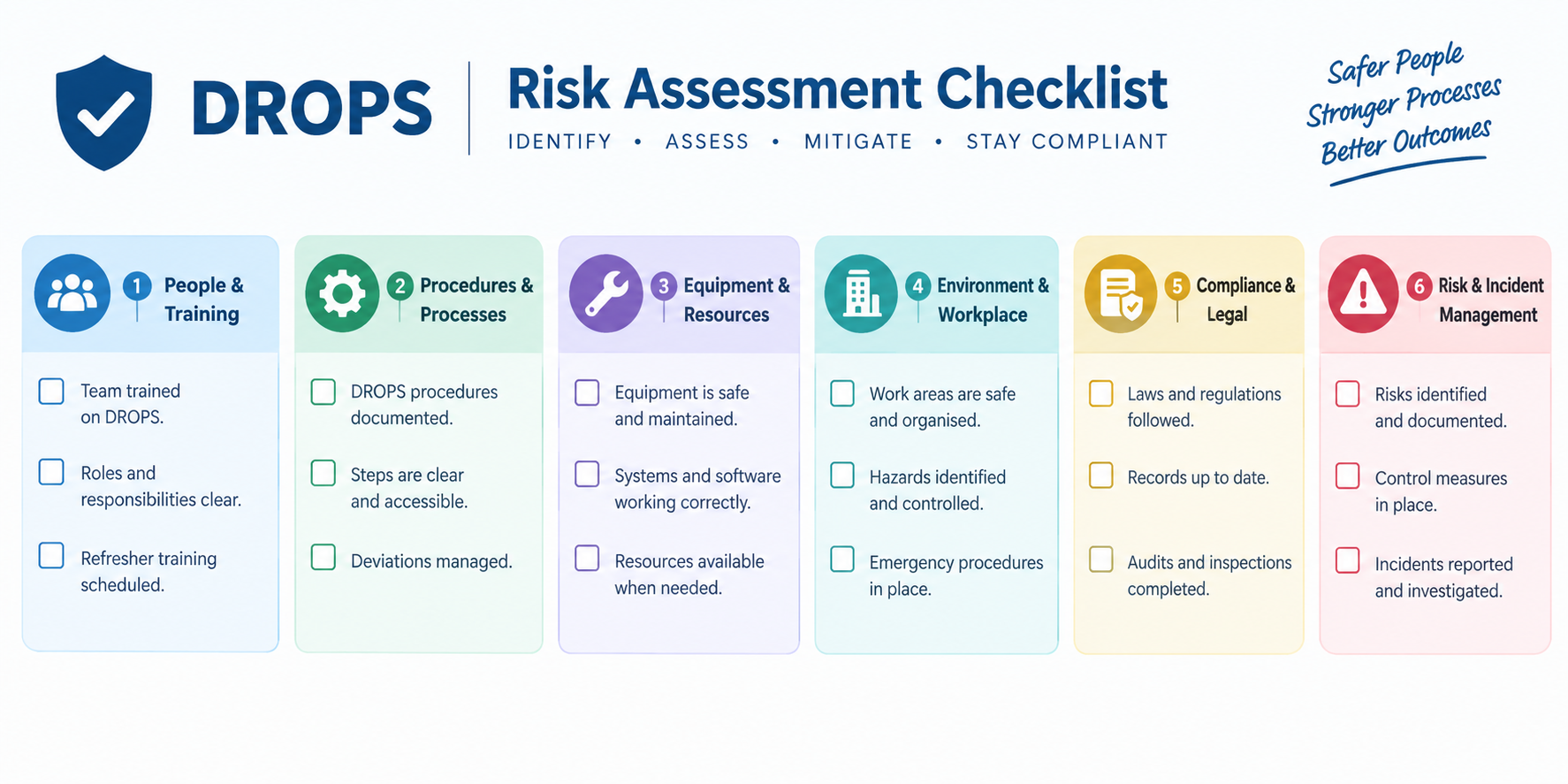
Traditional dropped object inspections often rely on paper checklists, spreadsheets, photographs stored separately, and manually updated action registers.
That creates a problem.
The organization may record a finding during an inspection, but it still needs to connect:
Finding → Location → Asset → Risk → Corrective Action → Evidence → Verification → Closure
This is where digital inspection management can help.
InspectionsTrack is an inspection management software platform designed for oil and gas inspection operations. It can help inspection teams move DROPS inspections, findings, evidence, reports, and corrective actions into a connected digital workflow.
For example, an inspector can use the platform to:
This becomes particularly useful for offshore and remote inspection teams because they cannot always rely on a stable internet connection.
Instead of managing DROPS findings across separate spreadsheets, emails, photographs, and paper forms, inspection information can remain connected to the relevant inspection and asset history.
A digital workflow can look like this:
1. Inspect
Inspector identifies an unsecured component.
↓
2. Record
The inspector records the location, asset, observation, risk information, and photographs.
↓
3. Assess
The organization evaluates the finding using its DROPS risk assessment process.
↓
4. Assign
A responsible person or department receives the corrective action.
↓
5. Correct
The securing issue is repaired, replaced, removed, or otherwise controlled.
↓
6. Verify
Evidence is captured to demonstrate that the corrective action has been completed.
↓
7. Close
The finding is reviewed and formally closed.
↓
8. Report
The completed inspection and findings can be included in the final inspection report.
This approach creates a stronger audit trail and helps managers understand what teams found, what they fixed, and what remains open.
Even experienced teams can overlook certain issues.
A small object can still cause serious injury when it falls from height.
Lower-level dropped objects can still result in injuries, as industry examples have demonstrated.
The DROPS Calculator provides guidance on potential consequence. It does not replace site-specific professional risk assessment.
Secondary retention may be required depending on the equipment and risk.
A corrective action should not simply be marked “completed” because someone entered a comment.
Evidence and verification matter.
A previously safe area can become hazardous when scaffolding, lifting operations, maintenance work, or temporary equipment is introduced.
Therefore, DROPS assessments should be reviewed when conditions change.
There is no single inspection frequency that applies identically to every facility.
Frequency should be based on:
DROPS Recommended Practice calls for inspection programs that include systematic inspections, unplanned inspections, competent personnel, and independent inspections at defined intervals.
Therefore, organizations should develop an inspection schedule based on their own risk profile rather than relying on a generic calendar alone.
A strong dropped object risk assessment should answer five basic questions:
| Question | What to Determine |
|---|---|
| What can fall? | Object, component, tool or material |
| Why could it fall? | Failure, corrosion, vibration, poor securing or human action |
| How far could it fall? | Potential fall distance |
| What could happen? | Injury, equipment damage, environmental or operational impact |
| How do we prevent it? | Elimination, securing, barriers, procedures and verification |
The key is to turn these answers into action.
A DROPS assessment should not simply identify hazards. It should help teams remove, secure, control, monitor, and verify them.
Dropped object prevention is ultimately about controlling hazards before they become incidents.
The DROPS Calculator provides a useful way to benchmark potential consequence based on object mass and fall distance. However, effective DROPS risk management goes further by considering exposure, equipment condition, work activities, securing methods, restricted zones, and verification.
For oil and gas inspection teams, digital inspection software can further strengthen this process by connecting field inspections with photographs, findings, corrective actions, asset history, reports, and audit trails.
With a structured DROPS risk assessment framework, organizations can move from simply finding dropped object hazards to managing them throughout their lifecycle.
Identify the hazard. Assess the consequence. Control the risk. Verify the solution.
A stronger dropped object prevention program starts with this foundation.
Read more : Fall Protection Equipment Inspection: What Rope Access Teams Commonly Miss
A DROPS risk assessment is a structured process for identifying potential dropped objects, evaluating their possible consequences, considering personnel and asset exposure, and implementing controls to prevent or reduce the risk.
The DROPS Calculator uses the mass of an object and its potential fall height to provide an indication of potential consequence. However, it is a guide and should be combined with a detailed, site-specific risk assessment.
DROPS guidance states that you should not deduct a person’s height because the object could strike different parts of the body. A person may also be crouching, bending, or lying down.
Controls can include eliminating unnecessary objects at height, improving equipment design, reliable primary and secondary securing, tool tethering, inspection, restricted zones, barriers, and effective work planning.
Yes. Digital inspection software can help teams record DROPS findings, capture photographs, assign corrective actions, track closure, maintain inspection history, and generate reports. Platforms such as InspectionsTrack can support these workflows for oil and gas inspection operations.

Falling objects in industrial sites are a serious safety concern. Every year, thousands of workers suffer injuries due to objects falling from heights, loose equipment, or poorly secured materials. Understanding the causes of these incidents…

Dropped objects are a major safety concern in the oil and gas industry. Even a small tool falling from height can cause severe injuries, equipment damage, or operational downtime. Adhering to dropped object inspection standards…


