
Working at height is one of the most demanding activities in industrial environments. For rope access teams, however, safety depends on more than having the right equipment. Fall protection equipment must also be inspected correctly, consistently, and at the right intervals.
A harness may look perfectly serviceable while hiding damaged stitching. Likewise, a rope can appear clean while suffering from abrasion, chemical exposure, heat damage, or internal deterioration.
That is why fall protection equipment inspection should never be treated as a simple visual check.
Instead, rope access teams need a structured inspection process that identifies defects, records findings, tracks equipment history, and ensures that unsafe equipment is removed from service.
This guide explains what rope access teams commonly miss during fall protection inspections and how inspection teams can improve their processes, particularly in demanding oil and gas, offshore, construction, and industrial environments.
Fall protection equipment is designed to protect workers from serious injury or death during work at height. However, even certified equipment can become unsafe through normal use, environmental exposure, improper storage, or repeated loading.
Therefore, regular inspection helps identify problems before equipment is relied upon during a critical operation.
A comprehensive inspection can cover:
Moreover, inspection records provide valuable evidence that safety procedures are being followed.
For oil and gas companies, this documentation can become particularly important because equipment may be exposed to saltwater, hydrocarbons, chemicals, extreme temperatures, offshore conditions, and heavy industrial use.
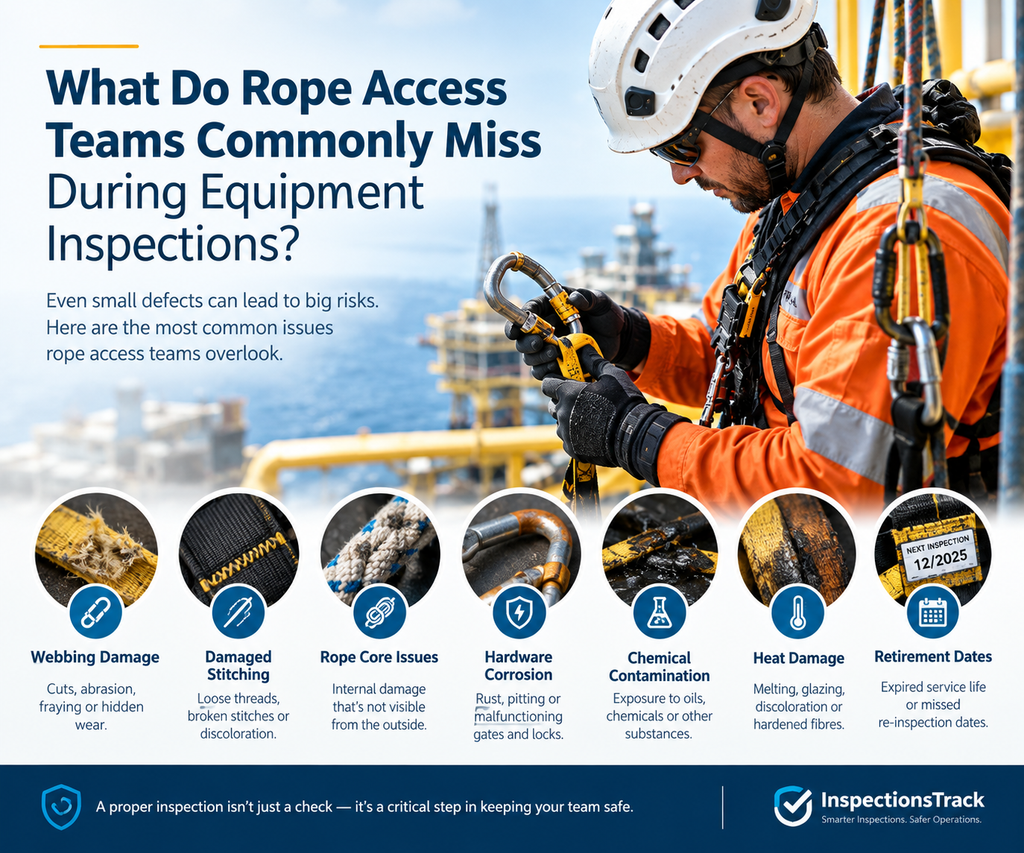
Although trained inspectors follow established procedures, some defects are easy to overlook.
Here are some of the most common inspection gaps.
Inspectors often focus on the webbing itself. However, stitching can be equally important.
Harnesses and lanyards rely on carefully engineered stitching to withstand significant loads. Consequently, loose, broken, pulled, or damaged stitching can indicate that equipment should be removed from service.
During an inspection, check for:
In addition, pay close attention to high-load connection points.
Webbing damage is not always obvious.
A harness may have small cuts, melted areas, abrasion, or hardened sections that are difficult to identify during a quick inspection.
Therefore, inspectors should examine the entire length of the webbing rather than only checking areas around buckles and connectors.
Look for:
Furthermore, flexing the webbing during inspection can help reveal damage that is not immediately visible.
Chemical exposure is particularly relevant to oil and gas inspections.
Equipment used around refineries, offshore platforms, petrochemical facilities, and processing plants can encounter hydrocarbons, solvents, acids, cleaning chemicals, and other substances.
However, contamination is sometimes recorded simply as “dirty equipment.”
That can be a mistake.
Inspectors should identify the potential contaminant and assess whether it could affect the material’s strength or integrity.
Chemical exposure should never be dismissed simply because the equipment still looks functional.
Rope access equipment can be exposed to high temperatures from:
Ropes and synthetic materials can suffer significant damage from excessive heat.
Signs may include:
Therefore, inspectors should consider the equipment’s operating environment, not just its physical appearance.
One of the most important things rope access teams can miss is internal rope damage.
A rope may appear acceptable externally while its core has been compromised.
Potential causes include:
For this reason, rope inspection should involve more than checking the outer sheath.
Inspectors should follow the manufacturer’s inspection methodology and applicable rope access procedures.
Metal components are another commonly overlooked inspection area.
Corrosion can develop around:
This becomes especially important in offshore and coastal oil and gas environments, where saltwater and humidity can accelerate corrosion.
Inspectors should check for:
A connector that does not operate smoothly should receive further attention rather than being automatically passed.
Another common mistake is treating an equipment inspection as a simple pass/fail exercise.
Equipment also has a lifecycle.
Depending on the manufacturer and equipment type, retirement may be determined by:
Therefore, inspectors should record the equipment’s manufacture date, service history, inspection dates, and retirement status where applicable.
A structured checklist helps reduce missed inspection points.
| Equipment | What to Check | Common Defects |
|---|---|---|
| Full-body harness | Webbing, stitching, buckles, D-rings | Cuts, fraying, corrosion |
| Lanyard | Webbing, connectors, energy absorber | Abrasion, tears, deployment |
| Rope | Sheath, core condition, ends | Abrasion, contamination, damage |
| Karabiner | Gate, locking system, body | Cracks, corrosion, malfunction |
| Rope grab | Body, locking mechanism | Wear, deformation |
| Descender | Cam, body, attachment points | Excessive wear, damage |
| Anchorage equipment | Connectors, slings, hardware | Corrosion, cuts, deformation |
| Lifeline | Cable/rope, anchors, tension | Wear, corrosion, damage |
| Rescue equipment | Structural condition, deployment | Damage, expired components |
However, this checklist should complement—not replace—the manufacturer’s instructions and the inspection requirements applicable to the equipment and work environment.
There is no single inspection interval that applies to every item of fall protection equipment.
Instead, inspection frequency depends on factors such as:
Workers should check equipment before use according to the applicable procedures.
This helps identify obvious defects before the equipment is placed into service.
A competent or appropriately qualified person should conduct more detailed inspections at intervals determined by the applicable requirements and equipment manufacturer.
Equipment involved in a fall, shock loading, suspected overload, or other potentially damaging event should be assessed before being returned to service.
If there is any doubt about the equipment’s condition, it should be quarantined and evaluated rather than used.
Traditional paper-based inspections can work for small operations. However, they become difficult to manage as the number of assets, workers, locations, and inspection activities increases.
For example, an oil and gas company may need to track hundreds or thousands of inspection records across multiple facilities.
A paper-based process can make it difficult to answer simple questions:
Digital inspection software can make this information significantly easier to manage.
For organizations managing large-scale inspection programs, InspectionsTrack provides a digital approach to inspection data management.
Instead of relying entirely on paper forms and disconnected spreadsheets, inspection teams can use structured digital workflows to capture inspection information and maintain equipment records.
This can be particularly useful for oil and gas, offshore, industrial, and asset-intensive inspection operations.
A digital inspection platform can help organizations:
For rope access operations, this means inspectors can move from simply completing an inspection form to building a searchable history of equipment condition and inspection activity.
A single inspection provides only a snapshot of equipment condition.
Inspection history provides a much bigger picture.
For example, suppose a harness passes inspection three times but shows progressively increasing webbing abrasion during each inspection.
A digital history can make that trend easier to identify.
Over time, inspection data can help organizations identify:
Consequently, inspection data becomes useful not only for compliance but also for asset management and operational decision-making.
A robust inspection process should follow a consistent workflow.
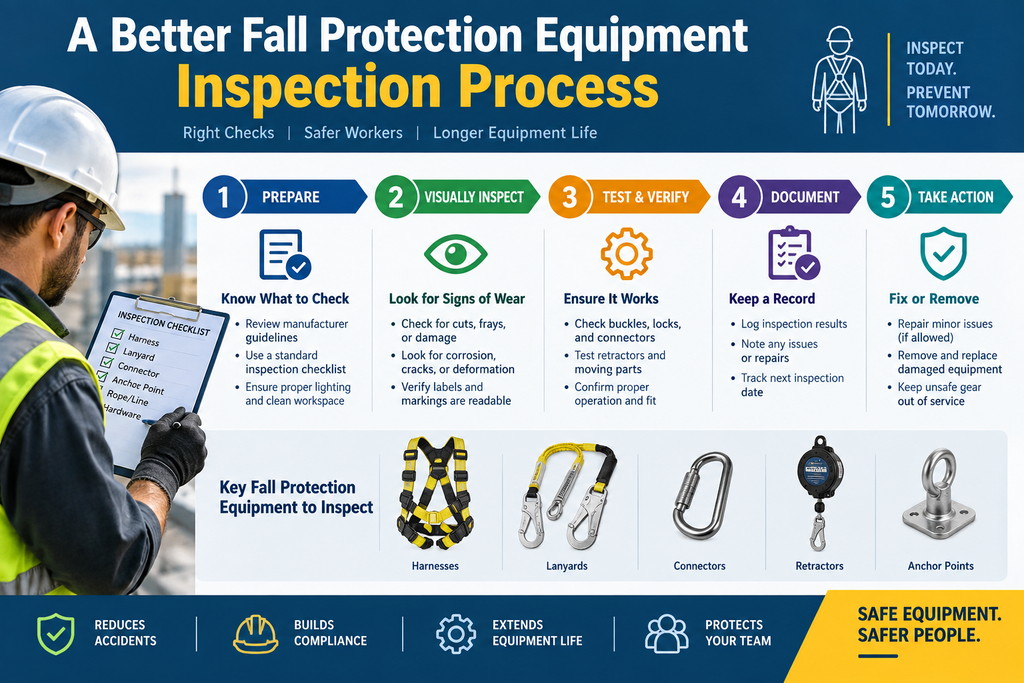
Record key information such as:
Before inspecting the equipment, review previous findings where available.
This provides useful context and helps identify recurring problems.
Inspect webbing, stitching, ropes, hardware, connectors, mechanisms, and other components according to the applicable inspection procedure.
Avoid vague descriptions such as “damaged” or “failed.”
Instead, record specific observations.
For example:
Weak:
“Rope damaged.”
Better:
“Visible sheath abrasion approximately 150 mm from termination.”
Specific observations improve traceability and make corrective action easier.
Depending on the inspection outcome, equipment may be:
The exact status categories should align with the organization’s procedures.
Where a defect requires action, record:
Finally, store the inspection results against the equipment record so the information can be retrieved during future inspections, audits, and reviews.
Even experienced teams can make avoidable mistakes.
Pre-use checks are important, but they should not replace formal periodic inspections where required.
Damage can occur underneath labels, around stitching, inside mechanisms, or within rope structures.
Oil, chemicals, UV radiation, saltwater, heat, and moisture can all influence equipment condition.
“OK” provides limited information.
Specific inspection observations create much stronger records.
If inspection records are spread across paper forms, spreadsheets, and emails, important information can easily become difficult to retrieve.
Finding a defect is only the first step.
The organization must also ensure that the required action is completed and documented.
A digital checklist should reflect the actual risks associated with the equipment and working environment.
A useful rope access inspection checklist may include:
This structure creates a much more complete inspection trail than a simple paper pass/fail form.
Oil and gas environments introduce additional inspection challenges.
Equipment may be exposed to harsh operating conditions, including:
As a result, inspection programs should consider both equipment condition and environmental exposure.
For example, a harness used in an office maintenance environment may experience significantly different conditions from one used regularly on an offshore platform.
Therefore, inspection processes should be risk-based and appropriate to the actual operating environment.
Digital inspection software does more than replace paper.
When inspection information is structured correctly, organizations can use it to improve decision-making.
For example, managers can identify:
Which equipment has the highest defect rate?
Which sites have the most overdue inspections?
Which defect types occur most frequently?
Which assets require repeated corrective actions?
Are inspection failures increasing over time?
These insights can support better planning, maintenance, training, and safety management.
In other words, the goal is not simply to create more inspection records.
The goal is to create better inspection data that organizations can act on.
Read more :
A fall protection equipment inspection is a systematic examination of equipment used to protect workers from falls. It can include harnesses, lanyards, ropes, connectors, lifelines, anchorage equipment, and related components.
Inspectors should examine the harness webbing, stitching, buckles, D-rings, labels, adjustment points, and other components for cuts, abrasion, fraying, chemical damage, heat damage, deformation, corrosion, or other defects.
Inspection frequency depends on the equipment manufacturer’s instructions, applicable regulations and standards, equipment usage, environmental conditions, and organizational procedures. Pre-use checks and periodic formal inspections may both be required.
Digital inspection software can help oil and gas companies standardize inspections, centralize inspection records, track defects and corrective actions, maintain asset histories, and improve inspection reporting.
Fall protection equipment inspection is about more than checking whether equipment looks safe.
Rope access teams need to identify subtle damage, consider environmental exposure, understand equipment history, document findings accurately, and ensure defective equipment is properly controlled.
Most importantly, inspection data should remain accessible after the inspection is complete.
For oil and gas and other asset-intensive organizations, digital inspection software such as InspectionsTrack can help turn individual inspection records into a structured source of operational information.
By combining competent inspections with consistent digital records, organizations can improve traceability, corrective action management, equipment history, and overall inspection visibility.
The result is a more reliable approach to managing equipment used in some of the most demanding working-at-height environments.
If your organization is still managing rope access, fall protection, or oil and gas inspection records through paper forms and disconnected spreadsheets, InspectionsTrack can help create a more organized digital inspection workflow.
Explore how digital inspection management can support your inspection teams, assets, and safety processes.
A flare stack may look like a simple vertical structure standing above a rig or production facility. In reality, it is one of the most important safety systems for handling flammable gases and relieving potentially…
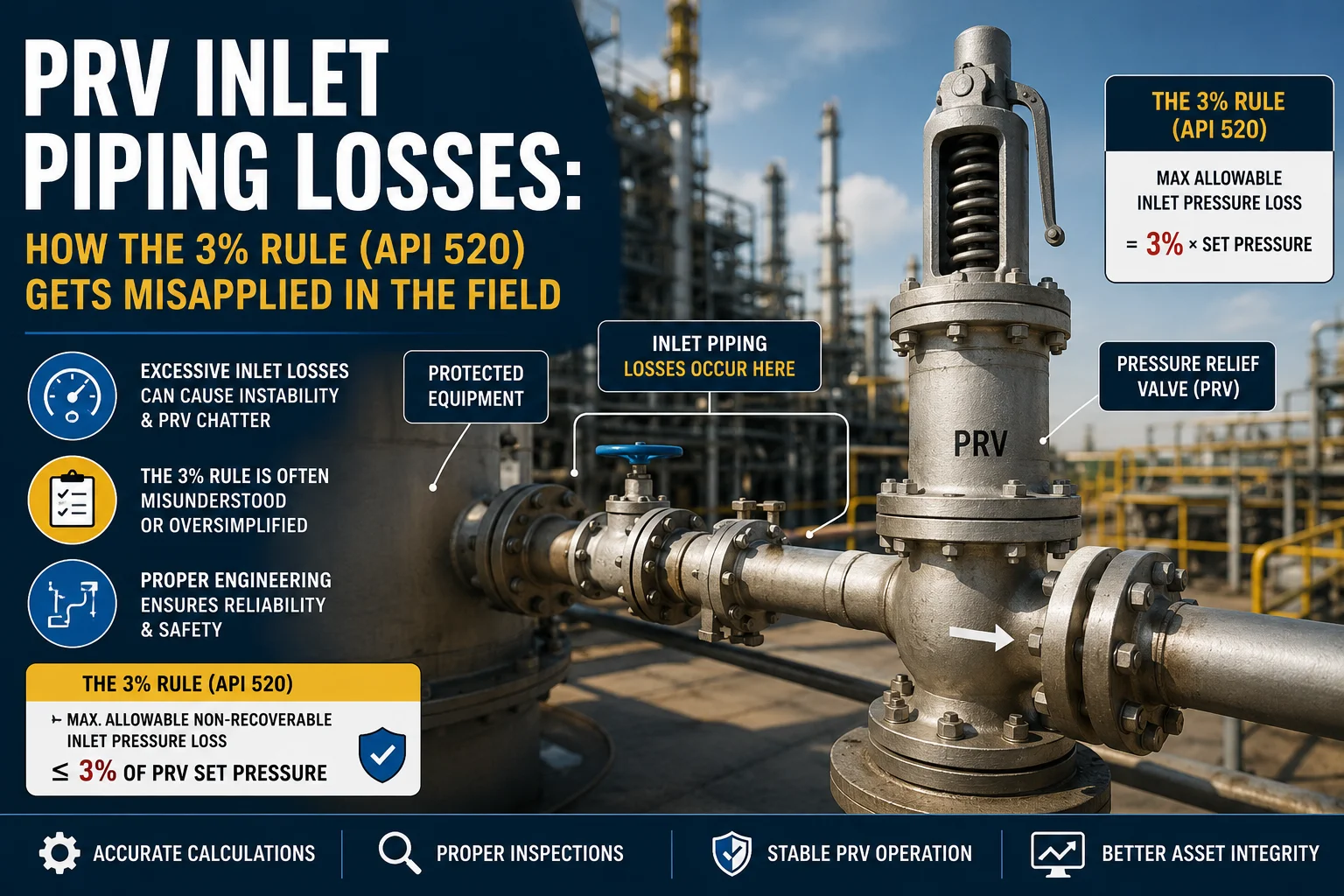
Pressure relief valves (PRVs) are critical safeguards in oil and gas, refining, petrochemical, and process facilities. However, installing the correct PRV is only part of the job. The piping between the protected equipment and the…


Comment (1)
DROPS Risk Assessment: A Practical Framework - inspectionstrack
Sep 11, 2026[…] Read more : Fall Protection Equipment Inspection: What Rope Access Teams Commonly Miss […]
Comments are closed.