
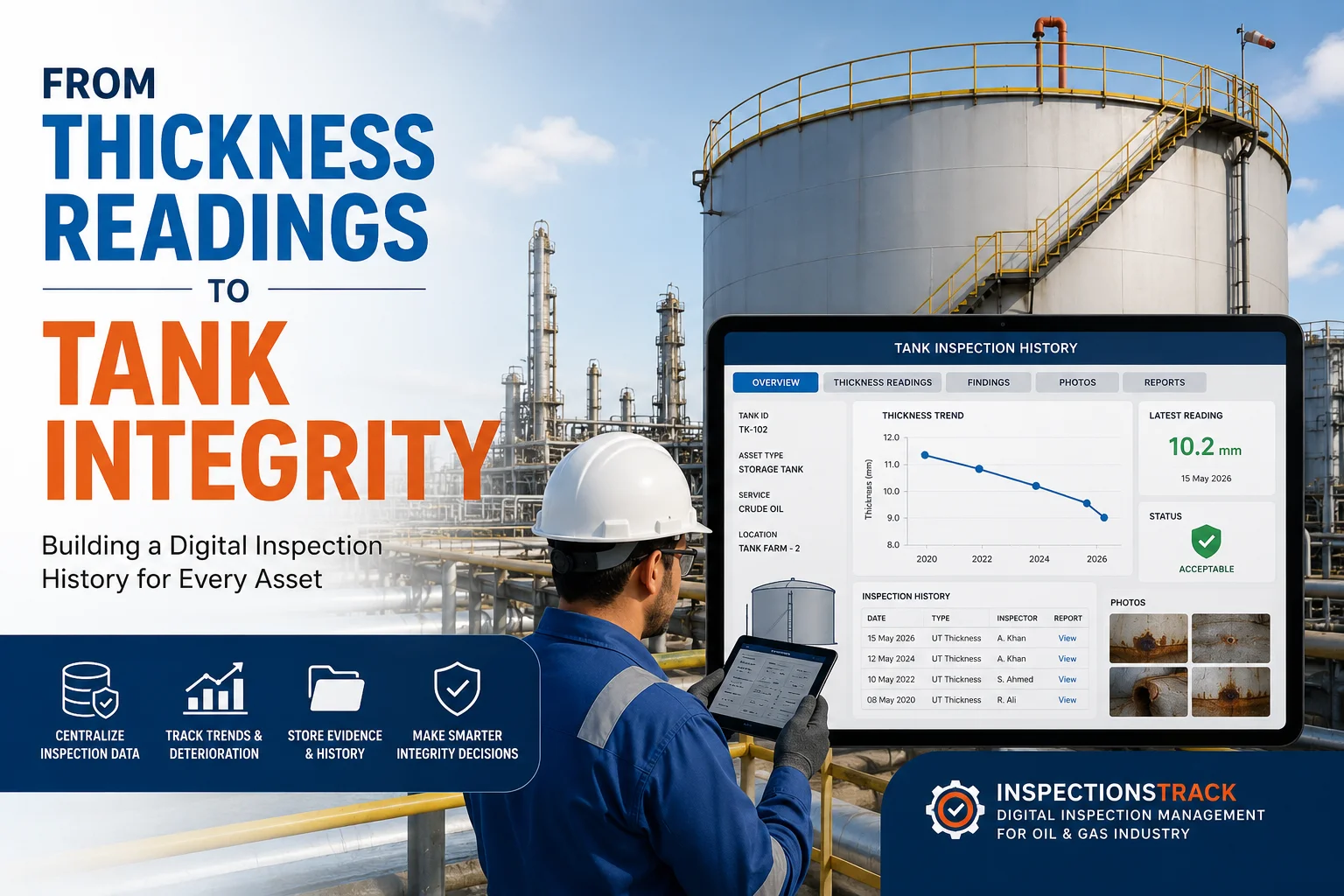
A single thickness reading can tell you something about a tank today. However, a well-maintained digital inspection history can tell you how that tank has changed over time—and, more importantly, what may happen next.
For oil and gas operators, storage terminals, refineries, and industrial facilities, tracking inspection data over the asset lifecycle is essential for effective tank integrity management. Yet, when thickness measurements, inspection photos, reports, and maintenance records are scattered across spreadsheets, folders, and paper documents, identifying long-term deterioration becomes difficult.
That is where digital inspection software can make a significant difference.
With platforms such as InspectionsTrack, inspection teams can centralize inspection information and create a more complete, traceable history for tanks and other oil and gas assets.
Tank integrity is not determined by one inspection. Instead, it depends on understanding how an asset performs across multiple inspection cycles.
For example, an ultrasonic thickness (UT) inspection may identify a wall thickness of 10.2 mm. On its own, that number provides limited insight. However, if previous inspections recorded:
| Inspection Year | Thickness Reading | Change |
|---|---|---|
| 2022 | 11.4 mm | — |
| 2024 | 10.8 mm | -0.6 mm |
| 2026 | 10.2 mm | -0.6 mm |
the inspection team can begin identifying a deterioration trend.
Therefore, a digital inspection history helps answer important questions:
Instead of treating every inspection as an isolated event, operators can build a continuous asset history.
Thickness measurements are valuable, but their real value increases when they are connected with other inspection information.
A complete digital record can combine:
This creates a clearer relationship between inspection data, deterioration trends, and integrity decisions.
Consider a tank that has been inspected five times.
If each inspection exists in a separate spreadsheet, an integrity engineer may need to manually locate previous files, compare readings, review photographs, and determine whether the same area has deteriorated.
With a structured digital history, however, the information can be accessed against the same asset record.
As a result, teams spend less time searching for information and more time evaluating the condition of the asset.
A useful digital inspection system should maintain more than just measurement values.
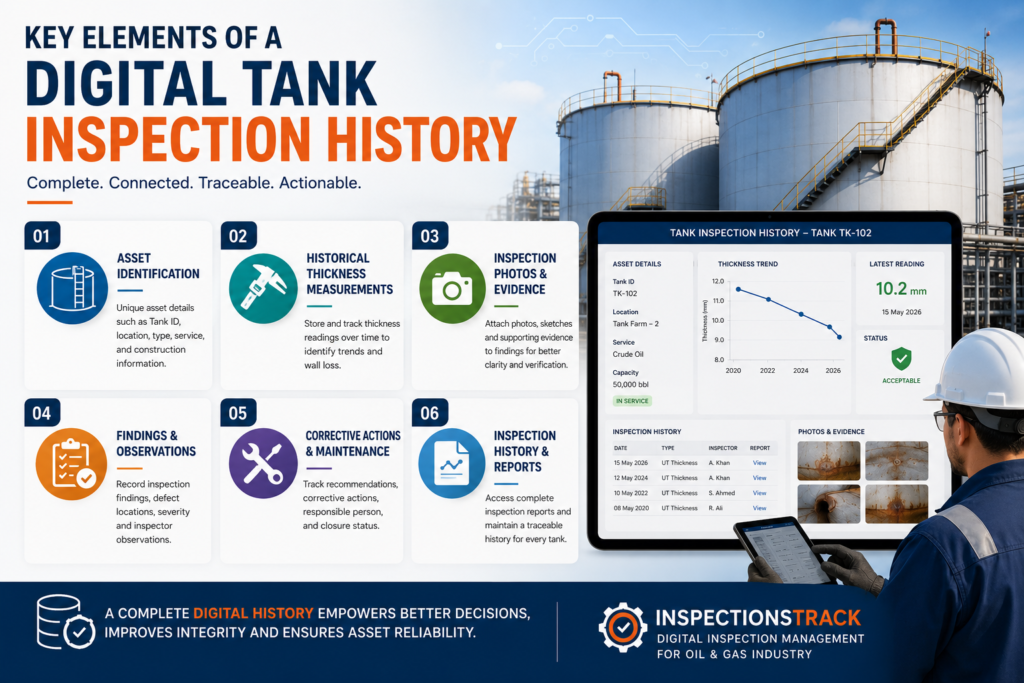
Every tank should have a consistent digital identity.
The record can include information such as:
This prevents inspection records from becoming disconnected from the asset they describe.
Thickness readings should be stored in a structured format rather than buried inside reports or spreadsheets.
Historical measurements make it easier to compare readings and identify potential corrosion trends.
Photos provide important visual evidence of corrosion, coating degradation, cracking, deformation, weld conditions, and other findings.
When photographs are linked directly to inspection records, inspectors and integrity teams can better understand the condition of an asset without searching through separate folders.
An inspection history should also show what happened after an issue was identified.
For example:
Finding → Recommendation → Corrective Action → Verification → Closure
This creates a stronger audit trail and helps prevent outstanding issues from being forgotten.
Traditional spreadsheets can still be useful for basic calculations. However, they become increasingly difficult to manage as inspection programs grow.
| Area | Spreadsheet-Based Process | Digital Inspection System |
|---|---|---|
| Asset history | Often spread across files | Centralized |
| Thickness trends | Manual comparison | Easier historical analysis |
| Photos | Separate folders | Linked to inspections |
| Findings | Manually tracked | Structured records |
| Corrective actions | Can be difficult to follow | Trackable |
| Reporting | Manual compilation | Faster digital reporting |
| Traceability | Depends on file management | Stronger asset-level history |
| Field access | Limited | Designed for digital workflows |
Therefore, the goal is not simply to replace paper with software. The goal is to create a connected inspection data lifecycle.
InspectionsTrack is designed to support digital inspection workflows across the oil and gas industry.
Instead of maintaining disconnected inspection documents, organizations can use a centralized platform to manage inspection information and improve visibility across their inspection processes.
For tank inspection programs, digital workflows can help teams capture inspection information consistently while maintaining a historical record for each asset.
The platform also supports a broader range of inspection requirements, including areas such as:
This broader approach can help organizations move toward a more connected digital inspection management system rather than managing individual inspection activities in isolation.
A practical digital inspection process can follow these steps:
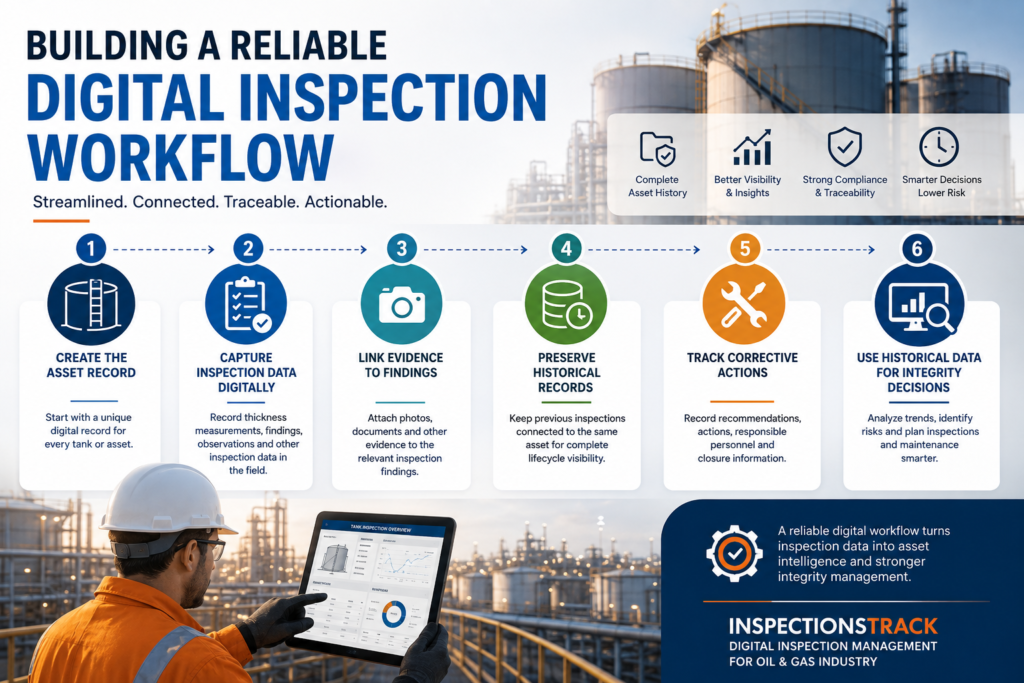
Start with a unique digital record for every tank or asset.
Record thickness measurements, findings, observations, and other inspection information directly within the inspection workflow.
Attach photographs and supporting evidence to the relevant inspection findings.
Keep previous inspections connected to the same asset so inspectors can review historical information.
Record recommendations, actions, responsible personnel, and closure information.
Finally, use accumulated inspection information to identify deterioration patterns and support maintenance and inspection planning.
The biggest advantage of a digital inspection history is not simply having more data.
It is having usable data at the right time.
When historical inspection records are structured and accessible, integrity teams can more easily identify recurring corrosion locations, compare thickness readings, investigate deterioration, and prioritize assets for further assessment.
Consequently, inspection data becomes part of the organization’s wider asset integrity management strategy.
Read more : Why Tank Inspection Data Gets Lost Between Field Inspections and Integrity Decisions
A digital inspection history is a structured record of an asset’s inspections, measurements, findings, photographs, recommendations, repairs, and other relevant information throughout its lifecycle.
Historical thickness readings help inspection and integrity teams identify changes over time. When multiple readings are compared, they can provide valuable information about potential wall loss and deterioration trends.
Digital inspection software can reduce dependence on spreadsheets by providing structured workflows, centralized records, reporting capabilities, and asset-level inspection histories.
A comprehensive tank inspection record may include thickness measurements, inspection findings, photographs, inspector observations, asset information, previous inspection data, recommendations, corrective actions, and closure records.
Digital inspection software can help oil and gas organizations standardize field data collection, improve traceability, centralize inspection records, accelerate reporting, and provide better visibility into asset condition.
A thickness reading is only one piece of the tank integrity puzzle. Its real value increases when it becomes part of a continuous, searchable, and traceable digital inspection history.
By connecting thickness measurements with inspection findings, photographs, corrective actions, and previous inspection records, oil and gas organizations can move from fragmented inspection documentation toward more informed asset integrity management.
With a platform such as InspectionsTrack, inspection teams can digitize oil and gas inspection workflows and build a stronger historical record for every asset helping turn field inspection data into information that supports better integrity decisions.
Ready to move beyond spreadsheets and disconnected inspection records? Explore how digital inspection management can help your oil and gas inspection program build a more complete asset history.
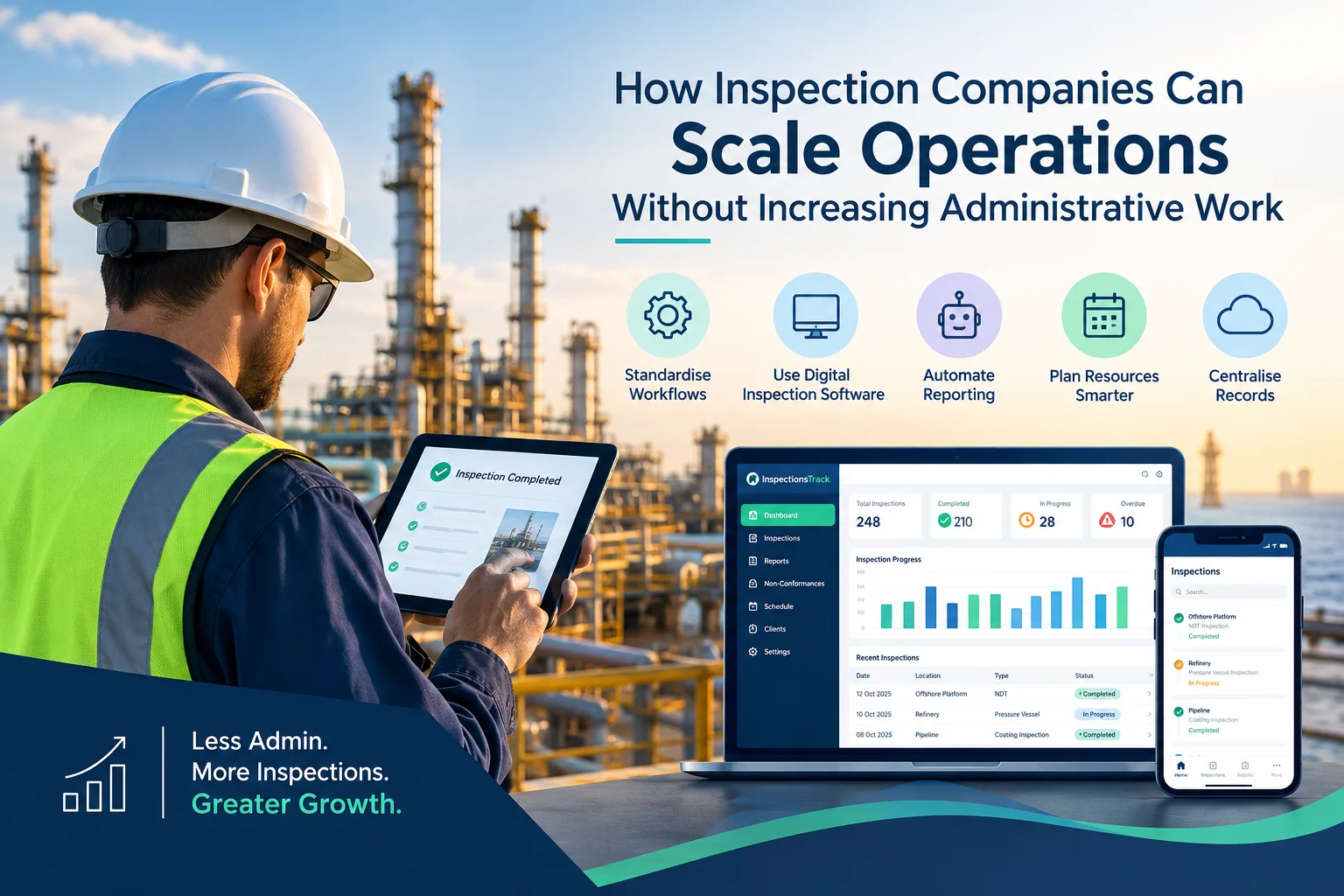
Inspection companies in the oil and gas industry face a common challenge: how to handle more inspections, manage larger projects, and meet client deadlines without increasing administrative workload. As businesses grow, inspection teams must manage…
Meeting client Service Level Agreements (SLAs) is essential for inspection companies working in demanding industries such as oil and gas, energy, and industrial maintenance. Clients expect inspections to be completed on time, reports to be…


Comment (1)
Digital Drill Pipe Inspection Records & Traceability - inspectionstrack
Aug 21, 2026[…] Read more : From Thickness Readings to Tank Integrity: Building a Digital Inspection History for Every Asset […]
Comments are closed.