
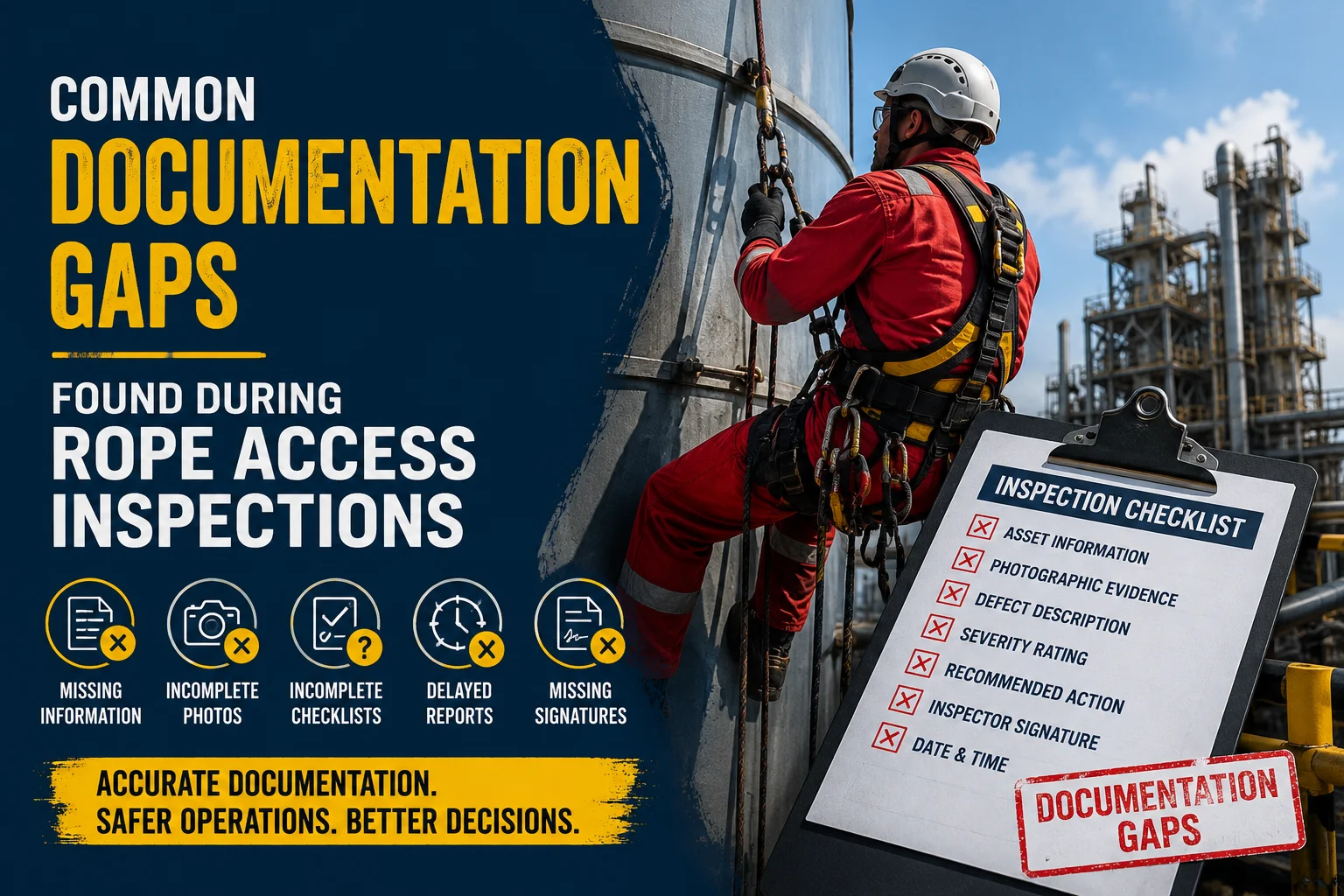
Rope access inspections play a critical role in maintaining offshore platforms, refineries, petrochemical plants, wind turbines, storage tanks, flare stacks, and other high-value industrial assets. While highly skilled technicians often perform these inspections efficiently, documentation mistakes continue to create significant operational and compliance risks.
In many cases, the inspection itself is completed correctly. However, missing photographs, incomplete checklists, inconsistent findings, or delayed reports reduce the value of the entire inspection process.
Therefore, organizations that rely on manual documentation frequently experience delayed maintenance decisions, failed audits, client dissatisfaction, and increased operational costs.
This guide explores the most common documentation gaps found during rope access inspections, explains why they occur, and demonstrates how digital inspection management software such as Inspections Track helps inspection companies eliminate these issues.
Unlike many ground-level inspections, rope access work is expensive, highly specialized, and often performed under limited access windows.
Because of this, every inspection visit must capture complete, accurate, and traceable information.
Proper documentation helps organizations:
Without reliable documentation, even the most detailed inspection loses much of its value.
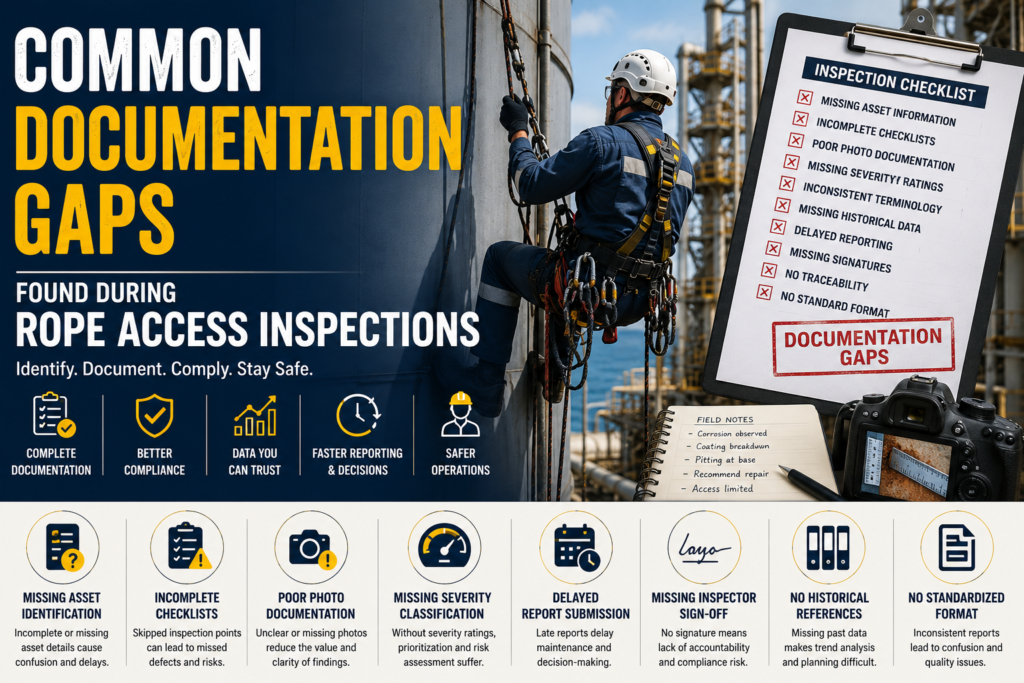
One of the most common issues involves inspectors documenting findings without clearly identifying the inspected asset.
Examples include:
As a result, maintenance teams struggle to determine exactly where defects exist.
Every inspection record should automatically include:
Many inspection teams still rely on paper forms.
Consequently, inspectors may accidentally skip important sections.
Typical omissions include:
Even experienced inspectors occasionally overlook required fields when working at height.
Digital checklists eliminate this problem by requiring mandatory fields before submission.
Inspection photographs often represent the strongest evidence during audits.
Unfortunately, documentation frequently suffers from:
Without visual evidence, engineering teams cannot confidently validate inspection findings.
Simply reporting corrosion or cracking is not enough.
Every defect should include:
Without standardized classifications, maintenance planning becomes inconsistent.
Different inspectors often describe identical defects using different language.
For example:
| Inspector A | Inspector B | Inspector C |
|---|---|---|
| Minor corrosion | Light corrosion | Surface corrosion |
Although these descriptions may refer to the same condition, inconsistent wording creates confusion during long-term asset analysis.
Therefore, organizations should use standardized inspection terminology across all inspection teams.
One inspection rarely tells the complete story.
Instead, engineers need historical comparisons such as:
Without historical data, trend analysis becomes difficult.
Many companies still spend days preparing inspection reports after fieldwork.
This creates several challenges:
Digital reporting significantly reduces these delays.
Inspection reports should always identify:
Without inspector accountability, compliance documentation becomes weaker.
Inspection records occasionally require updates.
However, organizations often fail to track:
Version history is essential for compliance and auditing.
Many inspection companies allow inspectors to create reports differently.
As a result:
Standard report templates solve this issue.
| Documentation Gap | Business Impact | Recommended Solution |
|---|---|---|
| Missing asset ID | Wrong maintenance planning | Digital asset management |
| Incomplete checklist | Missed inspection items | Mandatory digital forms |
| Poor photographs | Weak evidence | Photo validation |
| Missing severity ratings | Incorrect prioritization | Standard defect grading |
| Delayed reports | Slower maintenance | Automated reporting |
| No historical data | Poor trend analysis | Centralized inspection database |
| Missing signatures | Compliance risks | Digital approvals |
| Inconsistent terminology | Confusing reports | Standardized inspection templates |
Although paper forms have been used for decades, today’s inspection requirements demand much greater accuracy.
Manual documentation often leads to:
Consequently, many inspection companies are replacing manual workflows with digital inspection platforms.
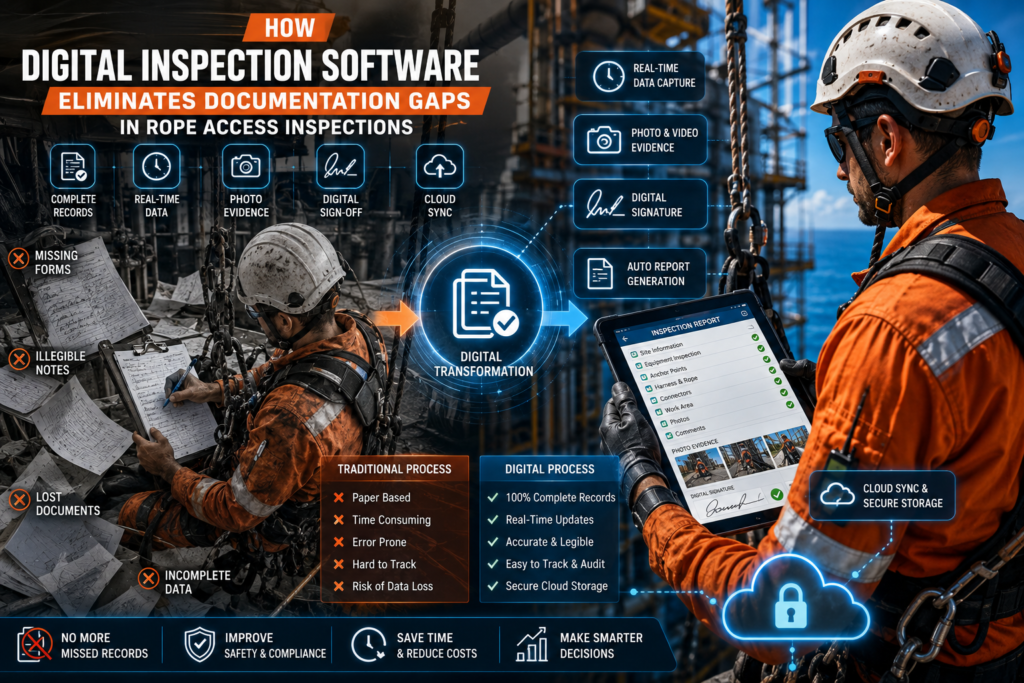
Modern inspection software automates documentation from the moment inspectors begin work.
Instead of relying on handwritten notes, inspectors capture structured digital data directly in the field.
Digital inspection platforms typically provide:
As a result, inspection quality improves while administrative effort decreases.
For inspection companies operating in the oil and gas industry, Inspections Track provides an end-to-end digital inspection management platform specifically designed for complex industrial inspections.
The software helps eliminate documentation gaps through:
Inspectors complete standardized digital forms that ensure every required inspection field is captured before submission.
Because offshore and remote facilities often have limited connectivity, inspectors can continue working offline. Once a connection becomes available, inspection data automatically synchronizes with the central system.
Every inspection is linked directly to the correct asset, providing complete traceability across the asset lifecycle.
Inspectors can attach high-resolution photographs, annotations, and supporting evidence directly within each inspection record.
Assets can be identified instantly using QR codes, reducing identification errors while improving inspection speed.
Instead of manually compiling reports, Inspections Track generates professional inspection reports automatically using predefined templates, reducing reporting time from hours to minutes.
Every inspection action is recorded, including:
This provides complete transparency during client audits and regulatory inspections.
Organizations should establish documentation standards before inspectors enter the field.
Recommended practices include:
Following these practices significantly improves documentation quality and regulatory compliance.
Industrial inspections continue to evolve through digital transformation.
Emerging technologies include:
Consequently, organizations that adopt digital inspection systems today will be better prepared for future compliance requirements.
Read more : Planning Multi-Discipline Rope Access Campaigns for Large Industrial Facilities
The most common issues include missing asset identification, incomplete checklists, poor photographic evidence, inconsistent terminology, delayed reports, missing signatures, and inadequate historical records.
Accurate documentation supports compliance, asset integrity, maintenance planning, engineering decisions, and successful regulatory audits.
Digital software standardizes inspection forms, enforces mandatory fields, captures photographs, stores inspection history, automates reports, and creates a complete audit trail.
Yes. Modern inspection platforms such as Inspections Track allow inspectors to capture inspection data offline and synchronize it automatically when connectivity is restored.
Industries include oil and gas, offshore drilling, petrochemical plants, refineries, wind energy, marine infrastructure, power generation, mining, and heavy industrial facilities.
Accurate documentation is just as important as the inspection itself. Even minor gaps such as missing asset IDs, incomplete checklists, poor photographic evidence, or delayed reports can lead to compliance issues, inefficient maintenance planning, and increased operational costs.
By replacing manual processes with a purpose-built digital solution like Inspections Track, oil and gas inspection companies can standardize documentation, improve data accuracy, accelerate report delivery, and maintain a complete audit trail. As industrial assets become more complex and compliance expectations continue to rise, investing in digital inspection management is no longer optional it is essential for safer, more efficient, and more reliable rope access inspection operations.
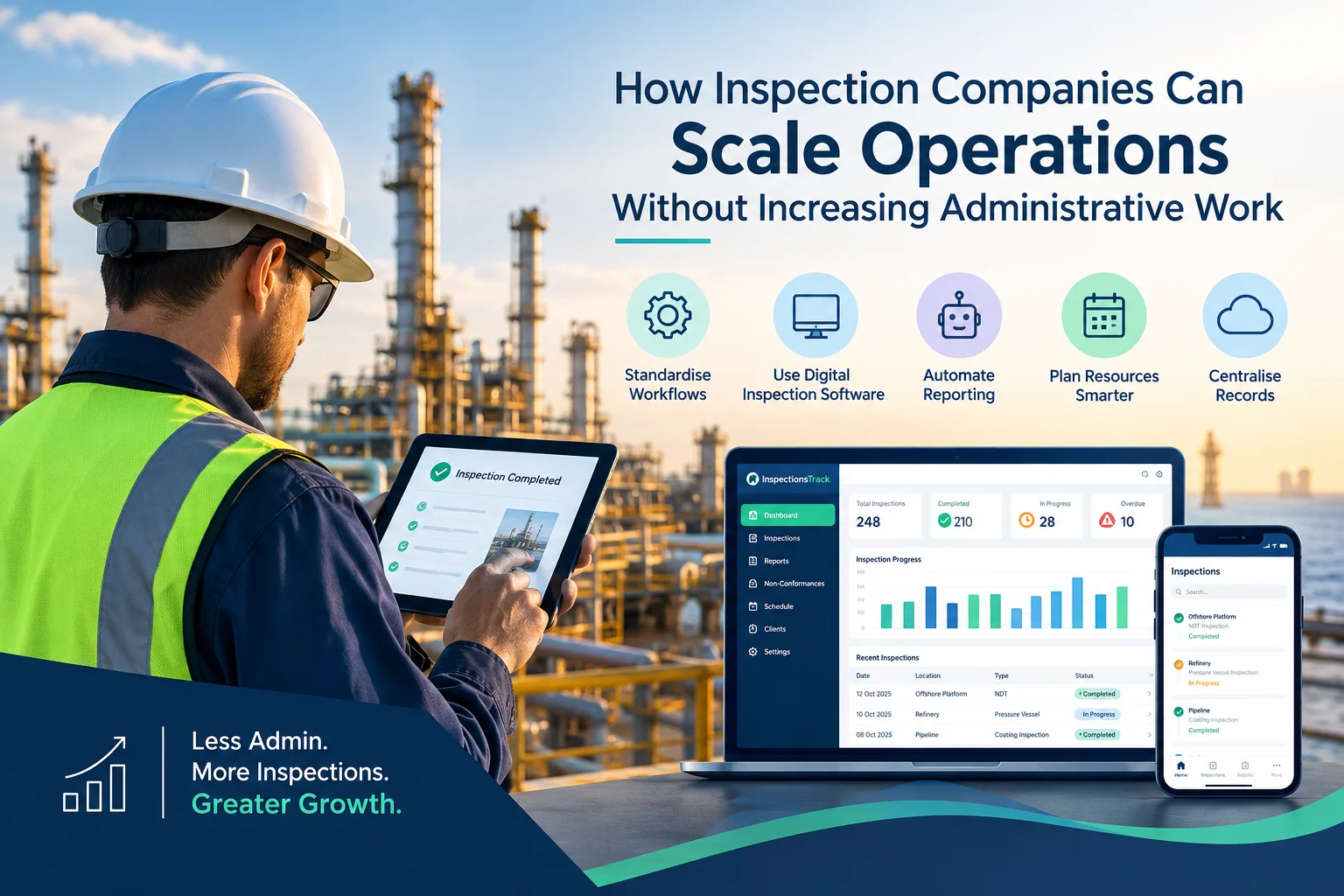
Inspection companies in the oil and gas industry face a common challenge: how to handle more inspections, manage larger projects, and meet client deadlines without increasing administrative workload. As businesses grow, inspection teams must manage…
Meeting client Service Level Agreements (SLAs) is essential for inspection companies working in demanding industries such as oil and gas, energy, and industrial maintenance. Clients expect inspections to be completed on time, reports to be…


