

Inspection data is only valuable when you can trust it.
In the oil and gas industry, inspection teams collect thousands of data points every year. These include asset condition, inspection findings, defect measurements, photographs, NDT results, equipment details, certificates, recommendations, and corrective actions.
However, collecting inspection data does not automatically make it reliable.
If information is incomplete, duplicated, outdated, poorly documented, or difficult to trace, it can lead to incorrect maintenance decisions, delayed reporting, compliance gaps, and unnecessary operational risk.
So, can you trust your inspection data?
The answer depends on how that data is collected, validated, stored, connected, and used.
This guide explains how oil and gas inspection teams can evaluate inspection data quality and build a more reliable inspection data management process.
Inspection data supports much more than an inspection report.
Operations teams use inspection information to understand asset condition, identify defects, prioritize maintenance, demonstrate compliance, and make decisions about equipment safety.
For example, a single inspection record may influence:
Therefore, poor-quality inspection data can create problems far beyond the inspection department.
Consider a pressure vessel inspection where the defect measurement is recorded incorrectly. If that information is later used to assess corrosion progression, the resulting maintenance decision may also be inaccurate.
Similarly, if inspection photographs are not connected to the correct asset or inspection record, an engineer may struggle to verify the original finding.
Reliable inspection data creates confidence. Unreliable inspection data creates uncertainty.
Trustworthy inspection data should be accurate, complete, consistent, traceable, timely, and accessible.
These qualities are closely connected.
For instance, data may be accurate when teams enter it, but it becomes less useful if nobody can identify the asset it belongs to. Likewise, complete information does not necessarily remain trustworthy if users cannot determine who collected it or when they collected it.
A reliable inspection data management system should provide clear answers to questions such as:
If your system cannot answer these questions easily, your inspection data may have reliability gaps.
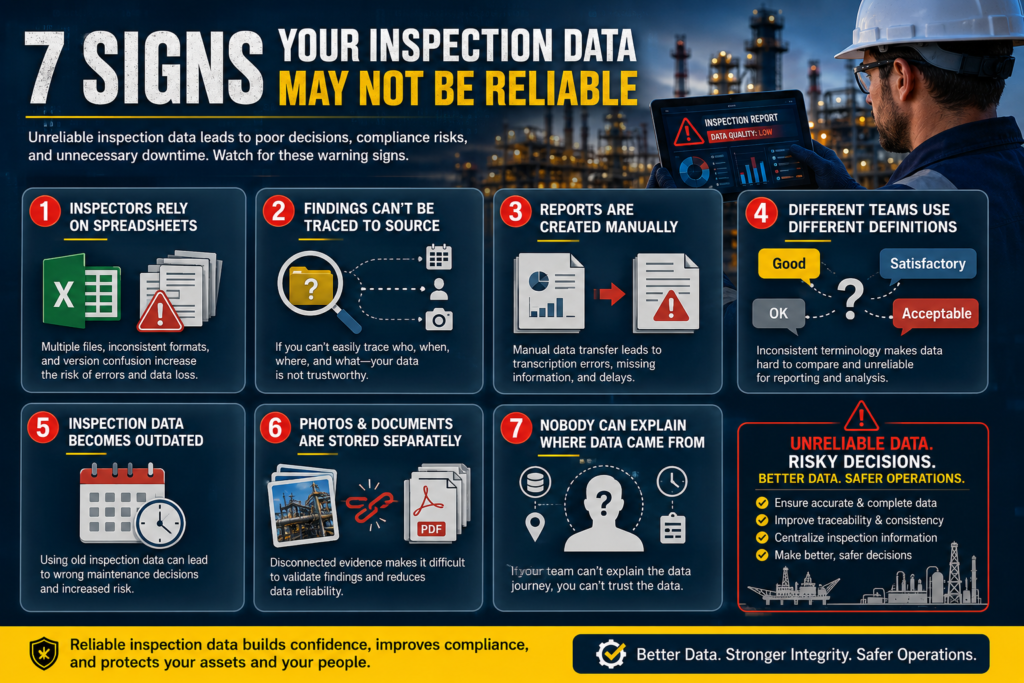
Excel remains useful for many business tasks. However, using spreadsheets as the primary system for managing complex inspection programs can introduce risks.
Files can be copied, renamed, overwritten, misplaced, or stored in different locations. Furthermore, different inspectors may use different formats or terminology.
As a result, your team may end up with multiple versions of the same inspection data.
Common warning signs include:
The problem is not necessarily Excel itself. The bigger issue is a lack of centralized inspection data management.
Traceability is one of the most important characteristics of trustworthy inspection data.
Suppose a report states that an asset has a critical defect.
Can your team quickly determine:
If answering these questions requires searching through emails, folders, spreadsheets, and PDFs, your data traceability is weak.
A strong inspection system should connect the finding with its supporting evidence.
Manual reporting can consume significant time.
An inspector may complete a field form, send information to an office team, wait for data entry, transfer information into a report template, insert photographs, check formatting, and then send the final report for review.
Every manual transfer creates another opportunity for error.
For example:
Field inspection → handwritten notes → spreadsheet → report template → PDF
This workflow can introduce:
The more often teams transfer data manually, the more opportunities they create to change or lose information.
Data consistency is another important indicator of quality.
Imagine that one inspector records an asset status as:
Good
Another uses:
Satisfactory
Another uses:
Acceptable
And another enters:
OK
A human can understand these terms. However, analytics and automated reporting systems may treat them as different values.
The same problem can occur with:
Standardized forms, predefined options, validation rules, and centralized asset records can significantly improve consistency.
Inspection data has a useful life.
An inspection record may accurately describe an asset at the time it was inspected. However, the asset’s condition can change afterward.
Therefore, inspection teams need to know:
What is the latest inspection status of this asset?
A reliable system should make it easy to see:
Without this visibility, teams may make decisions using outdated information.
Inspection evidence is extremely important.
Photographs, certificates, NDT results, measurements, drawings, and supporting documents can help validate inspection findings.
However, storing these files separately from the inspection record can make it difficult to find the correct evidence.
For example, imagine having folders containing hundreds of photographs named:
Which image belongs to which asset?
Which one supports the reported defect?
Without proper association between evidence and inspection records, the value of the data decreases.
A trustworthy inspection record should have a clear history.
You should be able to determine:
Who → What → When → Where → How → Result → Action
This is particularly important during audits and compliance reviews.
If an auditor asks for evidence supporting an inspection finding, your team should not have to spend hours searching through multiple systems.
Instead, the information should be available through a structured inspection record.
You do not necessarily need to replace your entire inspection process immediately.
Start by evaluating your existing data against several key quality dimensions.
Ask whether the information correctly represents the actual asset condition.
Check:
Accuracy is the foundation of useful inspection data.
Incomplete records can make otherwise accurate information less useful.
For example, an inspection report might contain a defect description but no photograph, measurement, location, or recommended action.
Create mandatory fields for information that inspectors must provide.
Depending on the inspection type, these may include:
Inspection data should follow standardized structures.
For example, your organization should define how teams record assets, inspection statuses, defect categories, and risk levels.
A consistent structure makes it easier to compare inspections across:
It also makes reporting and analytics more reliable.
Every important inspection finding should be traceable to its source.
A strong traceability model looks like this:
Asset → Inspection → Finding → Evidence → Recommendation → Corrective Action → Closure
This creates a complete inspection history.
It also makes future inspections more valuable because inspectors can review historical findings instead of starting from scratch.
Data should be available when decision-makers need it.
If an inspection takes place on Monday but the final report is not available until Friday, the organization may be working with incomplete information for several days.
Faster data capture and automated reporting can reduce this gap.
Reliable data should also be easy to find.
If your team needs to search through:
just to find one inspection record, your information may technically exist but still be difficult to use.
Centralized inspection data makes information much more accessible.
You can use the following framework to evaluate your current inspection data process.
| Data Quality Area | Key Question | Warning Sign |
|---|---|---|
| Accuracy | Is the information correct? | Frequent corrections |
| Completeness | Are required fields populated? | Missing measurements/photos |
| Consistency | Is data recorded uniformly? | Different naming formats |
| Traceability | Can findings be traced to evidence? | Manual file searches |
| Timeliness | Is data available quickly? | Reporting delays |
| Accessibility | Can teams find records easily? | Multiple storage locations |
| Security | Is access controlled? | Unmanaged shared files |
| History | Can previous inspections be reviewed? | No centralized asset history |
| Action Tracking | Can recommendations be followed? | Open actions lost in emails |
| Reporting | Can reports be generated efficiently? | Heavy manual formatting |
The more warning signs you identify, the more likely it is that your inspection data process needs improvement.
Digital inspection software can help standardize the entire inspection lifecycle.
Instead of moving information between multiple disconnected tools, teams can capture inspection data directly within a structured workflow.
A modern inspection platform can provide:
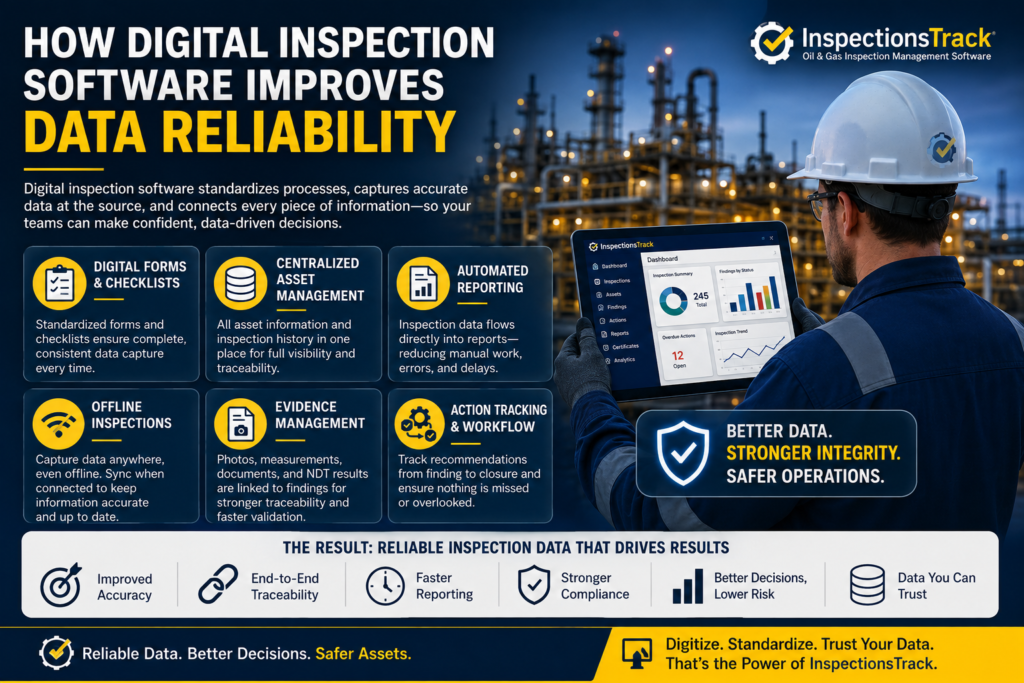
Inspectors can use standardized digital forms instead of relying on inconsistent paper documents or spreadsheets.
This helps ensure that important information is captured during the inspection.
Each asset can have a structured inspection history.
Teams can then review previous inspections, findings, certificates, and maintenance-related information from a centralized environment.
Inspection data can flow directly into reports.
This reduces manual transcription and allows teams to generate reports faster.
Offshore and remote environments do not always provide reliable internet connectivity.
Offline inspection functionality allows inspectors to continue collecting data and synchronize information when connectivity becomes available.
Teams can associate photographs, findings, measurements, and supporting documentation with inspection records.
Consequently, teams can improve traceability and reduce time spent searching for evidence.
For oil and gas inspection companies, InspectionsTrack provides a centralized SaaS platform for managing inspection activities, assets, findings, reports, and related inspection information.
The platform helps inspection and asset integrity teams manage NDT, DROPS, LGI, drill pipe inspections, derrick surveys, cranes and winches, EX surveys, helideck inspections, tank inspections, pressure gauge calibration, and planned and audit inspections.
Instead of treating each inspection as an isolated document, InspectionsTrack can help organizations build a connected inspection data workflow.
A typical digital workflow can look like:
Plan Inspection → Select Asset → Complete Digital Checklist → Capture Findings → Add Evidence → Review Results → Generate Report → Track Actions → Maintain Inspection History
This approach helps reduce unnecessary manual data movement.
Furthermore, structured inspection information can make it easier for teams to identify recurring issues and monitor asset condition over time.
One inspection tells you about an asset at a particular point in time.
Multiple inspections tell you a story.
For example, consider corrosion measurements recorded during several inspection cycles:
| Inspection | Corrosion Measurement | Observation |
|---|---|---|
| 2023 | 2.8 mm | Initial observation |
| 2024 | 2.5 mm | Change identified |
| 2025 | 2.2 mm | Continued degradation |
| 2026 | 1.9 mm | Further reduction |
When teams structure and connect historical data, they can identify trends instead of simply reviewing individual reports.
This can support better maintenance planning and asset integrity decisions.
However, the quality of the conclusion depends on the quality of the underlying data.
Bad data produces bad trends. Reliable historical data produces more meaningful insights.
Improving inspection data quality does not have to happen overnight.
Start with the fundamentals.
Create standardized forms and checklists for recurring inspection types.
Avoid allowing every inspector or department to create its own format.
Each asset should have a unique and consistent identifier.
This prevents inspection information from becoming disconnected from the equipment it describes.
Do not rely entirely on inspectors remembering every required field.
Use structured forms and mandatory fields for critical information.
Whenever possible, inspectors should enter information directly into the inspection system.
This reduces unnecessary transcription between paper, spreadsheets, emails, and reports.
Photos, measurements, documents, and other evidence should remain connected to the relevant inspection and asset.
This improves traceability.
The final report should be generated from the inspection data whenever possible.
This reduces repetitive administrative work and minimizes transcription errors.
An inspection should not end when you issue the report. If a finding requires action, the workflow should continue until the team completes and verifies the action.
A useful process is:
Finding → Recommendation → Assigned Action → Due Date → Status → Verification → Closure
Inspection data quality should be monitored continuously.
Track indicators such as:
This allows organizations to identify problems before they become larger operational issues.
More data does not necessarily mean better data.
An inspection organization might collect thousands of records every year. Yet, if those records contain inconsistent asset IDs, missing measurements, disconnected photographs, and incomplete findings, the volume does not create meaningful value.
The goal should therefore be:
Better data, not simply more data.
High-quality inspection data allows teams to move from documentation to decision-making.
Before using inspection information for important operational decisions, ask these questions:
If several answers are “no,” your inspection data probably needs a stronger management process.
Inspection teams are moving beyond simple digital forms.
The next stage connects inspection data to support:
However, these capabilities depend on a reliable data foundation.
AI and analytics cannot magically fix poor inspection information.
If inspection data is incomplete, inconsistent, or disconnected, advanced analytics may simply produce faster versions of unreliable conclusions.
Therefore, organizations should first build a strong inspection data foundation.
Then, they can use automation, analytics, and AI more effectively.
The answer is not simply about whether your inspection software is digital.
It’s about controlling your entire inspection data lifecycle.
If the answer to these questions is yes, your organization is moving toward a more reliable inspection data environment.
For oil and gas inspection companies, platforms such as InspectionsTrack can help bring inspection forms, asset information, findings, evidence, reporting, certificates, and inspection workflows into a more connected digital process.
Ultimately, trustworthy inspection data is not just about better reports.
It is about giving inspection teams, asset integrity professionals, compliance managers, and operations leaders the confidence to make decisions based on information they can actually verify.
Because when inspection data supports critical decisions, “probably accurate” is not good enough.
Read more : How Offshore Inspection Teams Can Eliminate Reporting Bottlenecks
Inspection data quality refers to how accurate, complete, consistent, timely, traceable, and accessible inspection information is. High-quality data provides a reliable foundation for asset integrity, maintenance, compliance, and operational decisions.
Inspection data helps oil and gas organizations understand equipment condition, identify defects, plan maintenance, manage risks, demonstrate compliance, and monitor asset integrity over time.
Use standardized digital inspection forms, mandatory fields, validation rules, unique asset IDs, structured data capture, and centralized inspection records. Reducing manual transcription can also help minimize errors.
InspectionsTrack supports oil and gas inspection workflows across NDT, DROPS, LGI, drill pipe, derricks, cranes and winches, EX surveys, helidecks, tanks, pressure equipment, planned inspections, and audits. It provides tools for digital inspection forms, asset management, reporting, certificates, corrective actions, and inspection data management.
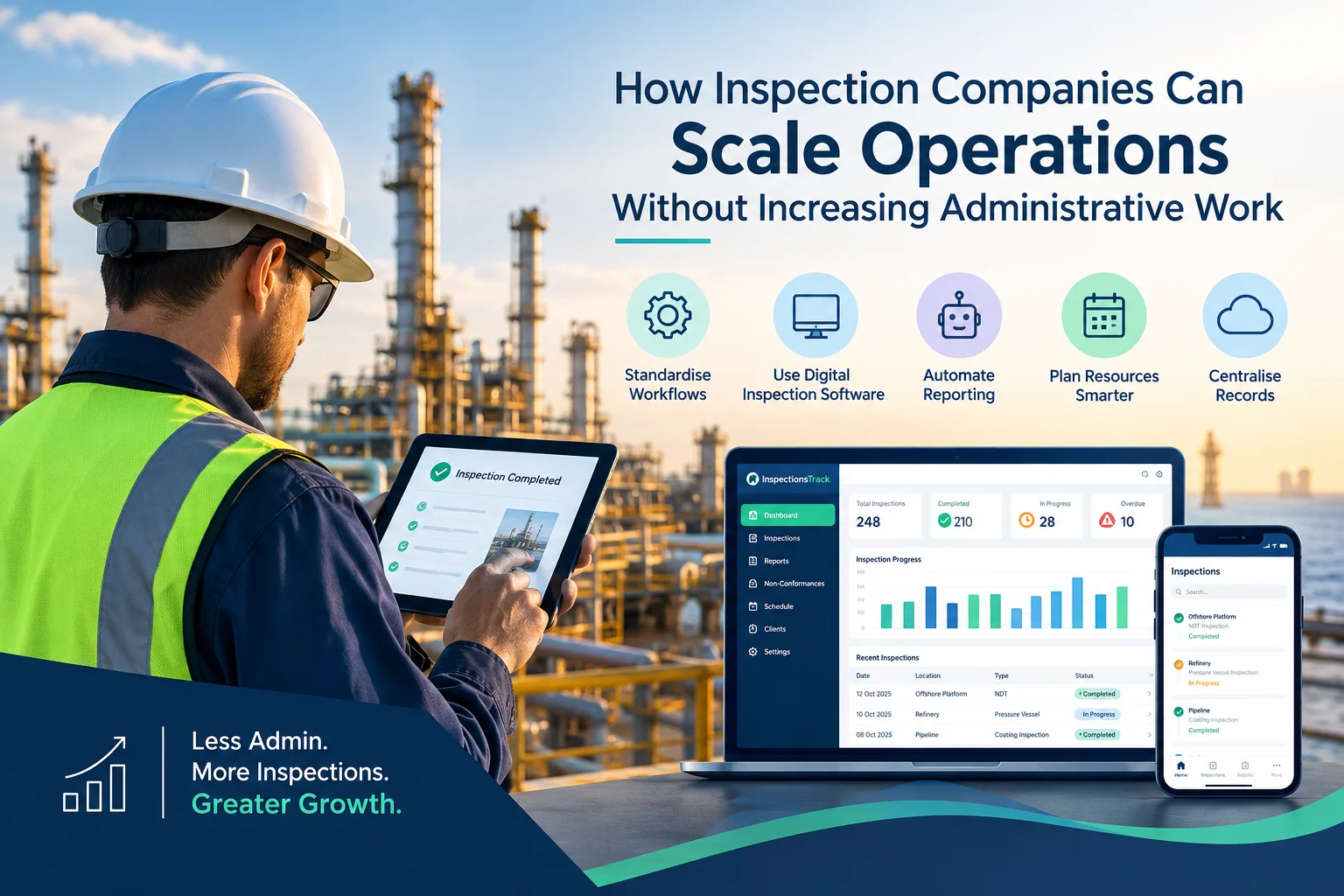
Inspection companies in the oil and gas industry face a common challenge: how to handle more inspections, manage larger projects, and meet client deadlines without increasing administrative workload. As businesses grow, inspection teams must manage…

Meeting client Service Level Agreements (SLAs) is essential for inspection companies working in demanding industries such as oil and gas, energy, and industrial maintenance. Clients expect inspections to be completed on time, reports to be…


Comment (1)
Digital Chain of Custody for Drill Pipe Inspection Data - inspectionstrack
Aug 18, 2026[…] Read more : Can You Trust Your Inspection Data? Here Is How to Tell […]
Comments are closed.