
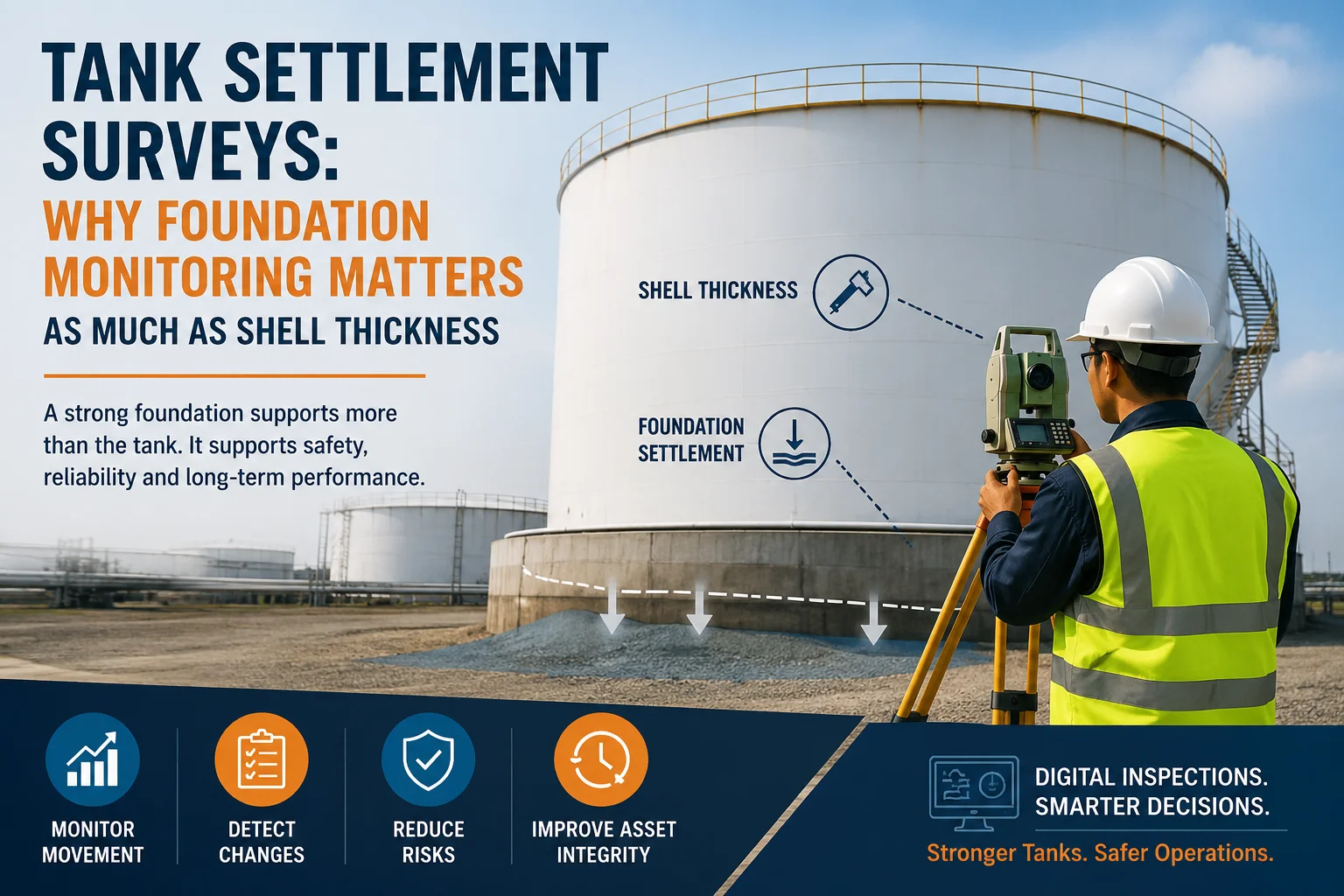
When inspecting an aboveground storage tank, shell thickness often gets the most attention. Inspectors measure corrosion, identify thinning areas, and compare results against minimum wall thickness requirements.
However, tank integrity depends on more than shell thickness.
A tank can have acceptable shell thickness and still face serious structural concerns if its foundation has settled unevenly. That is why tank settlement surveys and foundation monitoring should form an important part of an overall storage tank inspection program.
By monitoring settlement over time, operators can identify changes in tank geometry, foundation movement, and potential structural risks before they develop into costly failures.
A tank settlement survey is a dimensional inspection used to determine whether an aboveground storage tank has moved or settled relative to its original or established reference points.
The survey typically measures elevation at multiple locations around the tank perimeter. Inspectors then compare the measurements to previous surveys to determine whether settlement is:
The goal is not simply to determine whether a tank has moved. Instead, the survey helps engineers understand how the tank foundation is behaving and whether the movement could affect tank integrity.
Storage tanks transfer significant loads to their foundations. Therefore, changes in soil conditions, groundwater, drainage, construction activity, or foundation performance can influence tank geometry.
For example, differential settlement can cause different parts of the tank bottom and shell to move by different amounts. Consequently, the shell may experience additional stresses even when ultrasonic thickness measurements show acceptable wall thickness.
This creates an important distinction:
Shell thickness tells you about material loss. Settlement monitoring tells you about structural movement.
Both provide different pieces of the tank integrity picture.
Tank settlement can result from several factors, including:
Because these conditions can change throughout the tank’s service life, periodic monitoring provides valuable historical information.
Shell thickness inspection and settlement surveys answer different questions. Therefore, they should not be treated as competing inspection methods.
| Inspection Activity | What It Evaluates | Typical Information |
|---|---|---|
| Ultrasonic Thickness Testing (UT) | Shell material thickness | Corrosion and wall thinning |
| Visual Inspection | Visible condition | Cracks, deformation, corrosion and damage |
| Tank Settlement Survey | Foundation movement | Elevation changes and settlement patterns |
| Bottom Inspection | Tank floor condition | Corrosion, pitting and damage |
| Vacuum Box Testing | Bottom weld integrity | Potential leaks in weld areas |
| Dimensional Survey | Tank geometry | Deformation and dimensional changes |
Together, these techniques provide a more complete understanding of aboveground storage tank integrity.
Differential settlement occurs when different areas of a tank foundation settle by different amounts.
This is particularly important because a tank does not necessarily need to experience large overall movement before problems develop.
For example, imagine a tank where one section of the foundation settles significantly more than another. The resulting change in geometry can introduce stresses into the shell, bottom, annular plate, or connected piping.
Depending on the severity and location of the movement, differential settlement can contribute to:
Therefore, tank foundation monitoring can provide an early indication that deserves further engineering assessment.
A typical settlement survey establishes measurement points around the tank circumference. Survey equipment is then used to determine the elevation of each point.
The process generally includes:
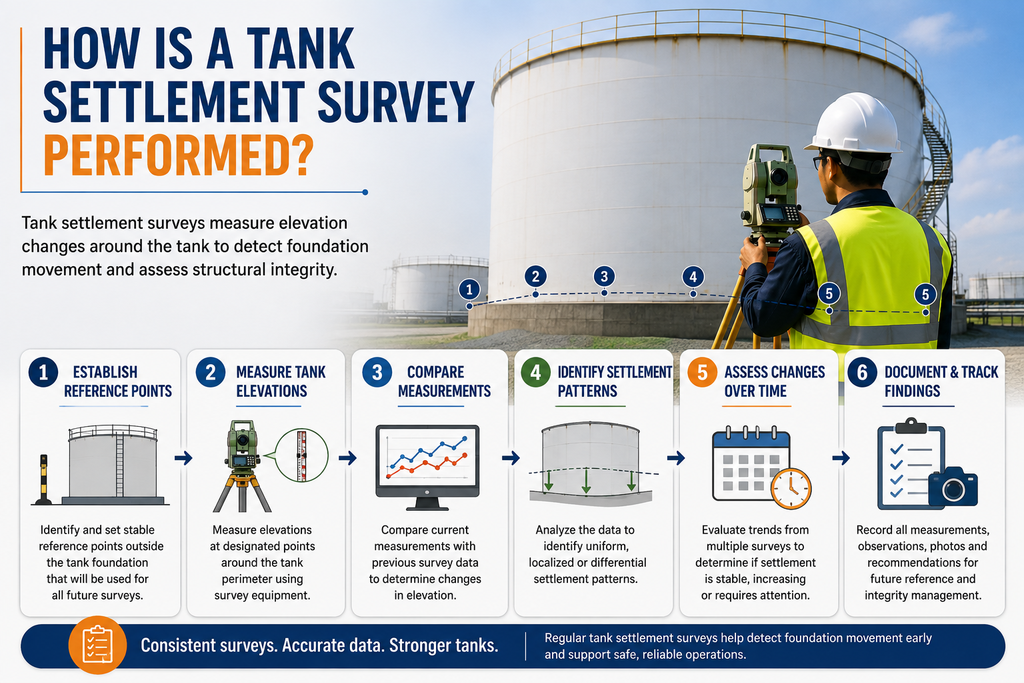
Inspectors establish suitable reference points that can be used consistently during future surveys.
Elevation readings are collected around the tank perimeter according to the inspection plan and applicable engineering requirements.
Current readings are compared with previous survey data where historical information exists.
Engineers review the results to determine whether movement appears uniform, localized, or differential.
Repeated surveys are especially valuable because they can show whether settlement is stable or continuing.
Finally, inspection teams record measurements, observations, calculations, photographs, and recommendations for future reference.
A single survey provides a snapshot.
However, a series of surveys creates a settlement history.
This distinction is important because not every measured elevation difference indicates an immediate structural problem. Instead, engineers often need to understand the rate, pattern, and progression of settlement.
For example:
Survey 1 → Survey 2 → Survey 3 → Survey 4
This sequence can help reveal whether:
As a result, maintaining historical inspection records can significantly improve asset integrity decision-making.
A structured inspection program should capture more than the final settlement value.
Useful data can include:
This information becomes much more useful when inspection teams can compare it across multiple inspection cycles.
Foundation monitoring should not operate in isolation.
Instead, settlement results can be reviewed alongside other inspection findings, such as shell thickness measurements, bottom condition, weld inspections, visual observations, and piping assessments.
For example:
Settlement increase + shell deformation + piping displacement
may warrant a different engineering review than:
Stable settlement + acceptable shell thickness + no visible deformation.
Therefore, combining inspection data can provide better context for asset integrity decisions.
Traditional inspection programs often rely on spreadsheets, paper reports, individual files, and manually maintained inspection histories.
Over time, this can make it difficult to answer basic questions such as:
This is where digital inspection management can help.
InspectionsTrack is an inspection management software suite designed for oil & gas and industrial inspection operations.
It can help inspection teams manage inspection activities, records, reports, assets, photographs, documents, and historical information within a centralized digital workflow.
For tank inspection programs, a digital system can help teams organize:
Because inspection information stays connected to the asset record, teams can build a clearer history of tank condition over time.
With a digital inspection workflow, inspectors can collect information in the field and synchronize it with the wider inspection system.
InspectionsTrack supports Windows Desktop, Android Mobile, and Web Portal workflows, including online and offline inspection capabilities.
This is particularly useful for oil & gas inspection teams working at remote facilities where reliable connectivity may not always be available.
The workflow can look like:
Plan Inspection → Perform Field Inspection → Record Findings → Attach Evidence → Review → Generate Report → Maintain Asset History
Consequently, inspection teams can reduce manual data handling while keeping inspection information easier to retrieve.
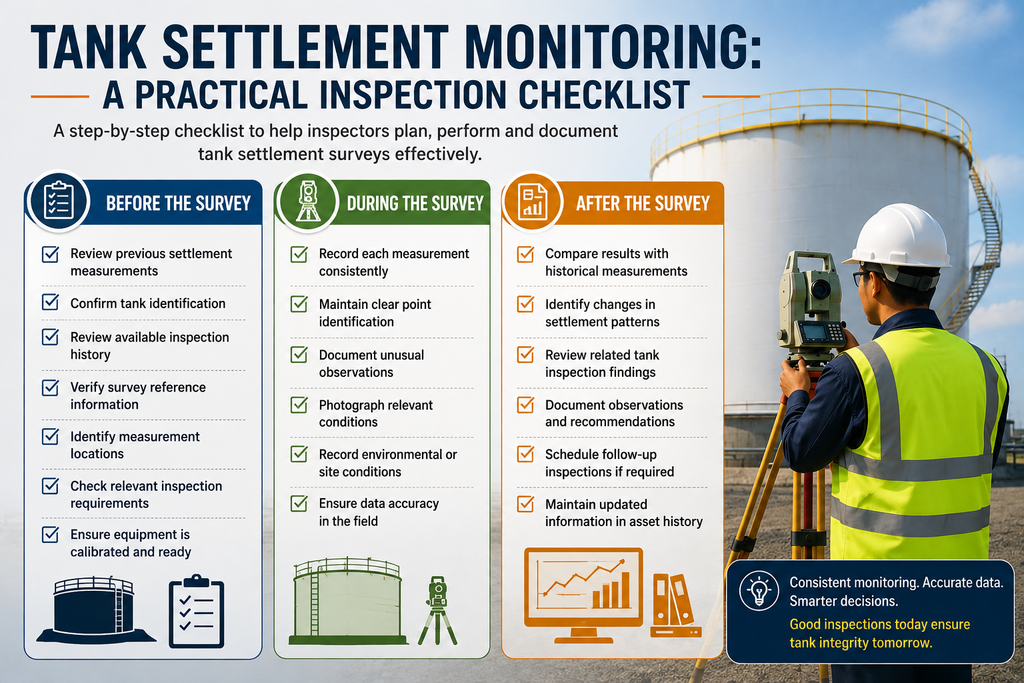
When planning a tank settlement monitoring program, consider the following:
Read more : Derrick Load Rating Recertification: When Do You Actually Need One?
The appropriate frequency depends on the tank, foundation conditions, operating environment, previous inspection results, applicable standards, and engineering assessment. Tanks with known settlement concerns may require closer monitoring than tanks with stable historical results.
Tank settlement concerns movement or deformation of the tank and its foundation, while shell corrosion concerns loss of metal thickness. Both can affect tank integrity, but they represent different inspection concerns.
Yes. Acceptable shell thickness does not by itself confirm that the foundation, tank geometry, bottom, or connected piping are free from other integrity concerns. Settlement monitoring therefore provides complementary information.
Digital inspection systems can be used to maintain asset records, inspection findings, measurements, photographs, reports, and historical information. A system such as InspectionsTrack can help inspection organizations centralize this information within their wider inspection workflow.
Tank settlement surveys are an important part of a comprehensive storage tank integrity program.
Shell thickness inspections help identify corrosion and material loss. However, foundation monitoring provides a different perspective by showing how the tank and its supporting foundation are changing over time.
Most importantly, repeated settlement measurements create a historical record. When combined with shell inspections, bottom assessments, visual inspections, piping observations, and other integrity data, that history can help inspection teams identify changes that deserve further assessment.
For oil & gas inspection companies, moving this information from disconnected spreadsheets and paper records into a centralized digital inspection workflow can also make historical data easier to manage.
With InspectionsTrack, inspection teams can connect field inspections, asset records, reports, photographs, checklists, and historical information within one inspection management platform.
Better tank integrity starts with looking beyond the shell.

Missed and overdue inspections can create more than scheduling problems. In the oil and gas industry, delayed inspections can affect equipment availability, compliance records, maintenance planning, and operational visibility. For inspection companies managing multiple assets,…
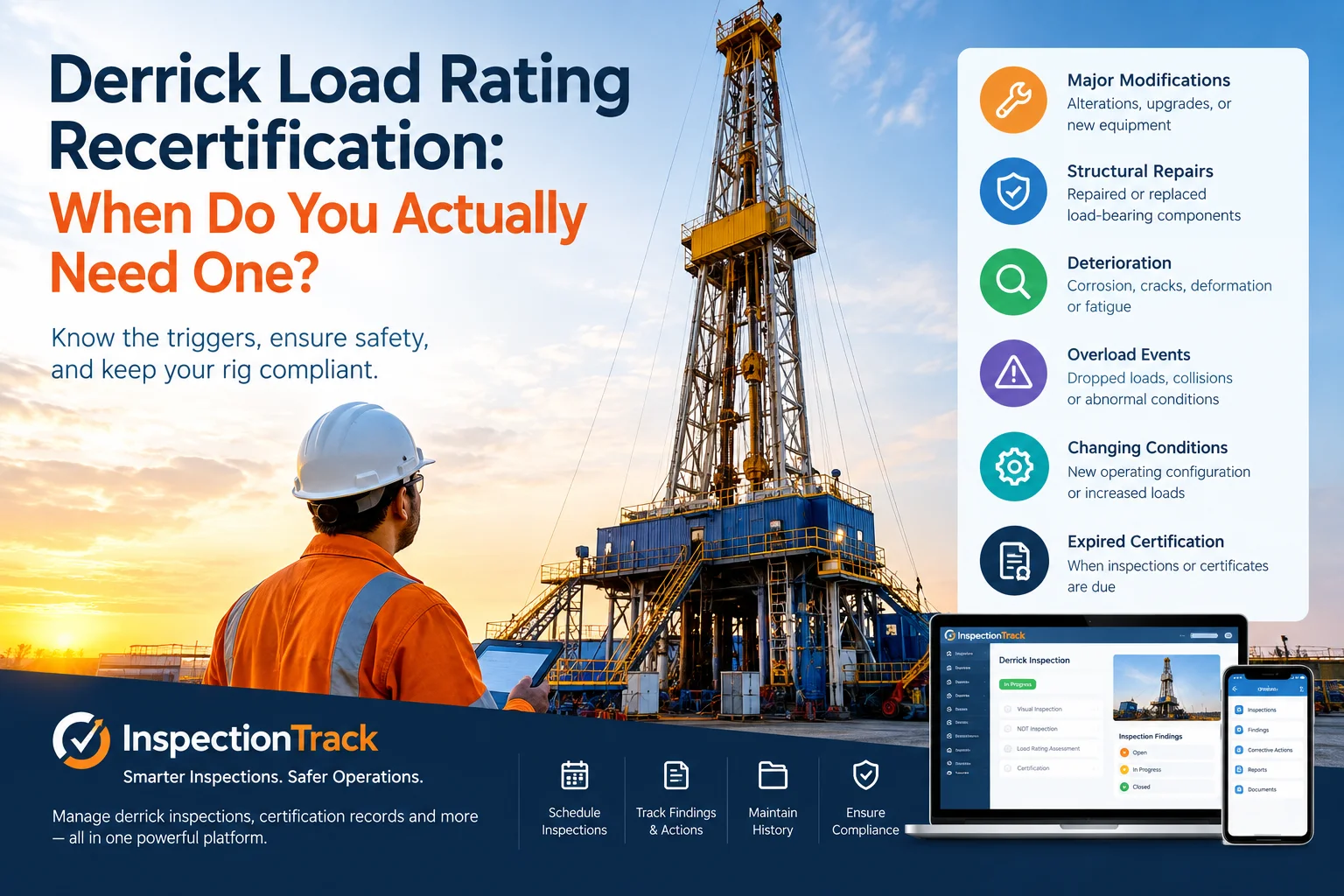
A drilling rig derrick operates under demanding loads and harsh conditions. Therefore, confirming its structural integrity and rated capacity is essential for safe drilling operations. But how often does a derrick need to be recertified?…


Comment (1)
Inspection Scheduling Software: Prevent Overdue Inspections - inspectionstrack
Sep 18, 2026[…] Read more : Tank Settlement Surveys: Why Foundation Monitoring Matters as Much as Shell Thickness […]
Comments are closed.