
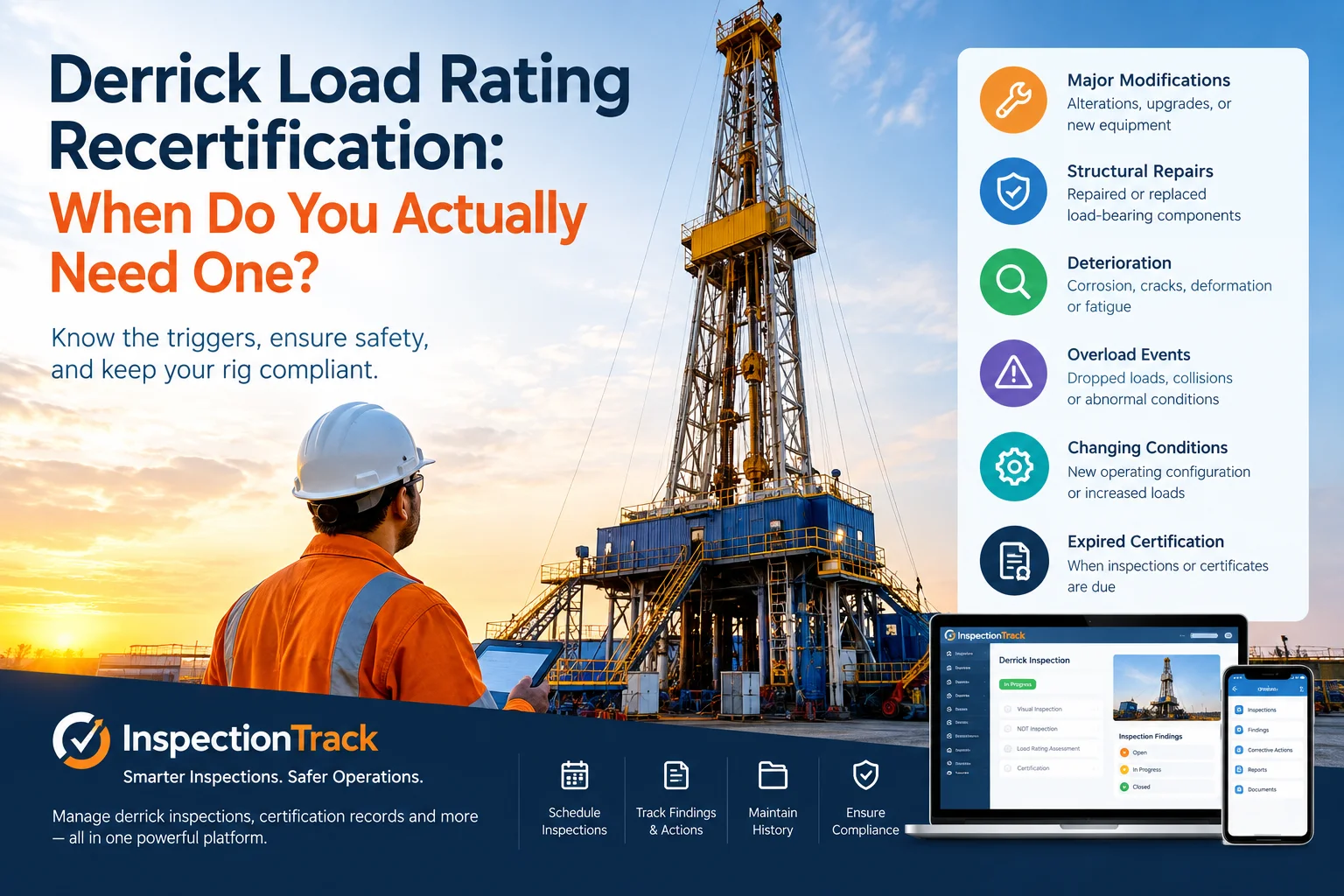
A drilling rig derrick operates under demanding loads and harsh conditions. Therefore, confirming its structural integrity and rated capacity is essential for safe drilling operations.
But how often does a derrick need to be recertified? More importantly, when is derrick load rating recertification actually required?
The answer depends on several factors, including the derrick’s condition, modifications, operating requirements, inspection history, manufacturer recommendations, and applicable industry standards or regulations.
This guide explains when you may need a derrick load rating recertification, what can trigger a reassessment, and how digital inspection software can help you manage derrick inspection and certification records more effectively.
Derrick load rating recertification is the process of verifying that a derrick remains capable of safely supporting its specified loads.
A competent inspection or engineering team typically reviews the derrick’s structural condition, documentation, previous inspection results, modifications, and applicable load requirements. Depending on the circumstances, the assessment may also involve engineering calculations, non-destructive testing (NDT), load testing, or other verification methods.
The goal is simple:
Confirm that the derrick’s current condition and configuration support its intended rated capacity.
It is important to remember that recertification is not simply a routine visual inspection. Instead, it is a broader assessment of whether the derrick remains suitable for its intended operating conditions.
There is no single universal trigger that applies to every drilling rig. However, several situations commonly justify a load rating review or recertification.
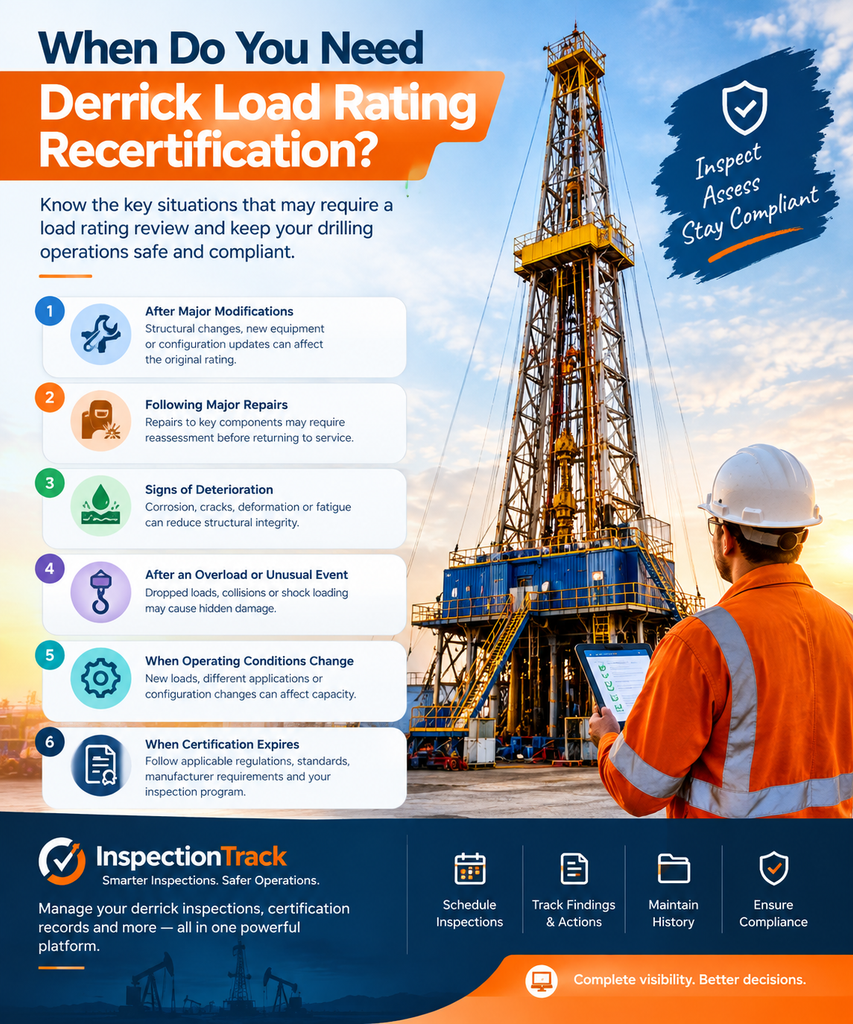
If significant changes have been made to the derrick, its original load rating may no longer automatically apply.
Examples include:
In these situations, an engineering review can determine whether the existing rating remains valid.
A major repair can also trigger the need for reassessment.
For example, repairs involving damaged legs, braces, girts, welds, connections, or other load-bearing components may affect the derrick’s structural capacity.
Therefore, simply completing the repair is not always enough. The repaired structure may need to be inspected, tested, and evaluated before the derrick returns to service.
Oil and gas equipment operates in challenging environments. Corrosion, fatigue, cracking, deformation, and mechanical damage can develop over time.
Common warning signs include:
If inspection findings raise concerns about structural integrity, a detailed engineering assessment may be necessary.
A derrick that has experienced an overload, dropped load, collision, severe shock loading, or other abnormal event should not simply return to normal operation without appropriate assessment.
The event may have caused damage that is not immediately visible.
Consequently, a post-event inspection and engineering evaluation can help determine whether the derrick’s load rating remains appropriate.
Operating conditions matter.
For example, a rig may be moved to a different application or configured to handle different loads. Additional equipment can also change the loading conditions.
Before increasing the operating load or changing the intended configuration, companies should verify that the derrick is suitable for the new requirements.
Many oil and gas operators work with scheduled inspection and certification programs.
If a required certification has expired, the asset may need to undergo the appropriate inspection or assessment before it can continue operating.
However, the exact frequency should come from the applicable regulatory requirements, recognized standards, manufacturer instructions, and the operator’s inspection program rather than relying on a generic interval.
These terms are related, but they are not necessarily the same thing.
| Activity | Primary Purpose | Typical Focus |
|---|---|---|
| Visual inspection | Identify visible defects | Corrosion, cracks, deformation, damage |
| NDT inspection | Detect hidden or surface defects | Welds, cracks, material condition |
| Structural assessment | Evaluate structural integrity | Components, connections, engineering calculations |
| Load test | Verify performance under specified conditions | Load response and equipment behavior |
| Load rating recertification | Confirm continued rated capacity | Current condition, configuration and capacity |
A routine derrick inspection may identify a problem that then leads to a more detailed engineering assessment or recertification.
Therefore, not every inspection automatically means the derrick needs a new load rating certificate.
The exact scope depends on the derrick type, inspection requirements, and reason for the assessment. However, an assessment may consider:
Inspectors may examine:
The assessment can also consider:
Historical information is equally important. Inspectors and engineers may need access to:
This is why maintaining accurate inspection records is just as important as performing the physical inspection.
There is no single universal recertification period for every derrick.
The required interval can depend on:
For this reason, companies should avoid using an arbitrary “every X years” rule without checking the requirements applicable to their equipment and location.
Instead, establish a documented inspection and certification schedule based on the relevant requirements and risk profile.

A load rating review deserves attention if you notice one or more of the following:
These conditions do not automatically mean recertification is required. However, they are strong reasons to investigate further.
Derrick certification involves more than the inspection itself.
Oil and gas companies must also manage inspection schedules, findings, photographs, reports, certificates, corrective actions, and historical records.
When these records are spread across spreadsheets, emails, PDFs, and paper files, important information can become difficult to track.
That’s where dedicated inspection management software can help.
InspectionTrack is an oil and gas inspection management platform designed to help organizations manage inspection workflows and equipment records digitally.
For derrick inspection programs, a centralized system can help teams:
InspectionTrack can also support broader oil and gas inspection programs, including DROPS, NDT, cranes and winches, drill pipe, tanks, pressure relief valves, EX inspections, helidecks, rope access, and other inspection workflows.
The advantage is not simply replacing paperwork. Instead, digital inspection management creates a clearer connection between equipment, inspections, findings, actions, reports, and historical records.
Before arranging a recertification or engineering assessment, review the following:
| Check | Question |
|---|---|
| Structural condition | Are there cracks, corrosion or deformation? |
| Modifications | Has the derrick been altered or reinforced? |
| Repairs | Have major structural repairs been completed? |
| Loading | Has the intended operating load changed? |
| Configuration | Has equipment or rig configuration changed? |
| Incidents | Has an overload or abnormal event occurred? |
| Documentation | Are drawings, reports and certificates available? |
| Previous findings | Have outstanding defects been resolved? |
| Requirements | Have applicable standards and regulations been reviewed? |
If several answers raise concerns, a competent person or qualified engineering organization should determine the appropriate next step.
Derrick load rating recertification is generally needed when there is a reason to question whether the derrick’s existing rated capacity still represents its current condition and configuration.
Major modifications, structural repairs, deterioration, overload events, changes in operating conditions, and certification requirements can all trigger the need for further assessment.
However, the correct requirement depends on the specific derrick, applicable standards, manufacturer requirements, regulations, and inspection program.
Most importantly, don’t treat certification as a document that sits in a folder until its expiry date. A strong inspection program continuously tracks condition, findings, repairs, inspections, certificates, and changes to the asset.
With a digital inspection management platform such as InspectionTrack, oil and gas organizations can make that process more structured, traceable, and easier to manage.
Derrick load rating recertification verifies that a derrick’s current structural condition and configuration continue to support its specified rated capacity.
A review may be appropriate after major modifications, structural repairs, overload events, significant deterioration, changes in operating conditions, or when required by applicable standards or certification procedures.
No. A routine inspection primarily identifies equipment condition and defects, while load rating recertification focuses on confirming the continued suitability of the derrick’s rated capacity. An inspection may, however, identify conditions that require a more detailed engineering assessment.
There is no universal interval that applies to every derrick. The appropriate frequency depends on applicable regulations, standards, manufacturer recommendations, operator procedures, equipment condition, and operating circumstances.
Yes. Digital inspection management software can help organizations schedule inspections, record findings, store supporting evidence, track corrective actions, and maintain historical inspection and certification records.
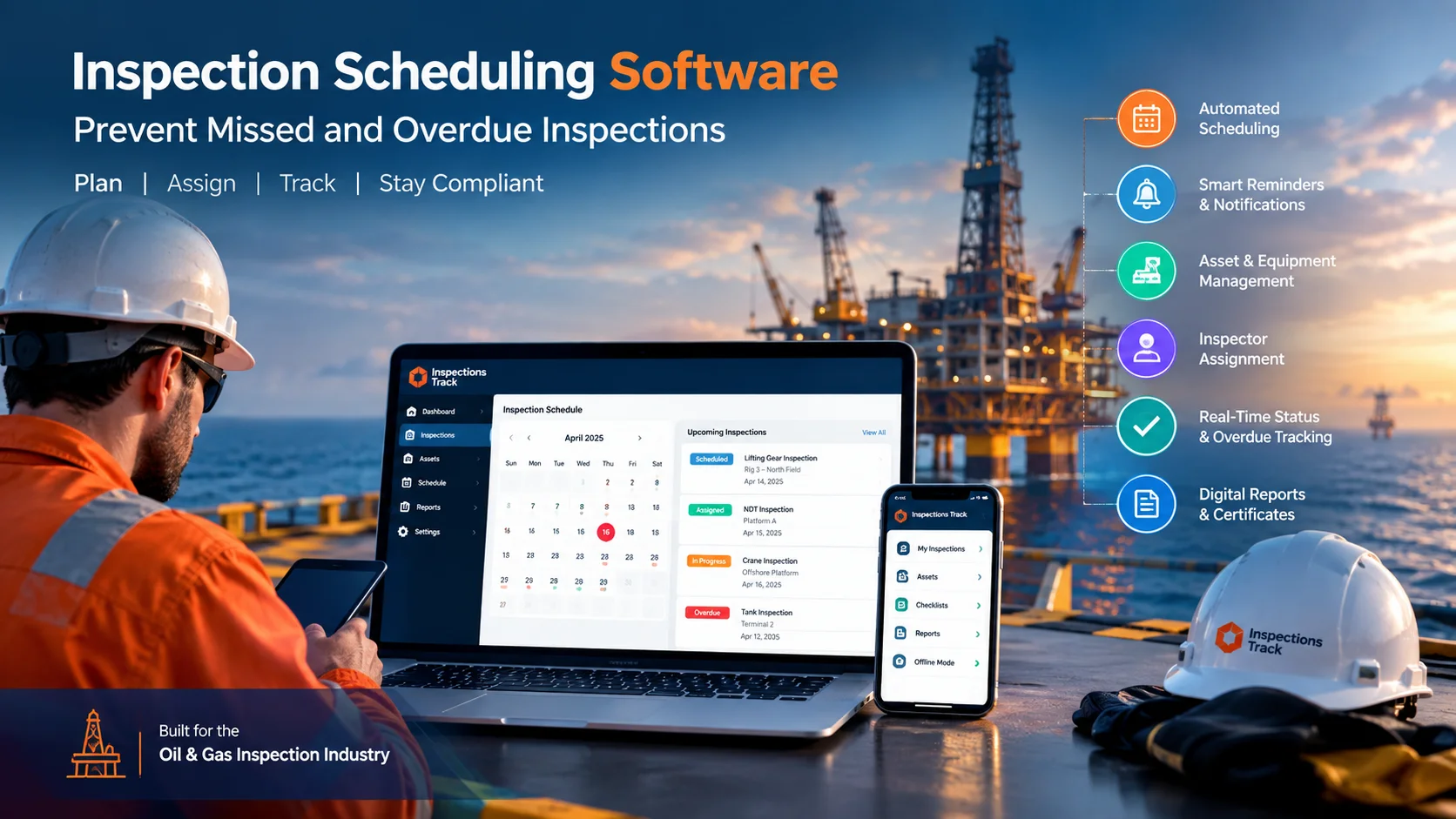
Missed and overdue inspections can create more than scheduling problems. In the oil and gas industry, delayed inspections can affect equipment availability, compliance records, maintenance planning, and operational visibility. For inspection companies managing multiple assets,…
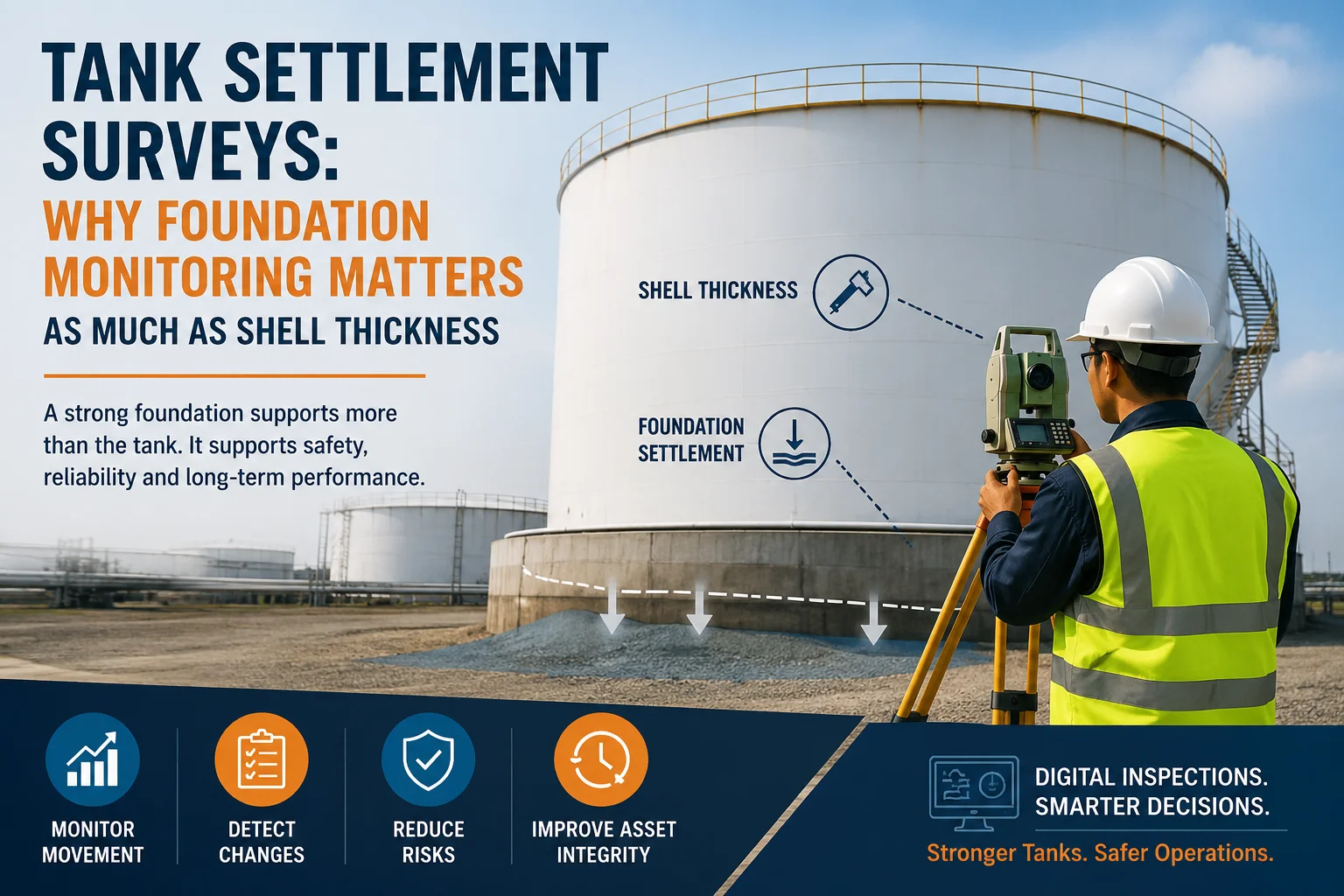
When inspecting an aboveground storage tank, shell thickness often gets the most attention. Inspectors measure corrosion, identify thinning areas, and compare results against minimum wall thickness requirements. However, tank integrity depends on more than shell…


Comment (1)
Tank Settlement Surveys: Why Foundation Monitoring Matters - inspectionstrack
Sep 16, 2026[…] Read more : Derrick Load Rating Recertification: When Do You Actually Need One? […]
Comments are closed.