
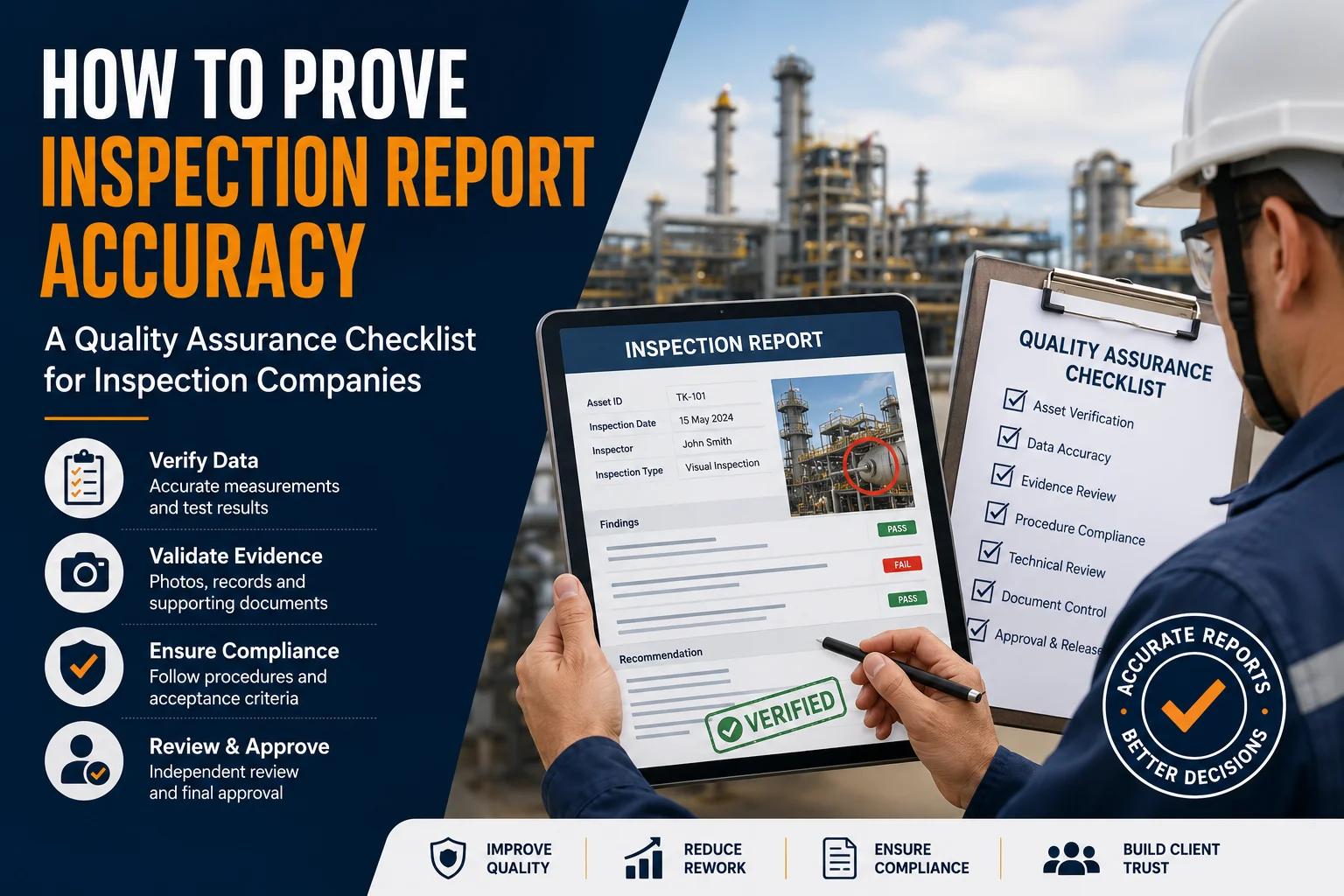
Accurate inspection reports are essential for maintaining safety, meeting client requirements, and making informed decisions about industrial assets. In the oil and gas industry, even a small reporting error can lead to incorrect maintenance decisions, delayed approvals, compliance issues, or costly rework.
However, completing an inspection is only half the job. Inspection companies must also demonstrate that their findings are correct, their measurements are reliable, and their reports accurately reflect the work performed.
So, how can you prove inspection report accuracy?
The most effective approach combines documented quality assurance procedures, verified inspection data, traceable evidence, technical reviews, and controlled reporting processes. With the right inspection quality control checklist and digital tools, companies can improve report reliability while reducing administrative errors.
Inspection report accuracy refers to how correctly an inspection report represents the actual condition of an asset, equipment item, component, or inspected structure.
An accurate report contains verified measurements, correct asset identification, valid inspection findings, supporting evidence, and complete documentation. Furthermore, it follows the applicable inspection procedure, technical requirements, and client reporting standards.
For inspection companies, report accuracy typically depends on five factors:
Importantly, a report that looks professional is not necessarily accurate. Companies must verify the underlying information and demonstrate how they validated it.
Oil and gas inspection companies manage complex assets, strict client requirements, and large volumes of inspection documentation. Consequently, reporting mistakes can affect operational decisions long after an inspector has completed the job.
For example, an incorrect equipment identification number could associate a defect with the wrong component. Similarly, an incomplete non-destructive testing (NDT) report could make it difficult for a client to verify whether the required inspection was performed.
Reliable inspection reports help companies:
Therefore, inspection report quality assurance should be part of the entire inspection workflow, not simply a final administrative check.
A structured quality assurance process makes it easier to identify errors before a report reaches the client. Use the following eight checks for a practical inspection report verification procedure.
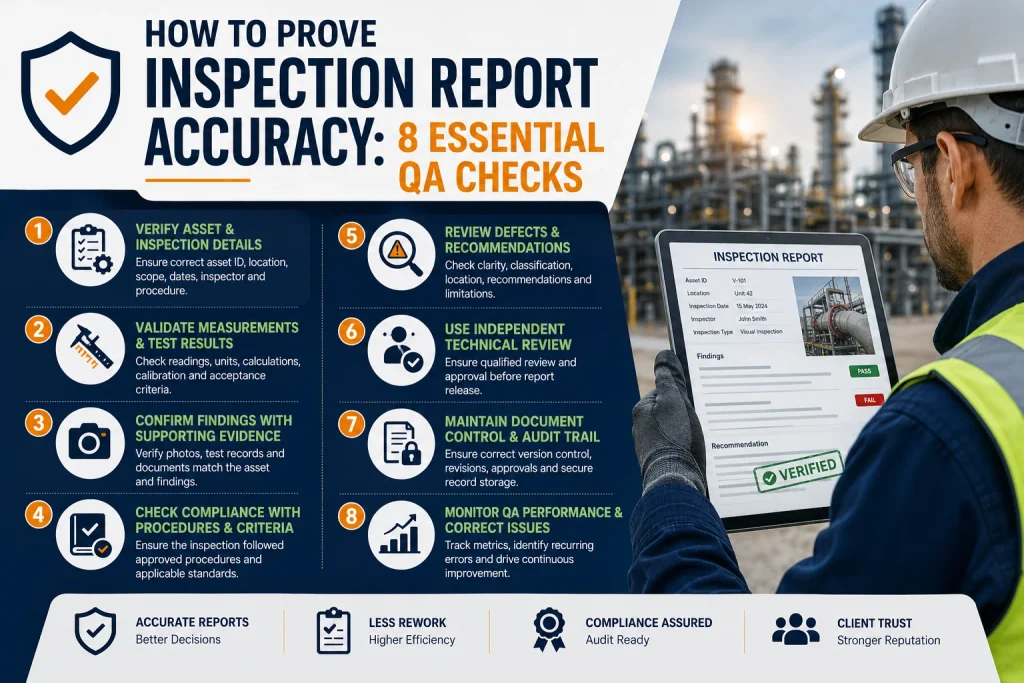
First, confirm that the report identifies the correct asset and inspection activity. Incorrect identification can undermine an otherwise technically sound report.
Check the following details:
Where QR codes or asset registers are available, use them to reduce manual data-entry errors. Additionally, verify that the report matches the relevant job record before approving it.
Next, check whether recorded measurements and test results are complete, internally consistent, and supported by the original inspection data.
For NDT and other technical inspections, verification requirements will vary according to the inspection method, equipment, procedure, and applicable acceptance criteria.
Review:
For example, an ultrasonic testing report should be checked against the applicable procedure and original readings. If a result falls outside the acceptance criteria, the report should clearly document the finding and its evaluation.
Best practice: Never change an inspection result simply to make a report appear acceptable. Correct genuine recording errors through a documented process while preserving the original information and audit trail.
An inspection report should provide sufficient evidence for another qualified person to understand and evaluate the recorded findings.
Depending on the inspection type, supporting evidence may include:
For instance, if an inspector identifies corrosion, the report should describe the observed condition and include supporting evidence when required by the procedure or client.
Furthermore, confirm that each attachment belongs to the correct asset and inspection job. A correct photograph attached to the wrong report can still create a serious documentation problem.
Accurate reporting requires more than recording observations. Inspectors must also evaluate those observations against the appropriate requirements.
Review whether the inspection followed the approved procedure, specified scope, and applicable acceptance criteria.
Inspection companies can strengthen their quality management processes by aligning appropriate procedures with recognized frameworks such as the ISO 9001 quality management standard, which supports consistent processes, performance evaluation, and continual improvement.
Depending on the project, these requirements may come from:
For example, lifting equipment, pressure-relief devices, and NDT inspections may require different reporting fields and evaluation criteria.
Therefore, use inspection-specific QA requirements rather than relying on one generic checklist for every inspection type.
The next step is to confirm that the report communicates the inspection outcome clearly and consistently.
A quality reviewer should verify that:
However, recommendations should not exceed the inspector’s authority or imply a level of certainty unsupported by the available evidence.
If a finding requires further examination, the report should identify the limitation and explain the required follow-up rather than presenting an unverified conclusion as a confirmed result.
A second-person review can identify mistakes that the original inspector may overlook. For this reason, inspection companies should establish a review and approval process appropriate to the inspection’s complexity, risk, and contractual requirements.
During the review, the authorized reviewer should compare the report with the original records, check the calculations where relevant, and verify that the conclusions follow from the findings.
A documented review should capture:
Where independence is required, the review should be performed by an appropriately qualified person who meets the applicable independence requirements.
As a result, companies can demonstrate not only that a report was reviewed, but also who reviewed it and how identified issues were resolved.
Even an accurate report can become unreliable if employees cannot determine which version is final or whether information was changed after approval.
Document control helps establish the integrity and history of inspection records.
Your QA process should include:
Additionally, define how the company handles revised reports. When a correction is necessary, the process should identify what changed, why it changed, who authorized the correction, and when the revised report was issued.
This creates a clearer audit trail and helps prevent outdated reports from being used for operational decisions.
Finally, measure reporting quality over time. A checklist can catch individual errors, but performance monitoring helps identify weaknesses in the overall inspection process.
Useful inspection report quality metrics include:
For example, if reports regularly return because of missing photographs, the company may need to improve field documentation procedures or provide better mobile reporting tools.
Review these metrics periodically and use the results to improve training, workflows, templates, and technical reviews.
Use this table as a practical starting point for verifying reports before submission. Adapt the checks to the inspection method, client requirements, and applicable quality management procedures.
| QA Check | What to Verify | Evidence of Verification |
|---|---|---|
| Asset identification | Correct equipment ID, serial number, and location | Asset register or job record |
| Inspection details | Date, scope, method, and inspector details | Completed inspection record |
| Measurements | Readings, units, and calculations are consistent | Original readings and test records |
| Equipment records | Required calibration and equipment details are valid | Relevant certificates or records |
| Inspection evidence | Photos, test results, and attachments match the asset | Linked evidence and supporting documents |
| Technical evaluation | Findings comply with applicable criteria | Approved procedure and evaluation records |
| Defect reporting | Observations, classifications, and recommendations are consistent | Technical review |
| Document control | Report number, revision, and issue status are correct | Controlled document record |
| Approval | Required review and authorization are complete | Review and approval history |
| Final submission | Correct report and attachments are delivered to the client | Submission record |
Recommended workflow: Mark each applicable check as Pass, Fail, or Not Applicable. Record the reason for any failure, assign corrective action where necessary, and obtain the required approval before releasing the report.
Manual reporting processes often involve spreadsheets, paper forms, emails, shared folders, and repeated data entry. As inspection volumes increase, these disconnected systems make it harder to maintain consistency and traceability.
Inspection management software can reduce these risks by connecting field data collection, asset records, evidence, report generation, and approval workflows.
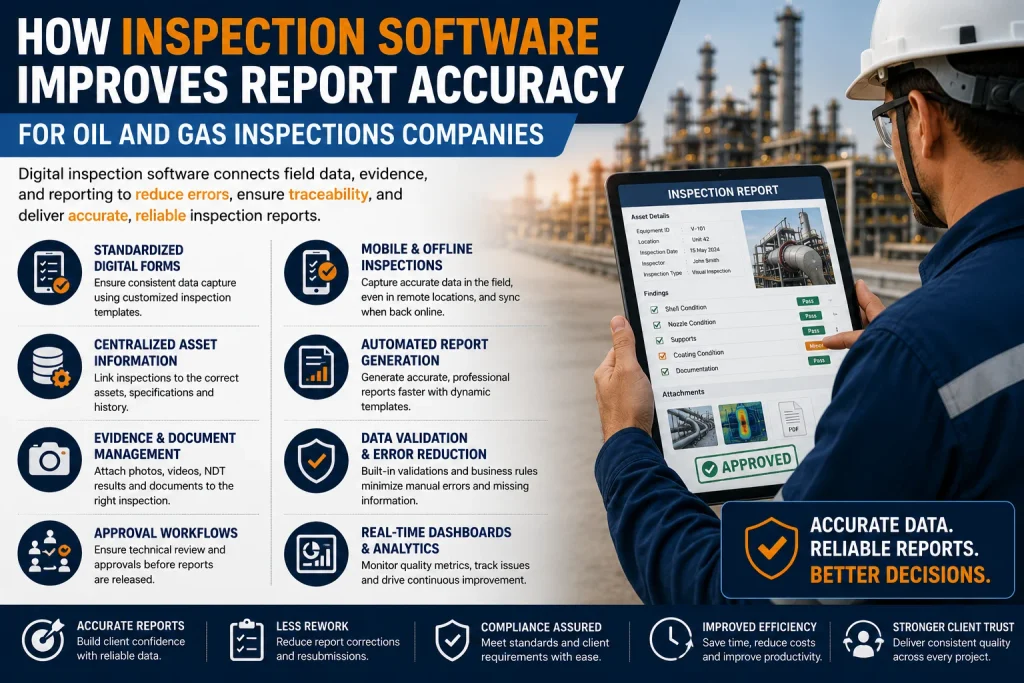
When evaluating digital inspection software, look for capabilities such as:
Nevertheless, software alone cannot guarantee accuracy. Inspectors must still follow approved procedures, enter reliable data, use appropriate equipment, and apply the correct technical criteria.
InspectionsTrack is an inspection management software suite developed for the inspection industry, including oil and gas inspection operations.
It brings together inspection activities, digital records, reporting, and operational workflows to help companies manage jobs more consistently.
Relevant capabilities include:
By connecting field operations with digital documentation, InspectionsTrack can help inspection companies reduce manual reporting effort and establish a more consistent process for preparing, reviewing, and managing inspection reports.
However, final report accuracy still depends on the quality of the captured data, the suitability of the configured workflows, and the competence of the personnel responsible for inspection and review.
Even experienced inspection teams can make documentation errors when reporting procedures are inconsistent or workloads increase.
Watch out for these common problems:
To prevent these issues, combine clear procedures, trained personnel, structured checklists, and appropriate inspection reporting software.
Read more : How to Measure Inspection Team Productivity: 10 KPIs for Inspection Service Companies
Verify the asset identification, inspection scope, measurements, supporting evidence, technical evaluation, and applicable acceptance criteria. Then, complete the required independent or authorized review, document corrections, and confirm that the final report has the correct revision and approval status.
A practical checklist should cover asset details, inspection date, inspector information, methods used, measurements, supporting evidence, defect descriptions, acceptance criteria, recommendations, document control, and approval records. The exact requirements depend on the inspection type and applicable procedures.
Responsibility is shared across the inspection process. Inspectors must record accurate findings, reviewers must verify the report within their authority, and quality managers must maintain suitable procedures and controls. Management should also provide the training, resources, and systems required to support reliable reporting.
Standardize inspection forms, capture data at the source, organize evidence digitally, automate repetitive report preparation, and introduce risk-appropriate review workflows. In addition, monitor rejection rates and turnaround times to identify where improvements are needed.
Proving inspection report accuracy requires more than a completed form or a professional-looking PDF. Inspection companies must demonstrate that their asset information, measurements, findings, evidence, technical evaluations, and approvals are reliable and traceable.
By implementing a structured quality assurance checklist, maintaining document control, reviewing recurring errors, and using suitable digital inspection tools, companies can improve reporting consistency while reducing avoidable rework.
For oil and gas inspection companies looking to connect field inspections with digital reporting and operational management, InspectionsTrack provides a platform for managing inspection workflows, supporting report generation, and organizing inspection records.
Explore InspectionsTrack to learn more about digital inspection management for your operations.

Inspection service companies need more than completed inspection reports to measure team productivity. They must also track inspection quality, job completion time, equipment utilization, safety compliance, and client satisfaction. However, when inspection data is scattered…

For inspection companies in the oil and gas industry, improving inspector utilization is essential for increasing productivity, controlling operational costs, and meeting client deadlines. However, maximizing the number of inspections completed does not necessarily mean…


