
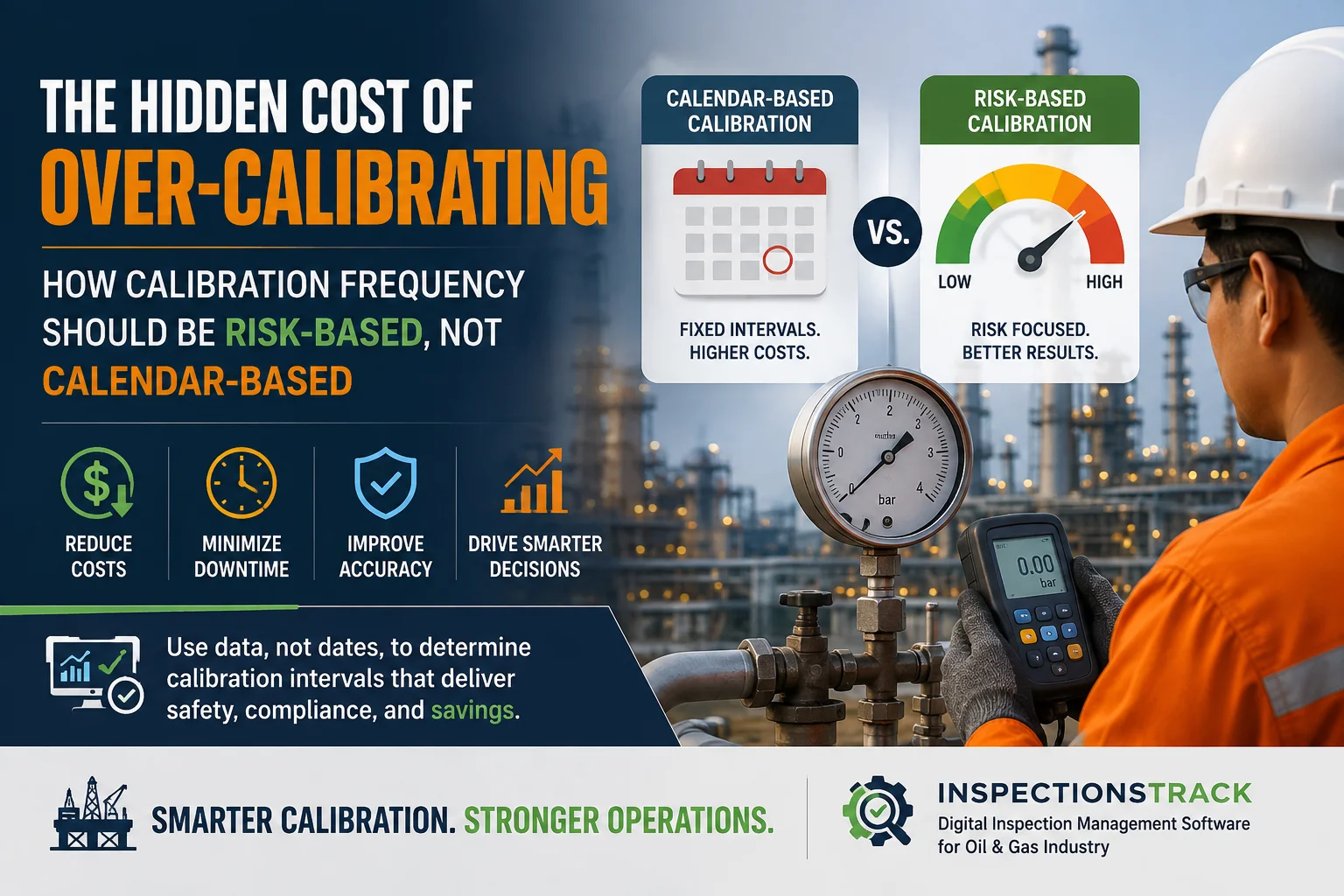
Calibration is essential for maintaining measurement accuracy, equipment reliability, and compliance across industrial operations. However, there is a problem that many organizations overlook: calibrating equipment too frequently can create unnecessary costs without delivering meaningful improvements in measurement reliability.
A fixed calibration schedule often looks simple. Calibrate every six months. Calibrate every year. Repeat the same process across every instrument.
However, not every instrument operates under the same conditions or carries the same level of risk.
A pressure gauge used in a critical oil and gas process may require a very different calibration strategy from an instrument used in a low-risk environment. Likewise, equipment exposed to vibration, temperature changes, corrosive environments, or heavy usage may drift faster than equipment operating in stable conditions.
Therefore, calibration frequency should be based on risk, equipment performance, operating conditions, and historical data not simply the calendar.
For oil and gas companies, this approach can reduce unnecessary calibration work while still protecting safety, asset integrity, measurement accuracy, and regulatory compliance.
Risk-based calibration is an approach that determines calibration intervals according to the actual risk and performance of an instrument rather than applying the same calendar interval to every asset.
Instead of asking:
“When was this instrument last calibrated?”
a risk-based approach also asks:
This creates a more intelligent calibration interval management strategy.
For example, an instrument with consistently stable calibration results may justify a longer interval, while an instrument showing repeated drift may require more frequent calibration.
The goal is not to calibrate less.
The goal is to calibrate at the right frequency based on evidence and risk.
Calendar-based calibration remains popular because it is straightforward.
A company may establish a policy such as:
Once these intervals are defined, technicians follow them regardless of how individual assets actually perform.
This approach has an obvious advantage: simplicity.
However, simplicity can come at a cost.
When organizations apply identical calibration intervals to assets with different operating conditions, they can end up spending significant resources calibrating equipment that has demonstrated little or no measurement drift.
At the same time, calendar-based schedules may fail to give additional attention to assets that actually represent higher operational risk.
That is where risk-based calibration becomes more valuable.
Over-calibration does not necessarily mean calibration is wrong or unnecessary. Instead, it means an organization may be calibrating an instrument more frequently than its actual risk and performance justify.
The financial impact can extend far beyond the calibration certificate.
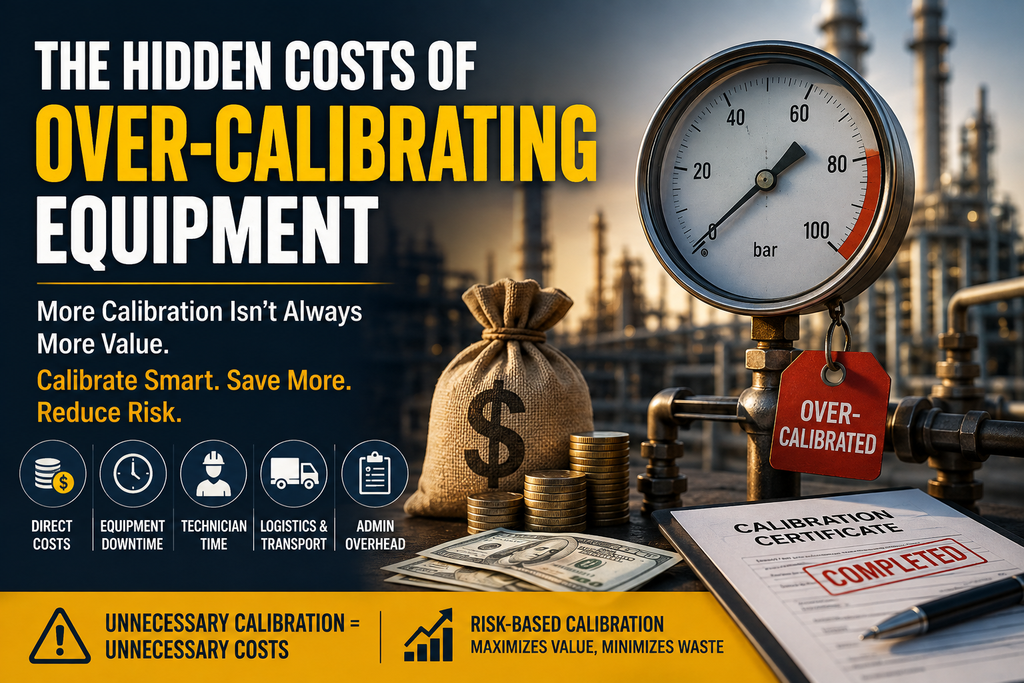
Every calibration activity requires resources.
Depending on the equipment and environment, organizations may pay for:
When hundreds or thousands of instruments are involved, small unnecessary costs can become significant.
Calibration often requires equipment to be removed from service.
In an oil and gas environment, taking an instrument offline may require:
Therefore, the true cost of calibration can include production downtime and operational disruption.
For critical equipment, that cost may be considerably higher than the calibration service itself.
Calibration programs consume engineering and maintenance resources.
Technicians must manage:
If stable instruments are calibrated unnecessarily often, technicians spend time performing low-value activities instead of focusing on assets with greater operational risk.
For offshore facilities and remote oil and gas operations, logistics can become a major component of inspection and calibration costs.
Moving instruments between:
can introduce additional transportation, handling, and scheduling costs.
Consequently, optimizing calibration intervals can have a measurable impact on operational efficiency.
Every calibration creates documentation.
That can include:
When an organization calibrates thousands of instruments unnecessarily, it also creates thousands of additional records that must be managed.
More documentation does not automatically mean better control.
Better data and better decisions matter more than simply creating more records.
One of the most common assumptions in calibration management is:
More frequent calibration = more accurate equipment.
That is not necessarily true.
Calibration frequency should reflect the instrument’s tendency to drift and the consequences of that drift.
Consider two pressure gauges.
| Factor | Gauge A | Gauge B |
|---|---|---|
| Previous calibration history | Stable | Frequent drift |
| Operating environment | Controlled | High vibration |
| Criticality | Low | High |
| Previous failures | None | Multiple |
| Usage | Occasional | Continuous |
| Risk level | Low | High |
| Potential interval | Longer | Shorter |
If both instruments are automatically calibrated every six months, the organization is treating very different risks as though they are identical.
A risk-based program recognizes this difference.
These terms are often used interchangeably, but understanding the distinction helps when developing a calibration management strategy.
Calibration interval is the period between calibration events.
For example:
Calibration every 12 months.
Calibration frequency describes how often calibration occurs over a particular period.
For example:
An instrument is calibrated once per year.
In practice, organizations should focus on determining the appropriate calibration interval based on risk, historical performance, and operating conditions.
A strong calibration program should consider multiple factors rather than relying on one fixed timeframe.
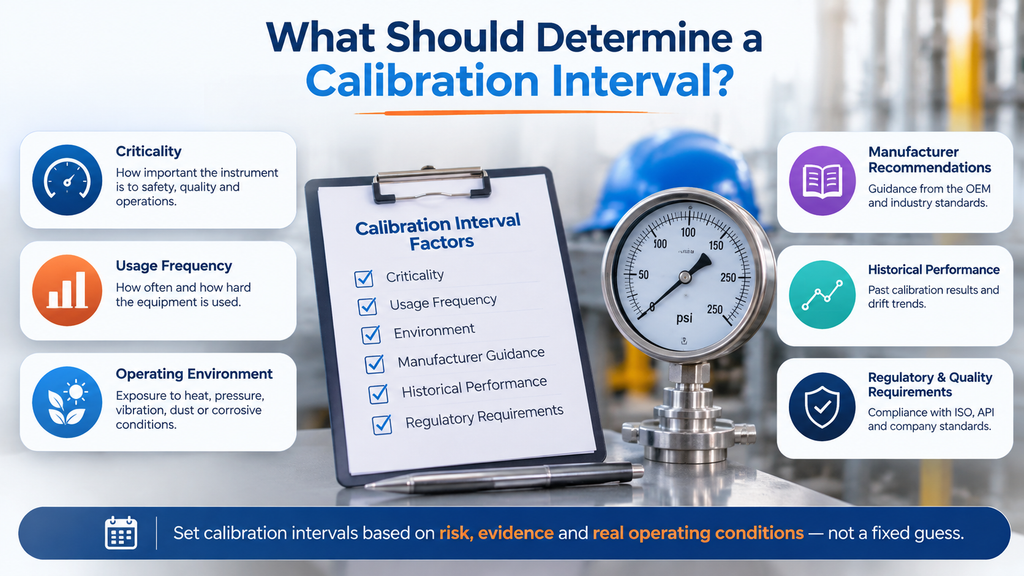
Not all instruments have the same operational importance.
Ask:
What happens if this instrument produces an inaccurate measurement?
For example, an inaccurate reading from a non-critical monitoring instrument may have limited consequences.
However, incorrect measurement from an instrument associated with pressure control, safety systems, process protection, or critical equipment could have serious consequences.
Therefore, criticality should influence calibration planning.
Historical data is one of the most valuable resources for optimizing calibration intervals.
Look for patterns such as:
If an instrument has remained within tolerance across multiple calibration cycles, that evidence can support an interval review.
On the other hand, repeated failures may justify a shorter interval or investigation into the root cause.
The environment surrounding an instrument can significantly affect its performance.
Risk factors may include:
For example, two identical instruments can have very different calibration requirements if one operates in a stable indoor environment and the other operates on an offshore installation exposed to harsh conditions.
Usage matters.
An instrument used continuously may experience more wear and stress than an identical instrument used occasionally.
Consequently, calibration programs should consider:
How often is the equipment actually being used?
Usage data can provide another useful input for determining calibration intervals.
Manufacturer recommendations provide an important starting point.
However, they should not always be treated as the final answer.
Actual operating conditions, historical performance, risk, and organizational requirements can provide additional evidence when reviewing calibration intervals.
Some applications allow relatively broad measurement tolerances.
Others require extremely precise measurements.
The narrower the acceptable tolerance, the more important calibration control becomes.
Therefore, calibration interval decisions should consider the required measurement accuracy of the specific application.
Organizations can develop a simple risk scoring model to classify instruments.
For example:
| Risk Factor | Low | Medium | High |
|---|---|---|---|
| Equipment criticality | Monitoring | Operational | Safety-critical |
| Historical drift | Stable | Moderate | Frequent |
| Environment | Controlled | Variable | Harsh |
| Usage | Occasional | Regular | Continuous |
| Failure consequence | Minor | Operational impact | Safety/production impact |
| Calibration history | Consistent | Some deviations | Repeated failures |
Organizations can then combine these factors to determine whether an asset should receive:
The exact scoring method should be aligned with the company’s quality system, applicable standards, equipment requirements, and risk management procedures.
One of the biggest advantages of digital calibration management is the ability to analyze historical performance.
Imagine an instrument calibrated four times:
| Calibration Cycle | Result | Status |
|---|---|---|
| Cycle 1 | 0.2% deviation | Pass |
| Cycle 2 | 0.3% deviation | Pass |
| Cycle 3 | 0.2% deviation | Pass |
| Cycle 4 | 0.3% deviation | Pass |
The instrument demonstrates a relatively stable pattern.
Now consider another instrument:
| Calibration Cycle | Result | Status |
|---|---|---|
| Cycle 1 | 0.4% deviation | Pass |
| Cycle 2 | 1.1% deviation | Warning |
| Cycle 3 | 1.7% deviation | Fail |
| Cycle 4 | 1.4% deviation | Fail |
These two instruments should not necessarily be managed in exactly the same way.
The second instrument may require:
This is the power of data-driven calibration interval optimization.
Oil and gas operations introduce additional complexity because equipment often operates in environments where inaccurate measurements can affect safety, production, compliance, and asset integrity.
Calibration may be relevant to equipment such as:
However, calibration requirements should always be determined according to the specific equipment, application, manufacturer’s requirements, company procedures, and applicable regulatory or industry requirements.
A risk-based strategy can help organizations prioritize resources without compromising these obligations.
For organizations managing large numbers of assets, spreadsheets and disconnected documents can make calibration management difficult.
InspectionsTrack is an inspection management platform designed for the oil and gas inspection industry. It can help teams bring inspection, asset, certificate, and reporting information into a centralized digital environment.
For calibration-related workflows, teams can use digital inspection forms and asset records to maintain structured information such as:
Instead of searching through separate spreadsheets, emails, and folders, inspection and maintenance teams can work from centralized asset information.
Risk-based calibration depends heavily on quality historical data.
If calibration results are stored consistently, organizations can more easily identify:
That creates a stronger foundation for data-driven calibration decisions.
Moving away from fixed calibration schedules does not have to happen overnight.
A practical approach can follow these steps.
Start by identifying all instruments and calibration-controlled equipment.
Capture information such as:
Without accurate asset data, risk-based calibration becomes difficult.
Divide assets into categories such as:
Critical
Failure could affect safety, environmental protection, major production, or critical process control.
Medium Risk
Failure could create operational disruption or maintenance concerns.
Low Risk
Failure has limited operational consequences.
This classification provides the foundation for prioritization.
Review previous calibration results.
Look for:
Where possible, use several calibration cycles rather than making decisions from a single result.
Review the actual environment.
Ask whether the instrument is exposed to:
This helps identify factors that may accelerate instrument drift.
Combine criticality, performance history, environmental exposure, usage, tolerance, and failure consequences.
The organization can then assign a risk category.
For example:
| Risk Category | Example Strategy |
|---|---|
| Low | Consider longer interval if evidence supports it |
| Medium | Maintain standard interval and monitor trends |
| High | Consider shorter interval and additional controls |
| Critical | Apply strict controls based on risk and applicable requirements |
Once enough data is available, evaluate whether the current interval is appropriate.
An interval should not be changed simply because an instrument has passed several calibrations.
Instead, the organization should consider the overall risk and applicable requirements before making the decision.
Risk-based calibration is not a one-time exercise.
After changing an interval, continue monitoring the equipment.
If drift increases, the interval may need to be shortened.
If performance remains stable over multiple cycles, further review may be appropriate.
This creates a continuous improvement cycle.
Risk-based calibration depends on information.
Unfortunately, many inspection teams still manage asset and calibration data across:
This makes trend analysis difficult.
Digital inspection software can create a centralized source of information.
With InspectionsTrack, oil and gas inspection teams can manage digital forms, assets, certificates, inspection records, reports, and other inspection information within one platform.
The result is not simply less paperwork.
It is better visibility into asset performance.
And better visibility supports better risk decisions.
Organizations can track several metrics to evaluate whether their calibration strategy is working.
These metrics can help management understand whether the calibration program is actually reducing risk and improving efficiency.
A risk-based approach can deliver value in several areas.
| Area | Calendar-Based Approach | Risk-Based Approach |
|---|---|---|
| Calibration scheduling | Fixed dates | Risk and performance driven |
| Resource allocation | Broadly distributed | Prioritized by risk |
| Historical data | Often underused | Used for decisions |
| High-risk assets | Same schedule as others | Greater attention |
| Stable assets | May be over-calibrated | Potentially optimized |
| Downtime | Potentially higher | Can be better controlled |
| Documentation | Often fragmented | Can be centralized |
| Decision-making | Schedule-driven | Evidence-driven |
The objective is not simply to reduce the number of calibrations.
Instead, it is to allocate calibration resources where they provide the greatest risk-reduction value.
Risk-based calibration can deliver significant benefits, but organizations should avoid several common mistakes.
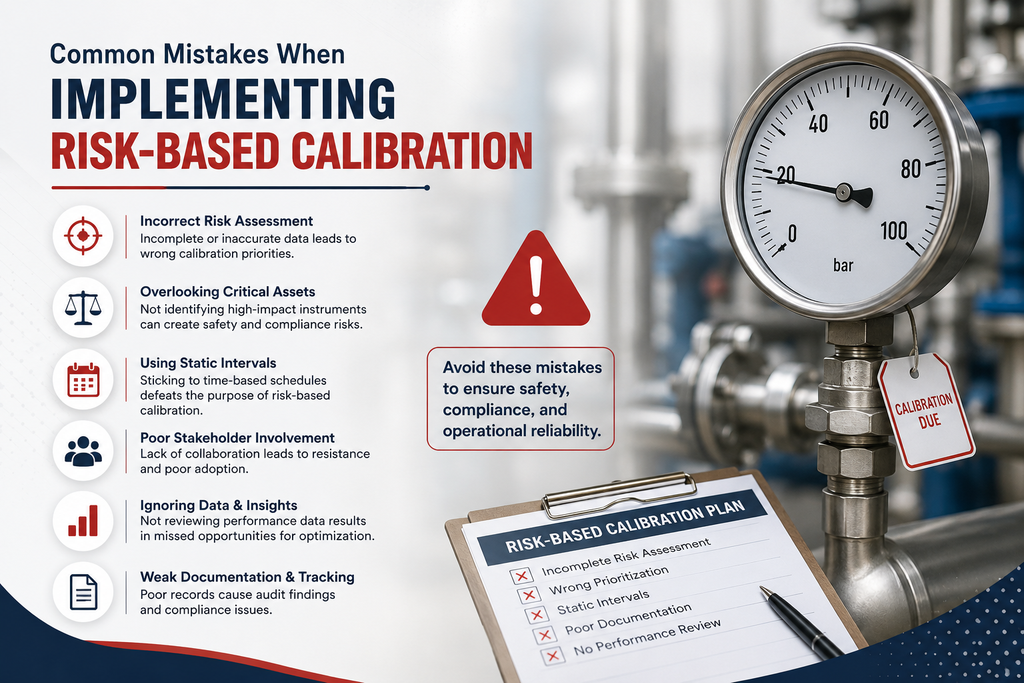
Risk-based does not mean “calibrate less.”
Some assets genuinely require shorter intervals.
A risk-based internal strategy does not override mandatory legal, regulatory, contractual, safety, or quality requirements.
Always consider applicable requirements before changing an established calibration interval.
One successful calibration result is rarely enough to establish a meaningful trend.
Where practical, analyze multiple calibration cycles and relevant operating information.
An instrument’s historical performance may change when its operating environment changes.
A previously stable asset may behave differently after relocation to an offshore or high-vibration environment.
Identical models do not always have identical risk.
Location, application, usage, criticality, and operating conditions matter.
Organizations should consider reviewing an interval when:
An interval review should be documented and supported by evidence.
Industrial organizations are collecting more asset and inspection data than ever before.
The next step is turning that data into better decisions.
Instead of simply asking:
“Which instruments are due for calibration this month?”
maintenance and inspection teams can ask:
“Which instruments represent the highest calibration risk, and what does our historical data tell us about their performance?”
That is a much more valuable question.
Digital inspection platforms, centralized asset records, automated reporting, historical calibration data, and analytics can all contribute to this transition.
Over time, organizations can move from calendar-driven maintenance to evidence-driven asset management.
Calibration remains a critical part of quality, safety, measurement reliability, and asset management.
However, simply calibrating every instrument at the same fixed interval does not necessarily create the best calibration program.
A smarter strategy considers:
When these factors are combined, organizations can develop a risk-based calibration strategy that directs resources toward the equipment that matters most.
For oil and gas inspection teams, digital platforms such as InspectionsTrack can help centralize asset information, inspection records, certificates, forms, and reporting. More importantly, structured historical data can provide the foundation for better risk-based decisions.
The ultimate goal is simple:
Don’t calibrate equipment simply because the calendar says it’s due. Calibrate according to what the risk and evidence tell you.
Read more : Third-Party Inspection vs. In-House Inspection in Oil and Gas: Which Is Right for Your Operation?
Risk-based calibration sets calibration intervals based on equipment criticality, performance history, operating conditions, and measurement risk rather than fixed calendar dates.
Yes. It can reduce unnecessary calibration, downtime, technician workload, and administrative costs while keeping high-risk equipment under closer control.
InspectionsTrack helps oil and gas teams manage asset records, calibration certificates, inspection history, digital forms, and reports in one centralized platform.

Introduction In high-risk industries like oil and gas, even a single dropped object can result in severe injuries, asset damage, or environmental incidents. A proactive DROPS (Dropped Object Prevention Scheme) survey is more than just…

The oil and gas industry operates in one of the most demanding and high-risk environments in the world. From offshore rigs to refineries, every operation depends on precision, safety, and efficiency. That’s where real-time inspections…


Comment (1)
High-Pressure Gauge Verification: DWT vs Calibrator - inspectionstrack
Aug 31, 2026[…] Read more : The Hidden Cost of Over-Calibrating: Why Calibration Frequency Should Be Risk-Based, Not Calendar-Ba… […]
Comments are closed.