

A repair contractor completes the work, closes the job, and sends the equipment back. However, one critical question remains: has anyone verified that the equipment is ready for its intended service?
In oil and gas operations, a completed repair and an approved return to service represent different decisions. A maintenance record explains what the technician fixed. By comparison, reinspection establishes whether the repaired equipment meets the applicable acceptance criteria.
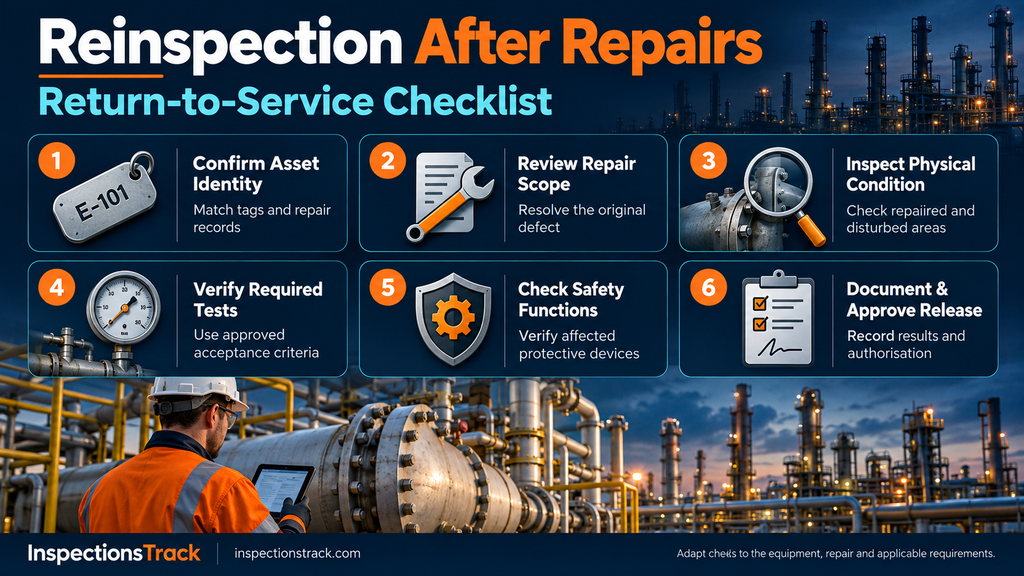
Before equipment returns to service, verify its identity, repair scope, physical condition, required test results, safety functions, inspection records, and release approval. The checks should reflect the equipment, the repair, manufacturer instructions, and applicable requirements.
This guide explains how to organise reinspection after repairs and prevent incomplete evidence from becoming an unsafe equipment release.
Reinspection after repairs is a follow-up assessment that checks whether corrective work has resolved an identified defect and whether the equipment meets the requirements for continued use.
For example, replacing a damaged crane component confirms that maintenance occurred. However, the relevant inspection and testing must still establish whether the repaired assembly performs acceptably.
Three records therefore serve different purposes:
Keeping these decisions separate helps prevent a closed maintenance job from automatically becoming permission to operate.
The need and scope depend on how the repair affects equipment safety and integrity. Therefore, assess the repair before choosing a checklist.
Typical triggers for review include:
For a specific regulatory example, UK HSE guidance identifies repair or replacement of critical lifting equipment parts as circumstances that may require a thorough examination. However, requirements vary by jurisdiction and equipment category. HSE
Consequently, the competent person should define the inspection scope using the relevant manufacturer instructions, inspection scheme, site procedures, and applicable rules.
Use the following table as a planning framework. Then, adapt each check to the asset and repair rather than treating every row as a universal testing requirement.
| Check | What to verify | Evidence to retain |
|---|---|---|
| Equipment identity | Asset number, serial number, location, and repaired component match | Asset record and identification photographs |
| Original defect | The repair addresses the specific finding | Original report and defect reference |
| Repair scope | Completed work matches the approved scope | Repair report and work order |
| Replacement components | Parts and materials meet the specified requirements | Part details and traceability documents, where required |
| Physical condition | Repair quality and disturbed areas meet acceptance criteria | Inspection observations and measurements |
| Required testing | Applicable tests produce acceptable results | Test reports, criteria, and instrument details |
| Safety functions | Affected protective functions operate as specified | Functional test records |
| Documentation | Reports are complete, consistent, and linked to the correct asset | Reviewed inspection package |
| Release approval | The authorised person accepts the equipment for its intended use | Dated approval and operating restrictions, if applicable |
First, match the equipment identification to the original inspection finding and repair record.
For example, a report for one lifting accessory cannot support the release of another similar-looking item. Therefore, resolve missing tags, inconsistent serial numbers, or unclear component references before proceeding.
Also, review the original defect description. Otherwise, the inspector may confirm that a component looks new without verifying that the actual problem has been resolved.
Next, compare the completed work against the approved repair instructions.
Check whether the contractor recorded:
If the team discovers a change to the original design or specification, escalate it through the applicable engineering review or management-of-change process.
A repair can affect more than the original defect location. Therefore, inspect relevant adjacent components and any areas disturbed during the work.
Depending on the asset, this may include connections, fasteners, supports, guards, alignment, or visible signs of damage.
HSE guidance similarly advises that inspection scope should reflect the equipment, its use, exposure conditions, and manufacturer recommendations. A generic checklist alone may miss the features that matter most.
Before testing, establish the approved method and acceptance criteria. Then, record actual results rather than writing only “tested” or “OK.”
Depending on the repair, the defined scope may include functional checks, measurements, non-destructive testing, or other specified examinations.
However, do not assume every repair requires a load test or pressure test. For lifting equipment, HSE states that testing decisions should reflect risk, manufacturer information, and competent-person judgement; some overload tests can damage equipment.
Where the repair affects protective functions, verify them through the approved test procedure.
For example, replacing a control component may require checks of the associated stop function or interlock. Likewise, mechanical repairs may affect guards or protective arrangements.
However, a successful operating cycle does not prove that every relevant safety function works.
The site’s procedures should identify who performs the technical assessment and who authorises operational release.
For ordinary work-equipment inspections, the inspector needs sufficient knowledge and experience to recognise relevant problems and respond appropriately. However, specialist equipment and formal examinations may require additional competence or independence.
For example, HSE guidance distinguishes lifting equipment thorough examinations from routine maintenance and calls for an appropriately competent, impartial examiner.
A practical arrangement assigns clear responsibilities:
Consequently, everyone knows which decision they own.
A useful report should allow another reviewer to understand what failed, what changed, and why the equipment was accepted or rejected.
Include:
Also, distinguish “not applicable” from “not checked.” Otherwise, a blank field can hide an incomplete inspection.
Do not automatically restart the inspection interval simply because a repair occurred. Instead, determine the next due date through the applicable inspection scheme and technical review.
Consider a hypothetical winch removed from service because of a braking defect.
First, the maintenance contractor replaces the specified component and documents the work. Next, the competent person reviews the repair scope and defines the relevant examination and functional checks.
During reinspection, the team verifies the asset identity, repaired assembly, affected functions, and results against the approved criteria.
However, if a required test remains incomplete, the equipment stays unavailable for operation. The maintenance job can be complete while the return-to-service decision remains pending.
Finally, the authorised person reviews the accepted inspection package and completes release under the site’s procedures.
This approach makes the release decision traceable rather than dependent on a verbal assurance.
Several avoidable errors weaken equipment release decisions:
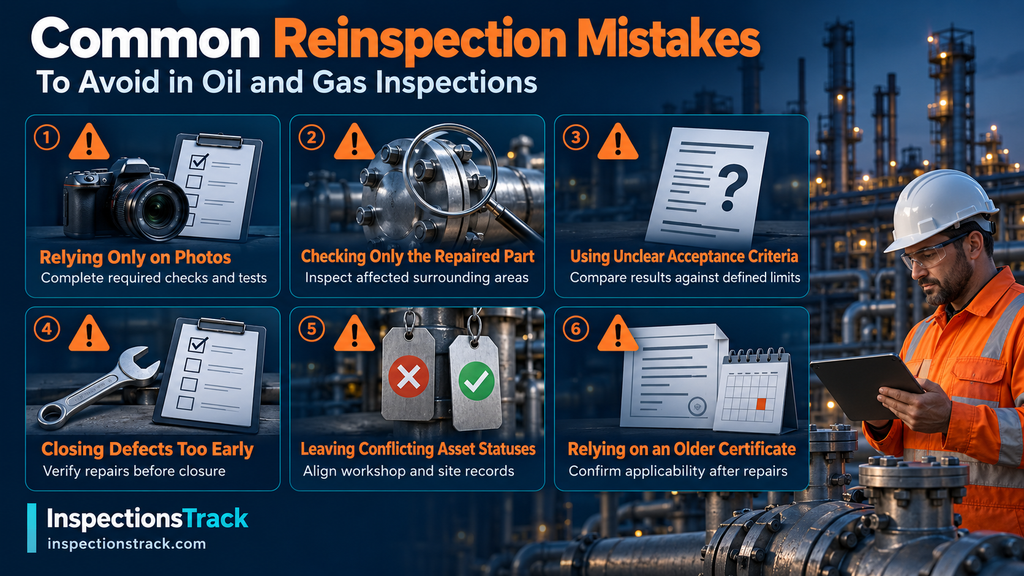
Therefore, resolve evidence gaps and status conflicts before operational handover.
Reinspection becomes harder to coordinate when asset records, findings, and reports sit in separate spreadsheets and email threads.
InspectionsTrack provides inspection software for the oil and gas inspections industry, including asset management, digital checklists, inspection reports, certificates, and registers. Its published features also include online and offline inspection data collection and a client portal with corrective-action visibility and closure functions.
These capabilities can support more organised reinspection records and easier access to asset information. However, teams should confirm the workflow configuration they need for repair evidence, technical review, and release approval.
Software supports the inspection process; the responsible people still make the technical and operational decisions.
No. The necessary checks depend on the repair’s effect on safety, equipment requirements, and applicable procedures. However, safety-critical repairs need an appropriately defined assessment before release.
An unresolved safety-critical defect should prevent release. For other findings, any permitted continued use must follow the applicable technical decision, restrictions, and authorisation process.
No. An invoice confirms a transaction. Instead, closure should rely on repair evidence and the verification required by the finding.
Keep it unavailable for operation, document the failed criteria, and return the finding for further corrective action. Then, repeat the relevant assessment after the additional work.
Before the next repaired asset returns to service, establish a consistent sequence: identify the defect, document the repair, complete the required reinspection, review the evidence, and authorise release.
Then, ensure the equipment register and operational handover reflect the same decision.
For oil and gas inspection businesses, explore how InspectionsTrack can support your asset records, inspection checklists, reporting, and corrective-action management.

In oil and gas inspections, a pass or fail decision can affect equipment reliability, operational safety, compliance, and project timelines. However, when inspectors interpret acceptance criteria differently, the same equipment may receive different inspection results….
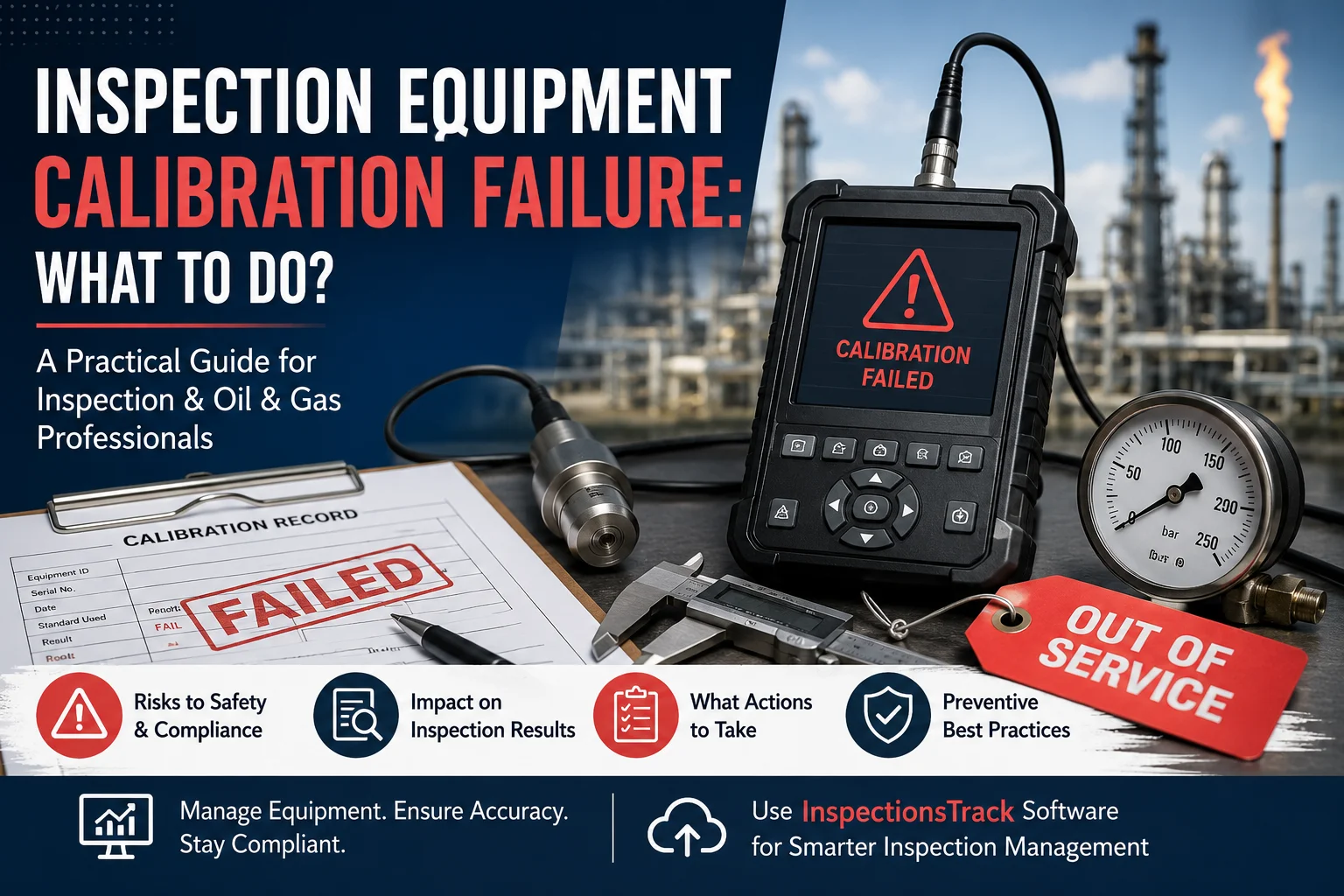
Inspection equipment plays a critical role in oil and gas, NDT, manufacturing, and industrial inspection. Inspectors rely on calibrated equipment to produce accurate and defensible results. But what happens when inspection equipment fails calibration? A…


