

Oil & gas shutdown inspection planning can determine whether a turnaround finishes safely and on schedule or gets delayed by unexpected inspection findings, missing resources, and poor coordination.
A shutdown or turnaround gives inspection teams a limited window to access equipment, perform detailed examinations, identify defects, and make critical repair decisions. Therefore, inspection teams need to prepare well before the plant goes offline.
Effective planning should combine equipment history, risk-based inspection (RBI), previous inspection results, damage mechanisms, inspection methods, resources, and turnaround priorities. Recent industry guidance also emphasizes that proactive inspection planning helps reduce unexpected discoveries and supports faster decision-making during the turnaround.
This guide explains how to prepare an oil & gas turnaround inspection plan and how digital inspection software can help teams manage the process more efficiently.
A turnaround brings many activities together within a limited shutdown window. Maintenance, inspection, engineering, NDT, contractors, operations, and safety teams must work around the same schedule.
At the same time, inspectors may need to examine:
Without a clear inspection scope, teams can waste valuable shutdown time deciding what to inspect, which method to use, or what resources they need.
Therefore, a well-prepared turnaround inspection plan should answer three basic questions:
Do not wait until the shutdown begins.
For major turnarounds, inspection planning can start many months before the actual shutdown. Some established turnaround inspection guidance recommends beginning detailed pre-turnaround planning around 9 to 18 months before the event, depending on the size and complexity of the facility.
A practical planning timeline can look like this:
| Planning Stage | Key Activities |
|---|---|
| 12–18 months before | Review asset history, RBI requirements and previous findings |
| 9–12 months before | Define inspection scope and preliminary methods |
| 6–9 months before | Confirm resources, contractors and equipment |
| 3–6 months before | Finalize inspection packages, access and logistics |
| 1–3 months before | Validate readiness and close planning gaps |
| During turnaround | Execute inspections, record findings and manage decisions |
| After turnaround | Verify repairs, complete documentation and update asset history |
The exact timeline will vary by facility. However, starting early gives inspection teams more time to identify difficult access requirements, specialist NDT needs, equipment requirements, and potential repair scenarios.
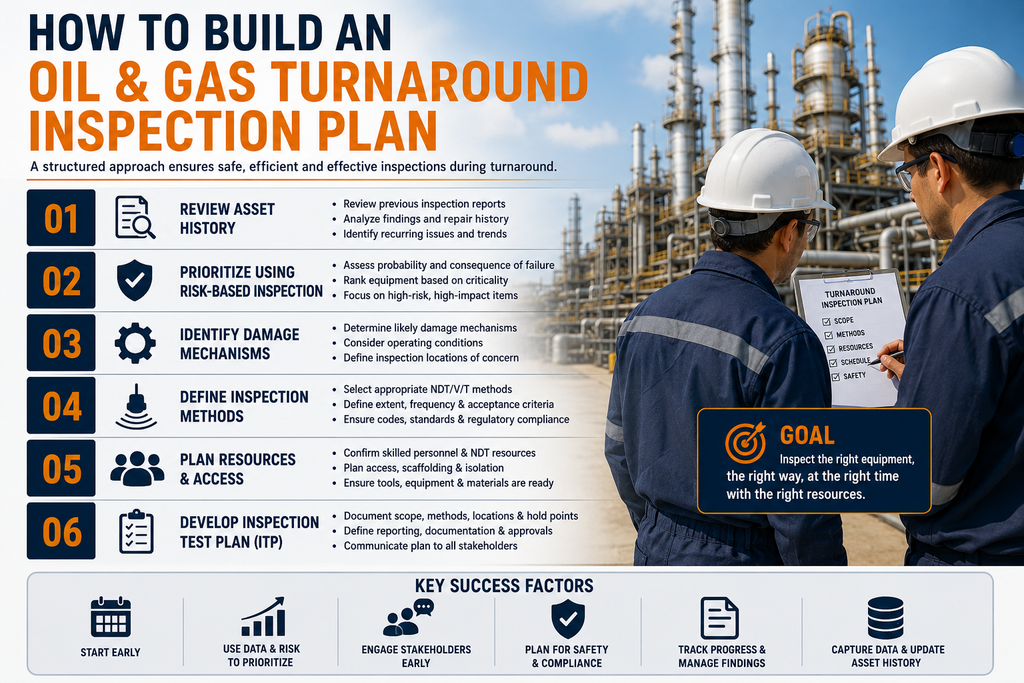
Start with what you already know about the equipment.
Review previous inspection reports, thickness measurements, NDT results, corrosion monitoring data, repair history, inspection recommendations, and outstanding findings.
Look specifically for:
This historical information helps inspectors identify where they should focus their attention during the shutdown.
Not every asset requires the same inspection depth.
Risk-based inspection helps teams prioritize inspection activities according to factors such as probability of failure and potential consequences.
For example, a high-risk pressure vessel may require a more detailed examination than a low-risk component with a stable inspection history.
Your turnaround scope should therefore consider:
The goal is not simply to inspect more equipment. The goal is to inspect the right equipment at the right time using the right method.
Damage mechanisms should influence both the inspection scope and inspection technique.
Depending on the equipment and process conditions, teams may need to consider:
Understanding the likely damage mechanism helps the inspection team determine where to look and which NDT method provides useful evidence.
Do not leave inspection-method decisions until equipment is opened.
The inspection plan should clearly define the required inspection techniques, locations, extent, and acceptance criteria where applicable.
Depending on the equipment and expected damage, methods may include:
A written inspection schedule should clearly identify factors such as the inspection type, location, frequency, and acceptance criteria.
An Inspection Test Plan (ITP) provides a structured roadmap for turnaround inspection activities.
A practical ITP should include:

| ITP Element | What to Define |
|---|---|
| Equipment | Tag number, asset type and location |
| Inspection scope | What must be examined |
| Inspection method | VT, UT, MT, PT, RT, PAUT, etc. |
| Inspection location | Specific areas or components |
| Acceptance criteria | Applicable requirements |
| Access requirements | Scaffolding, platforms or confined-space access |
| Resources | Inspectors, NDT technicians and equipment |
| Hold points | Activities requiring review or approval |
| Documentation | Reports, photos, readings and supporting evidence |
| Status | Planned, in progress, completed or requires action |
A centralized ITP also improves communication between inspection, engineering, maintenance, operations, and contractors. Recent turnaround inspection guidance highlights the ITP as an important roadmap for scope, methods, acceptance criteria, and hold points.
A technically correct inspection plan can still fail if inspectors cannot access the equipment.
Before the shutdown, identify access requirements such as:
Also confirm resource requirements early.
For example, if several vessels require advanced NDT during the same shutdown window, you may need additional qualified technicians and equipment to prevent inspection activities from becoming a schedule bottleneck.
Turnarounds rarely go exactly according to plan.
Once equipment is opened or cleaned, inspectors may discover unexpected corrosion, cracking, thinning, deformation, or other conditions that were not visible during previous inspections.
Therefore, your turnaround plan should include a process for handling unexpected findings.
Finding identified → Evidence captured → Technical assessment → Engineering review → Repair/replace/accept decision → Verification → Documentation
This approach prevents teams from making rushed decisions without sufficient inspection evidence.
Where appropriate, engineering teams may also need to evaluate whether a component can remain in service, requires repair, or requires replacement. Fitness-for-service considerations can become particularly important when unexpected damage is discovered during a turnaround.
Once the turnaround begins, visibility becomes critical.
Managers should be able to quickly answer:
Using spreadsheets, emails, paper forms, and separate folders can make this difficult, especially when multiple inspectors and contractors work simultaneously.
A centralized inspection system can provide a much clearer operational picture.
InspectionsTrack is an inspection management software platform designed for inspection companies and asset-intensive industries, including oil & gas.
Instead of managing inspection information across disconnected spreadsheets and documents, teams can use a centralized platform to manage jobs, inspections, reports, evidence, approvals, and asset history.
For shutdown and turnaround inspection projects, InspectionsTrack can help teams manage:
The offline capability is particularly useful for field teams working in areas with limited connectivity. Inspectors can capture inspection information in the field and synchronize it when connectivity becomes available.
A connected workflow can look like:
Turnaround Planning → Inspection Assignment → Field Inspection → Evidence Capture → Findings → Review & Approval → Final Report → Asset History
This reduces manual handovers and gives managers better visibility throughout the inspection lifecycle.
Before the turnaround begins, use this checklist to confirm inspection readiness:

Inspection teams can improve turnaround performance by focusing on preparation rather than reacting to problems after the shutdown starts.
The most effective practices include:
Start early. Build the inspection scope well before the shutdown.
Use historical data. Previous findings can reveal recurring integrity problems.
Prioritize by risk. Focus resources on equipment where inspection can have the greatest impact.
Prepare access in advance. Delayed scaffolding, cleaning, isolation, or equipment preparation can quickly affect the schedule.
Standardize inspection data. Consistent forms and checklists make results easier to review.
Capture evidence in the field. Photos, measurements, notes, and findings should stay connected to the relevant inspection.
Track exceptions immediately. A finding that sits unnoticed in a spreadsheet can become a major schedule problem.
Keep asset history updated. Turnaround findings should support future inspection planning instead of becoming isolated reports.
Successful oil & gas shutdown inspection planning starts long before equipment goes offline.
By reviewing asset history, using risk-based inspection principles, identifying damage mechanisms, defining NDT requirements, preparing access, and establishing clear inspection workflows, teams can make better use of the limited turnaround window.
Just as importantly, inspection data should remain accessible after the shutdown. The findings from one turnaround can become valuable inputs for the next inspection cycle.
With a centralized platform such as InspectionsTrack, oil & gas inspection companies can connect field inspections, evidence, findings, approvals, reports, and asset history in one workflow.
The result is a more organized inspection process, better visibility for managers, and a stronger foundation for future asset integrity decisions.
Read more : Reinspection After Repairs: What to Check Before Equipment Returns to Service
It is the process of defining inspection scope, methods, resources, access, and schedules before a plant shutdown or turnaround.
Planning should begin several months before the shutdown, ideally 9–18 months in advance for major turnarounds.
Common methods include visual inspection, UT, MT, PT, RT, thickness measurement, PAUT, and other specialized NDT techniques.
InspectionsTrack helps teams manage inspection jobs, checklists, field evidence, findings, reports, approvals, and asset history in one centralized system.

In oil and gas inspections, a pass or fail decision can affect equipment reliability, operational safety, compliance, and project timelines. However, when inspectors interpret acceptance criteria differently, the same equipment may receive different inspection results….
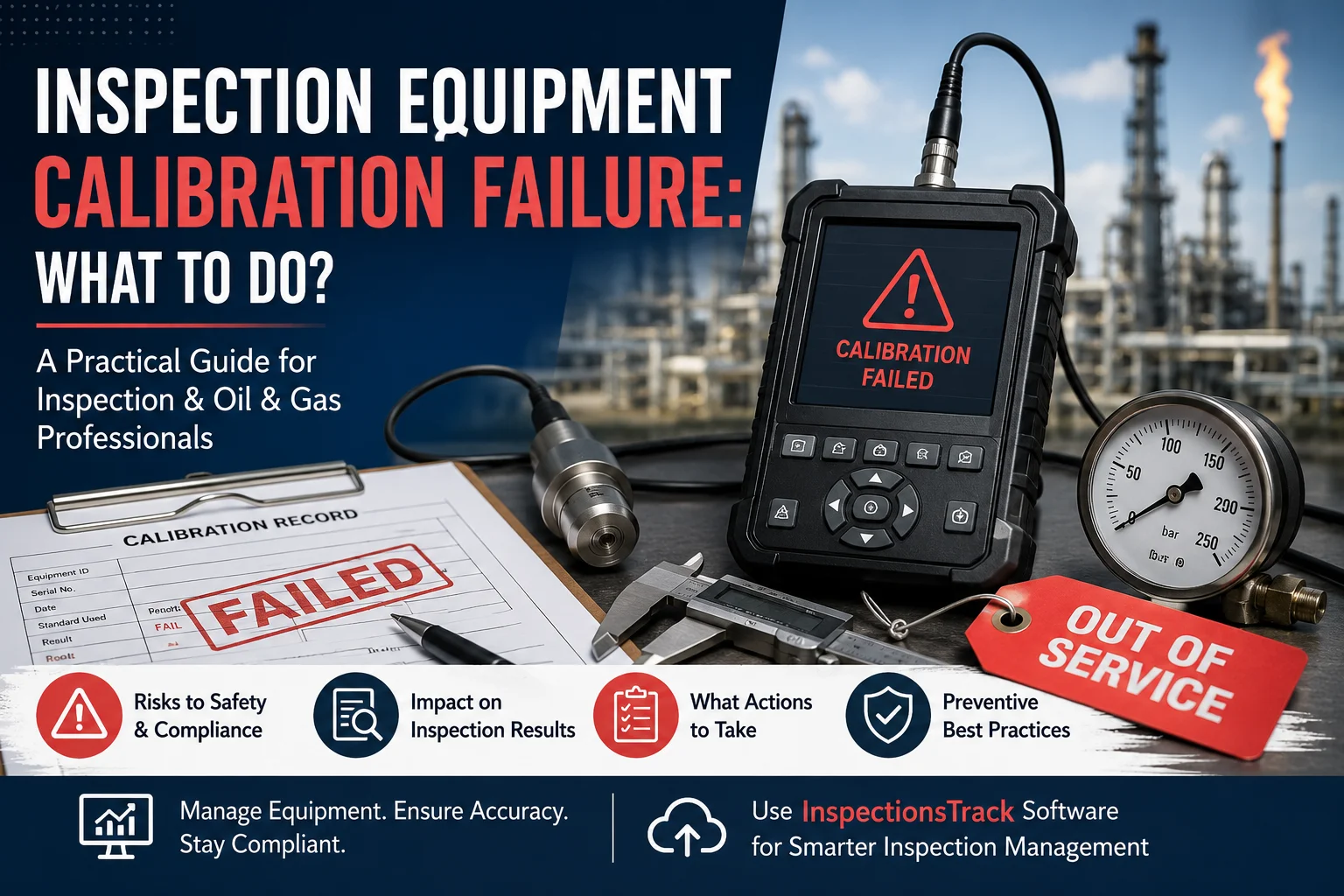
Inspection equipment plays a critical role in oil and gas, NDT, manufacturing, and industrial inspection. Inspectors rely on calibrated equipment to produce accurate and defensible results. But what happens when inspection equipment fails calibration? A…


Comment (1)
Inspection Equipment Calibration Failure: What to Do - inspectionstrack
Oct 08, 2026[…] Read more : Oil & Gas Shutdown Inspection Planning: How to Prepare for a Turnaround […]
Comments are closed.