
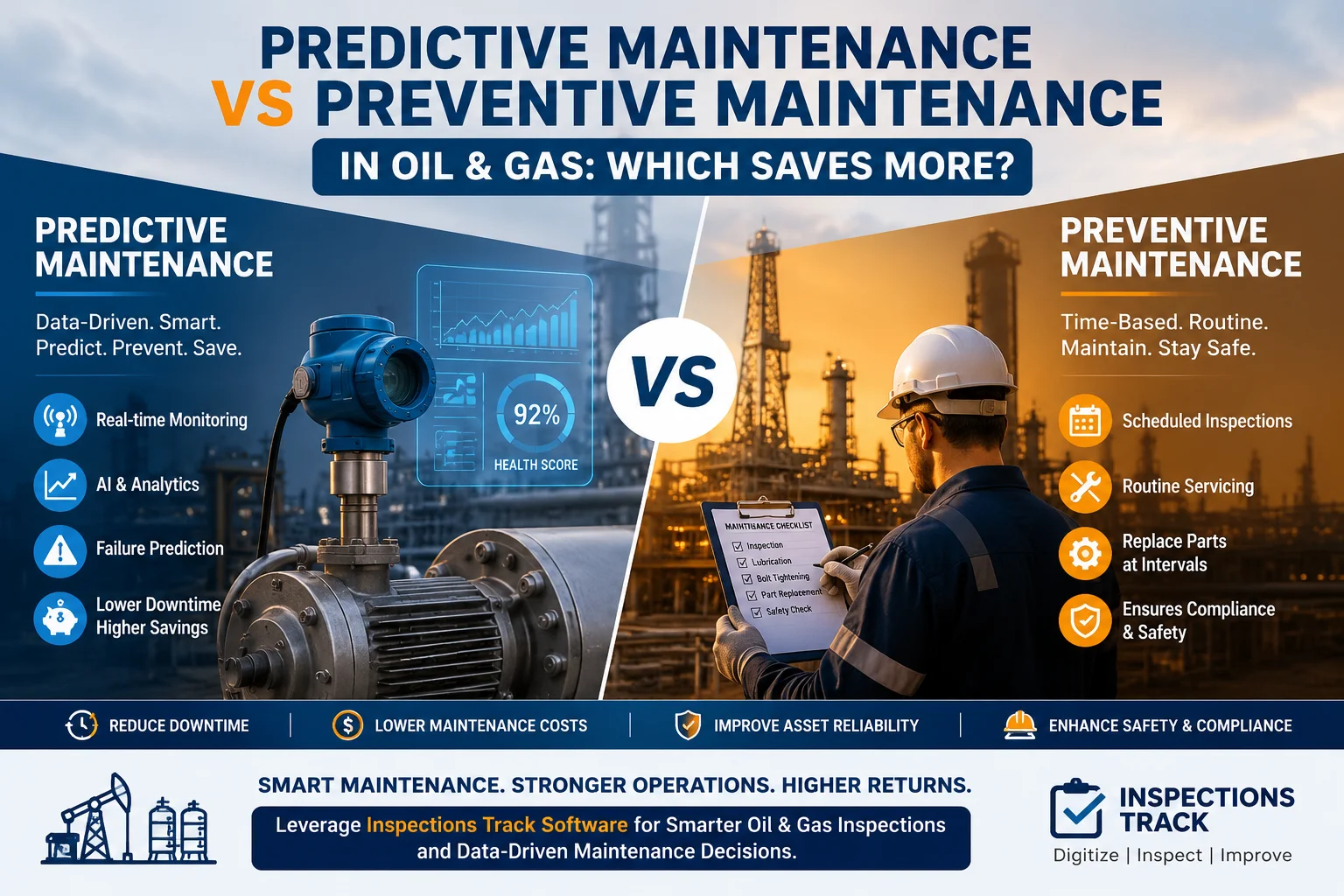
In the oil and gas industry, equipment downtime is not just inconvenient—it is extremely costly and potentially dangerous. That’s why maintenance strategy plays a critical role in operational efficiency, safety, and long-term profitability. Two of the most widely used approaches are predictive maintenance and preventive maintenance.
However, the key question remains: Which maintenance strategy saves more money and delivers better performance in oil & gas operations?
In this guide, we will break down both approaches in detail, compare their real-world impact, and explain how modern tools like Inspections Track Software for oil and gas inspections industry help companies make smarter, data-driven maintenance decisions.
Preventive maintenance (PM) is a scheduled, time-based maintenance strategy where equipment is serviced at regular intervals regardless of its actual condition.
In other words, machines are maintained before failure occurs, based on predefined schedules.
A drilling pump is inspected every 3 months and key components are replaced every 12 months, even if no visible issue exists.
However, preventive maintenance also has drawbacks:
Predictive maintenance (PdM) is a data-driven maintenance strategy that uses real-time monitoring, sensors, and analytics to predict when equipment is likely to fail.
Instead of following a fixed schedule, maintenance is performed only when needed.
A compressor is continuously monitored for vibration and temperature changes. Maintenance is scheduled only when data indicates early signs of failure.
However, predictive maintenance also comes with challenges:
Below is a clear comparison to help understand both strategies better:
| Feature | Preventive Maintenance | Predictive Maintenance |
|---|---|---|
| Approach | Time-based | Condition-based |
| Data Usage | Minimal | High (IoT + AI) |
| Cost Efficiency | Moderate | High long-term savings |
| Downtime Control | Medium | High |
| Initial Investment | Low | High |
| Maintenance Timing | Scheduled | As needed |
| Risk of Failure | Medium | Low |
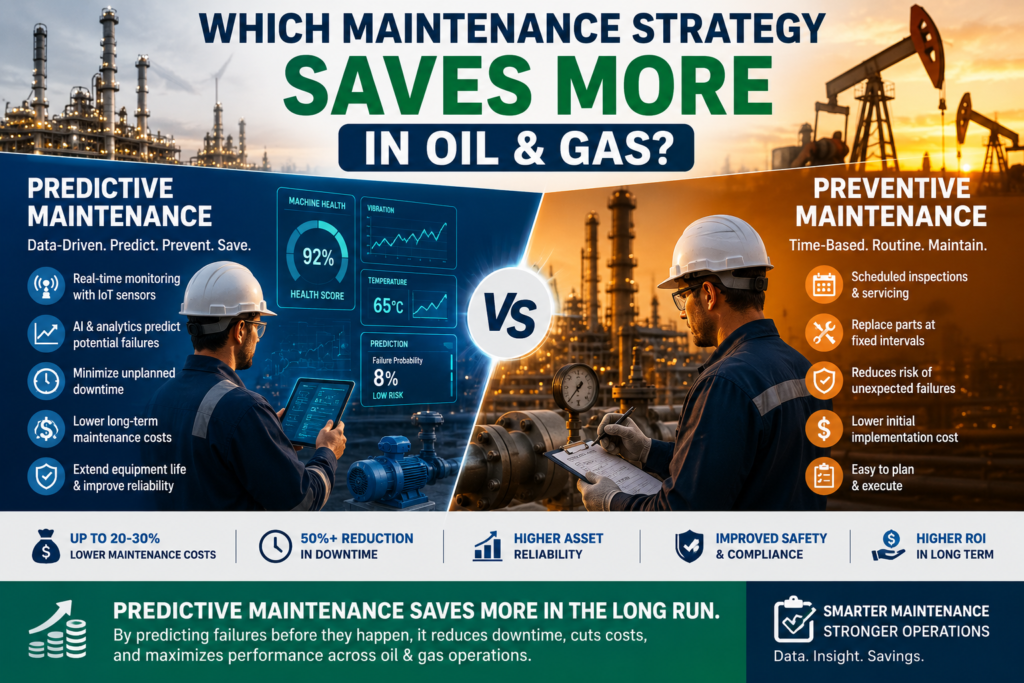
When comparing both strategies from a cost-efficiency and operational performance perspective, predictive maintenance generally delivers better long-term savings.
Firstly, predictive maintenance eliminates unnecessary servicing. As a result, companies avoid replacing parts that are still functional.
Secondly, it significantly reduces unexpected downtime, which is extremely expensive in oil and gas operations.
Moreover, predictive analytics helps teams identify issues early, preventing catastrophic failures.
However, preventive maintenance still holds value in certain cases where:
Therefore, most modern oil & gas companies are shifting toward a hybrid maintenance strategy.
Today, leading organizations are combining both approaches to maximize efficiency.
For example:
This hybrid model ensures:
Modern maintenance strategies are incomplete without digital inspection and tracking systems.
Inspections Track Software for oil and gas inspections industry plays a vital role in bridging the gap between field operations and maintenance planning.
By using such systems, companies can transition smoothly from reactive maintenance to a more intelligent, data-driven model.
Before selecting a maintenance approach, consider the following:
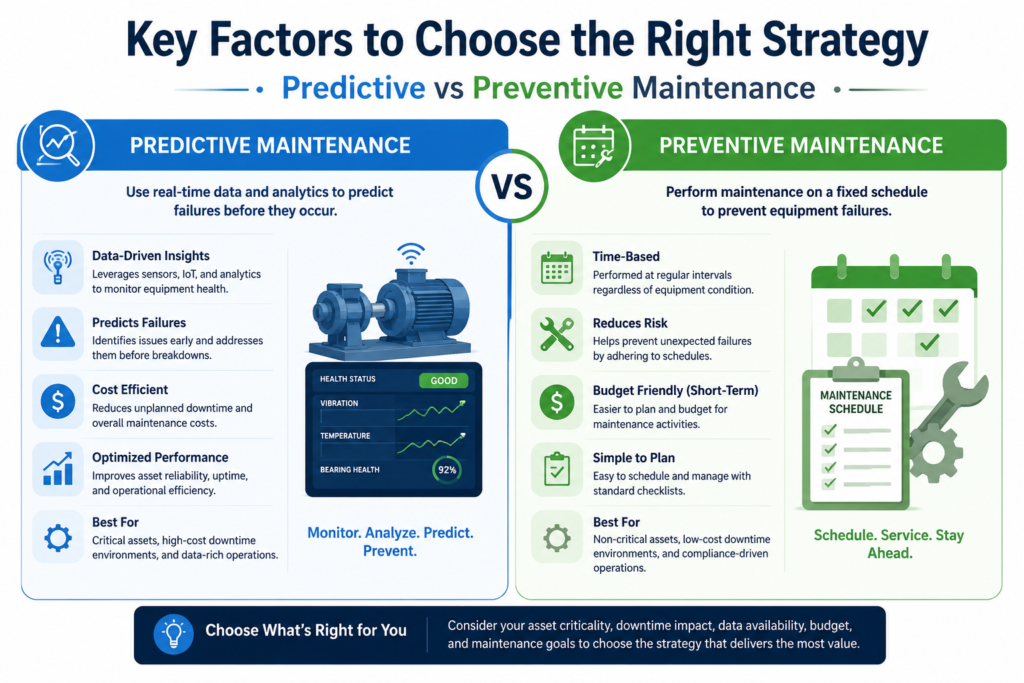
Critical systems benefit more from predictive maintenance.
Preventive maintenance is more budget-friendly initially.
Predictive maintenance requires reliable data infrastructure.
Large-scale operations gain more ROI from predictive systems.
High-risk environments require advanced monitoring.
The future is clearly moving toward AI-powered predictive maintenance systems combined with smart inspection platforms.
With advancements in:
Maintenance will become more automated, accurate, and cost-efficient.
So, which saves more in oil and gas: predictive or preventive maintenance?
While preventive maintenance remains useful for structured scheduling and basic asset care, predictive maintenance delivers superior long-term savings, reduced downtime, and higher operational efficiency.
However, the most effective approach is a hybrid model supported by digital tools like Inspections Track Software for oil and gas inspections industry, enabling companies to make smarter, data-driven maintenance decisions.
In the evolving oil and gas landscape, success will belong to organizations that move from routine maintenance to intelligent, predictive asset management.
Read more : How to Choose Inspection Management Software: A Buyer’s Checklist for Oil & Gas Teams
Preventive maintenance is done on a fixed schedule, while predictive maintenance is based on real-time equipment condition and performance data to predict failures before they happen.
Predictive maintenance is generally more cost-effective in the long term because it reduces unnecessary servicing, minimizes downtime, and prevents major equipment failures.
Yes, most companies use a hybrid approach preventive maintenance for low-risk assets and predictive maintenance for critical equipment to balance cost, safety, and efficiency.
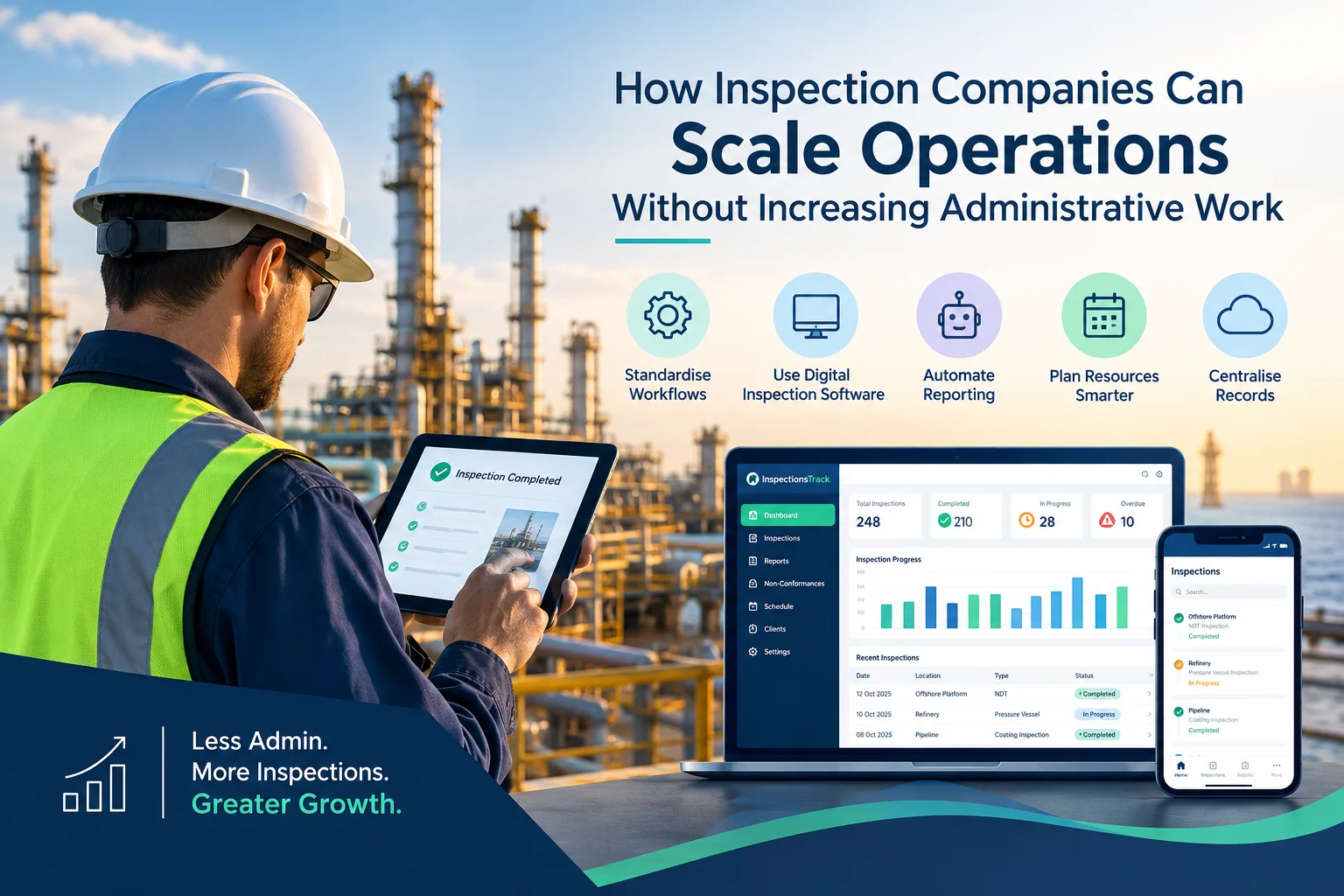
Inspection companies in the oil and gas industry face a common challenge: how to handle more inspections, manage larger projects, and meet client deadlines without increasing administrative workload. As businesses grow, inspection teams must manage…

Meeting client Service Level Agreements (SLAs) is essential for inspection companies working in demanding industries such as oil and gas, energy, and industrial maintenance. Clients expect inspections to be completed on time, reports to be…


