
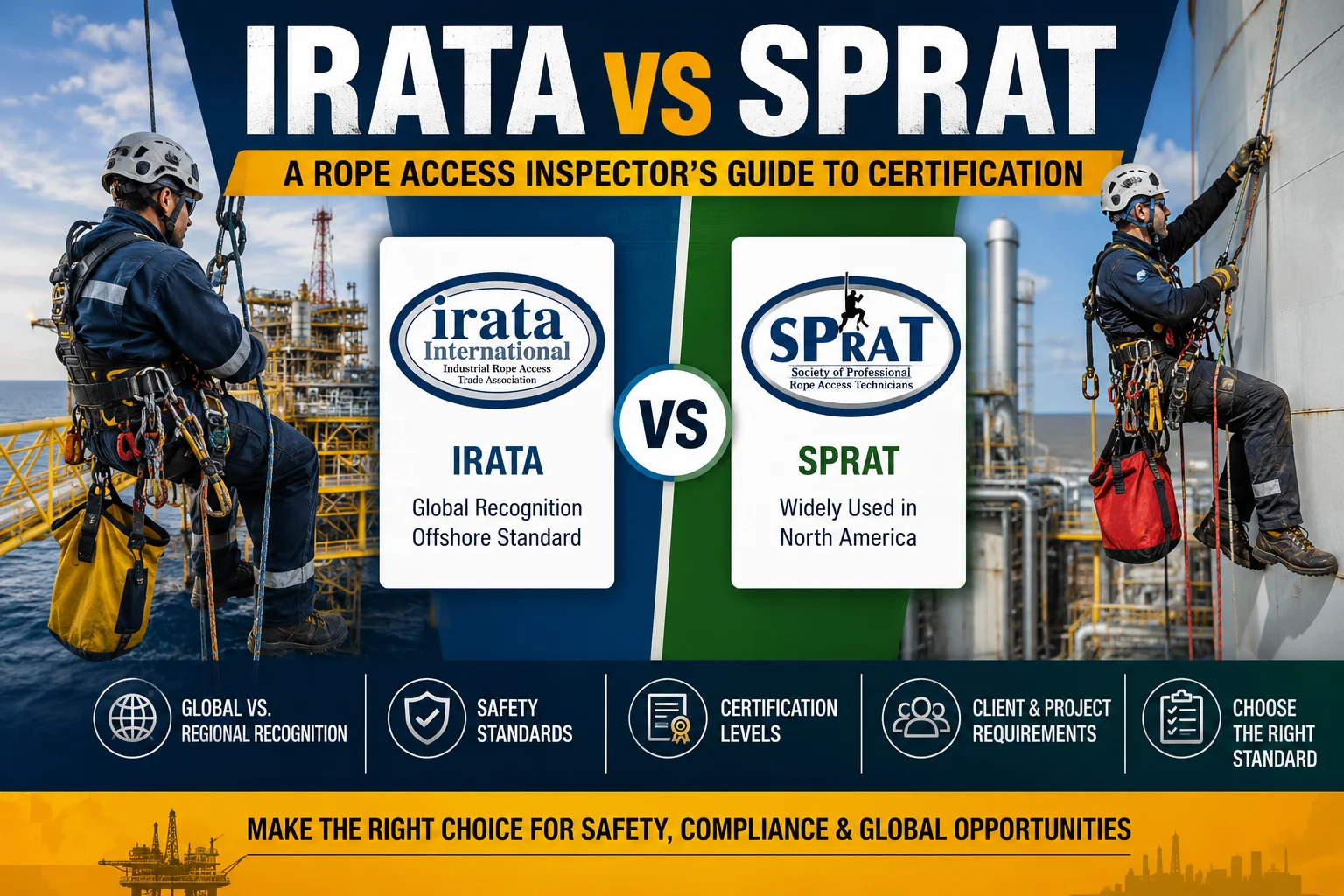
Rope access inspection teams working in offshore and industrial environments face a critical operational challenge: which rope access certification standard should they adopt IRATA or SPRAT?
The decision directly affects workforce mobility, client acceptance, project eligibility, compliance requirements, and inspection efficiency.
For inspection companies operating across multiple regions, selecting the wrong certification framework can create unnecessary barriers during mobilization, contractor prequalification, and client audits.
This guide explains the practical differences between IRATA and SPRAT from an oil and gas inspection operations perspective.
Rope access technicians perform inspections in locations where scaffolding or heavy access equipment is impractical or cost-prohibitive.
Typical inspection activities include:
Because these activities occur in high-risk environments, operators require technicians to hold recognized rope access certifications.
However, not all certifications are universally accepted.
Therefore, understanding the differences between IRATA and SPRAT is essential.
IRATA (Industrial Rope Access Trade Association) is the world’s most widely recognized rope access certification body.
Originally established in the offshore sector, IRATA has become the preferred standard across:
Today, many major operators in the Middle East, Europe, Asia, and offshore regions specify IRATA certification as a contractual requirement.
SPRAT (Society of Professional Rope Access Technicians) is a leading rope access certification organization primarily recognized throughout North America.
SPRAT is extensively used in:
Although SPRAT acceptance continues to grow internationally, its strongest market remains North America.
| Feature | IRATA | SPRAT |
|---|---|---|
| Full Name | Industrial Rope Access Trade Association | Society of Professional Rope Access Technicians |
| Primary Market | Global | North America |
| Offshore Acceptance | Very High | Moderate |
| Middle East Acceptance | Very High | Limited in some contracts |
| European Acceptance | Industry Standard | Less common |
| Certification Levels | Level 1, 2, 3 | Level I, II, III |
| Company Membership Requirement | Mandatory | Not always required |
| Audit Requirements | Extensive | Less prescriptive |
| Work System | Strict two-rope system | Two-rope system with operational flexibility |
| Typical Oil & Gas Preference | Preferred globally | Regional acceptance |
For international offshore projects, IRATA is generally the preferred standard.
Operators frequently requiring IRATA-certified technicians include:
In contrast, SPRAT is often sufficient for:
Therefore, inspection companies serving multinational oil and gas clients typically prioritize IRATA.
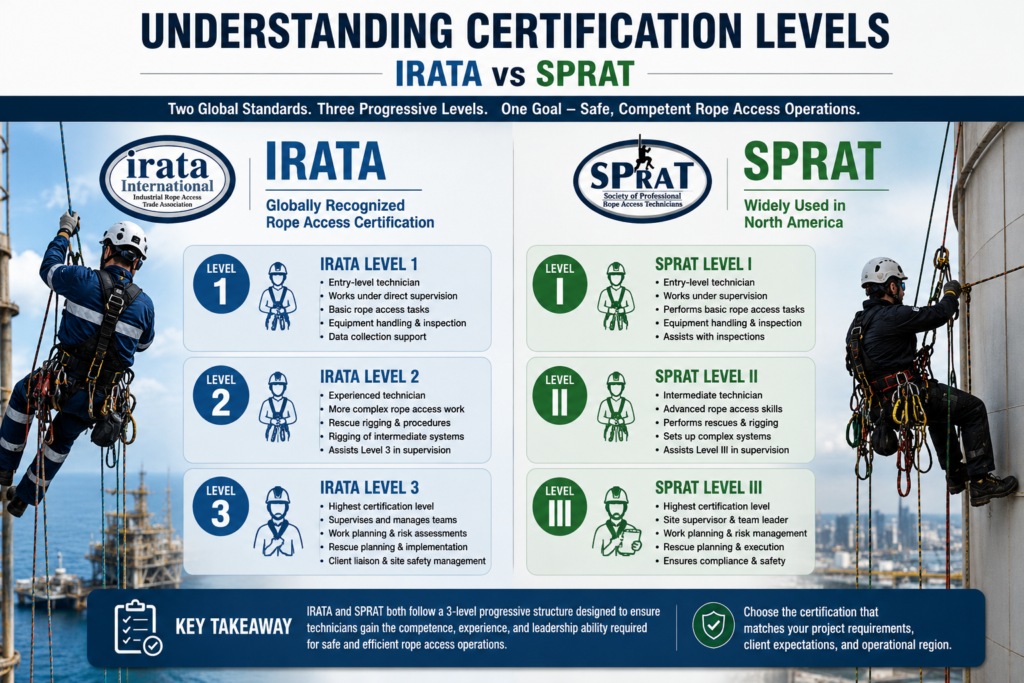
Entry-level technician capable of performing rope access work under supervision.
Typical responsibilities:
Experienced technician capable of more complex operations.
Responsibilities include:
Highest certification level.
Responsibilities include:
It follows a similar structure:
Entry-level rope access technician.
Intermediate technician capable of advanced rope systems and rescues.
Site supervisor responsible for operational oversight and rescue preparedness.
Inspection managers should evaluate several factors before standardizing certifications.
Ask:
| Operating Region | Preferred Certification |
|---|---|
| Middle East | IRATA |
| North Sea | IRATA |
| Asia Pacific Offshore | IRATA |
| Europe | IRATA |
| United States | SPRAT or IRATA |
| Global Operations | IRATA |
Review:
Many operators explicitly state:
“All rope access personnel shall be IRATA certified.”
Failure to comply can immediately disqualify bids.
Companies expanding internationally benefit from globally recognized credentials.
IRATA-certified personnel typically encounter fewer mobilization restrictions across:
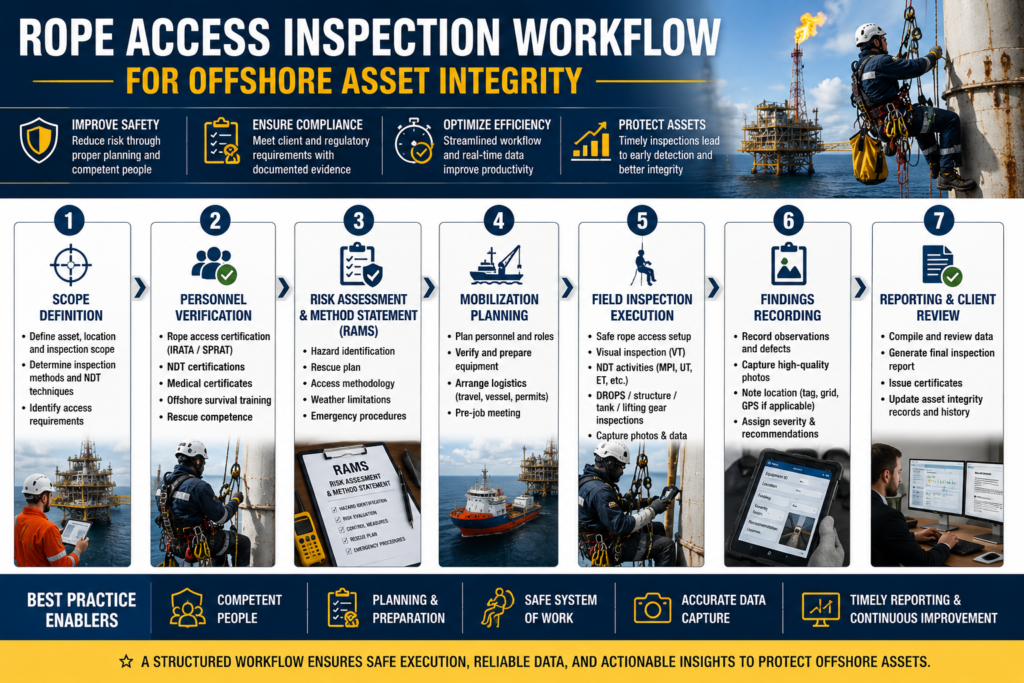
Inspection coordinators define:
Verify:
Develop:
Schedule:
Inspectors perform:
Inspection findings should include:
Generate:
Even highly skilled rope access technicians often struggle with:
Consequently, many organizations are replacing spreadsheets with digital inspection platforms.
The InspectionsTrack Software Suite by Sky Soft Connections helps inspection companies manage rope access inspection activities more efficiently.
Operational capabilities include:
Inspectors can:
Teams can manage:
Standardize inspections across:
Operations managers gain visibility into:
Inspection teams can rapidly generate:
This significantly reduces reporting delays frequently experienced during offshore campaigns.
Many international inspection companies maintain IRATA as their primary certification framework while recognizing SPRAT equivalencies where applicable.
IRATA and SPRAT both establish high standards for rope access safety and competence.
However, from an oil and gas inspection operations perspective, IRATA remains the dominant certification for international and offshore projects.
Ultimately, certification decisions should align with client expectations, geographic strategy, workforce mobility requirements, and operational growth objectives.
Organizations that combine competent rope access personnel with digital inspection management platforms such as the InspectionsTrack Software Suite by Sky Soft Connections are better positioned to improve safety, accelerate reporting, and maintain compliance across complex inspection programs.
Read more : ATEX vs IECEx: Choosing the Right Ex Inspection Standard for Your Site
Neither is inherently better. However, IRATA has broader global acceptance, especially within offshore oil and gas operations.
Many international operators and offshore contractors specify IRATA certification in tender and project requirements.
Only if the client accepts SPRAT equivalency. Many offshore projects specifically require IRATA certification.
For international offshore inspection work, IRATA is generally the preferred and most widely accepted certification.
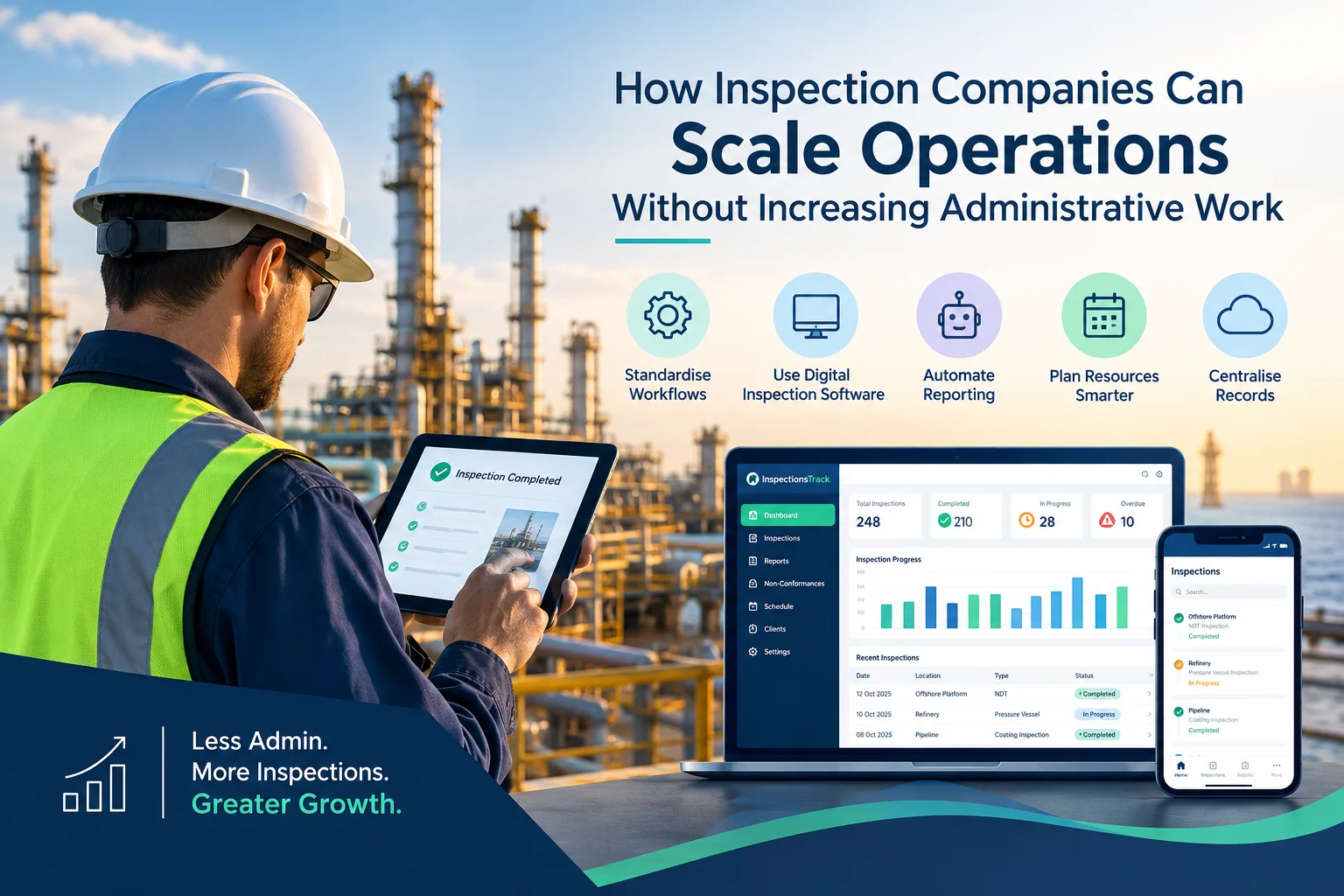
Inspection companies in the oil and gas industry face a common challenge: how to handle more inspections, manage larger projects, and meet client deadlines without increasing administrative workload. As businesses grow, inspection teams must manage…

Meeting client Service Level Agreements (SLAs) is essential for inspection companies working in demanding industries such as oil and gas, energy, and industrial maintenance. Clients expect inspections to be completed on time, reports to be…


