
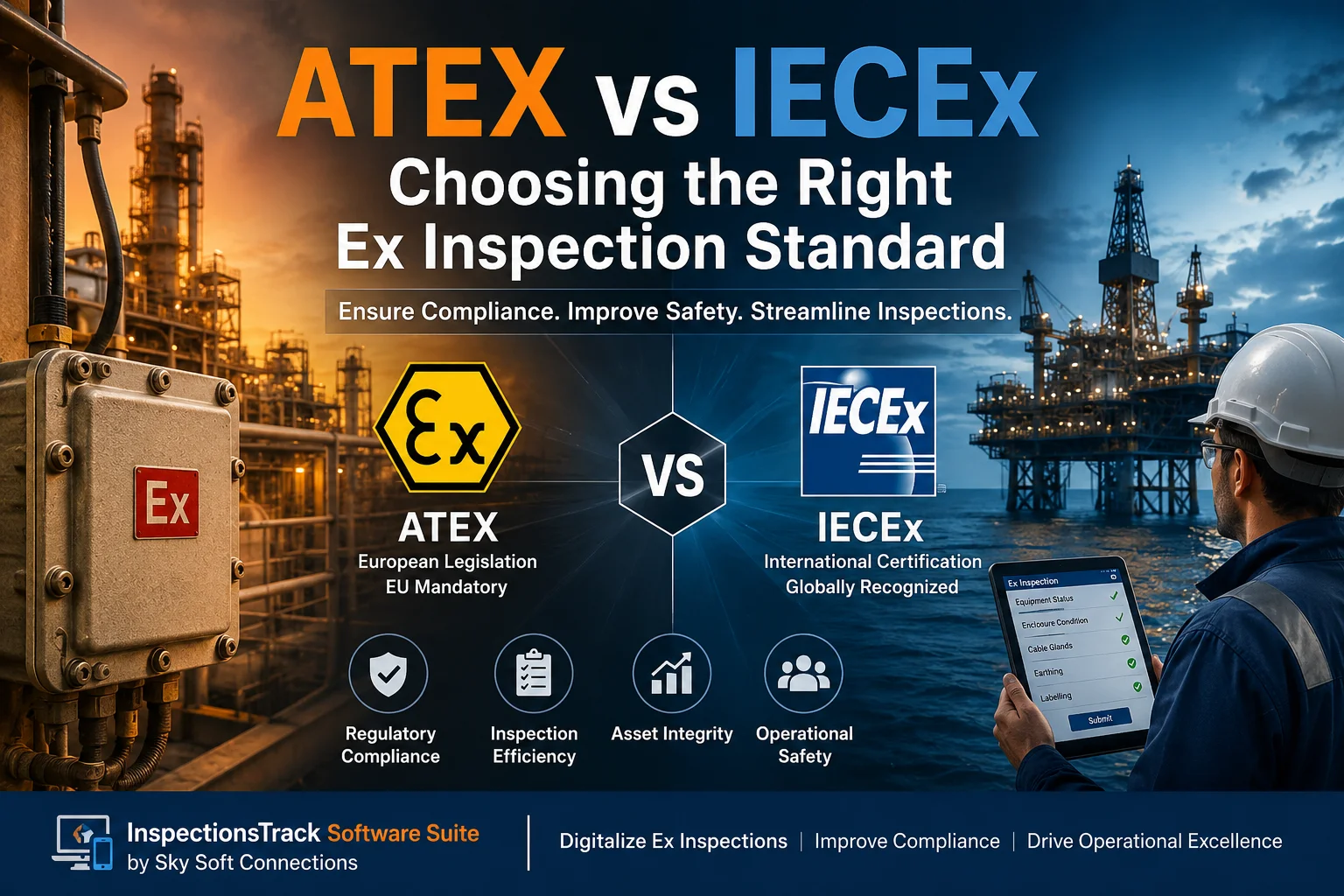
Explosive atmosphere inspections remain one of the most critical compliance activities in oil and gas operations. Yet many inspection teams still struggle with a practical question:
Should our site follow ATEX, IECEx, or both?
This uncertainty often creates operational challenges such as:
For inspection companies, offshore operators, and asset integrity teams, understanding the differences between ATEX and IECEx is essential for maintaining compliance, ensuring operational safety, and reducing inspection inefficiencies.
This guide explains the practical differences between ATEX and IECEx, where each standard applies, and how digital inspection platforms such as the InspectionsTrack Software Suite by Sky Soft Connections help organizations manage Ex inspections more effectively.
Ex inspection standards govern equipment installed in hazardous areas where flammable gases, vapors, dust, or combustible substances may be present.
Typical hazardous environments include:
The primary objective is simple:
Ensure that electrical and mechanical equipment installed in hazardous areas does not become an ignition source.
However, global operations often require compliance with different certification schemes.
The two most widely recognized systems are:
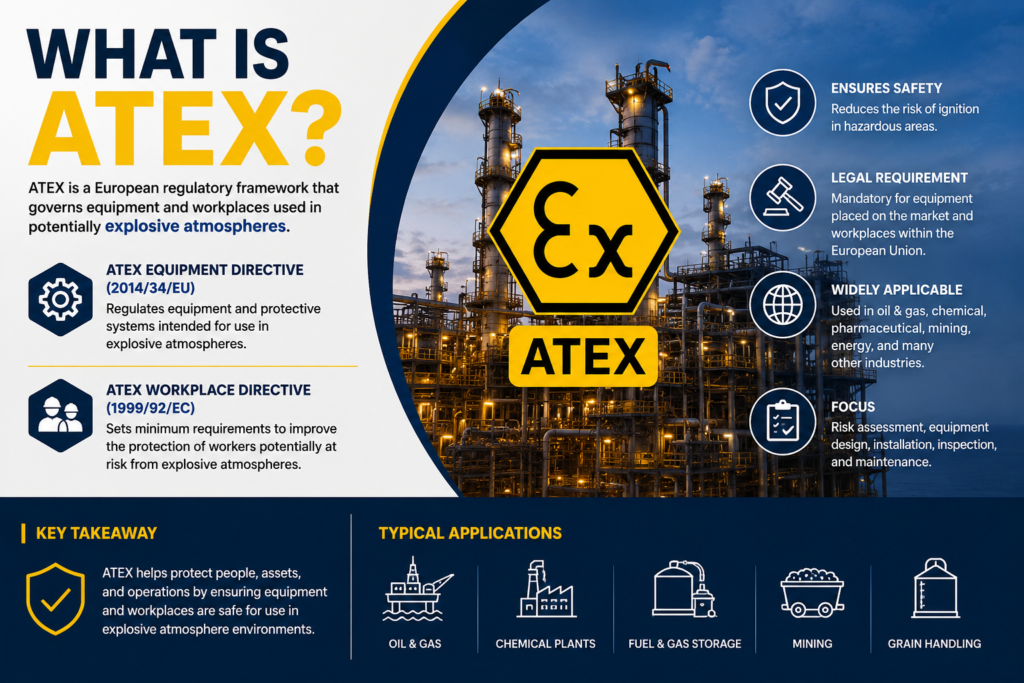
ATEX is a European regulatory framework governing equipment and workplaces used in explosive atmospheres.
The term ATEX originates from the French phrase:
ATmosphères EXplosibles
ATEX consists mainly of two directives:
This directive governs manufacturers and equipment certification.
This directive specifies employer responsibilities for hazardous area classification, worker protection, and inspection requirements.
ATEX is mandatory for equipment placed on the market within the European Union.
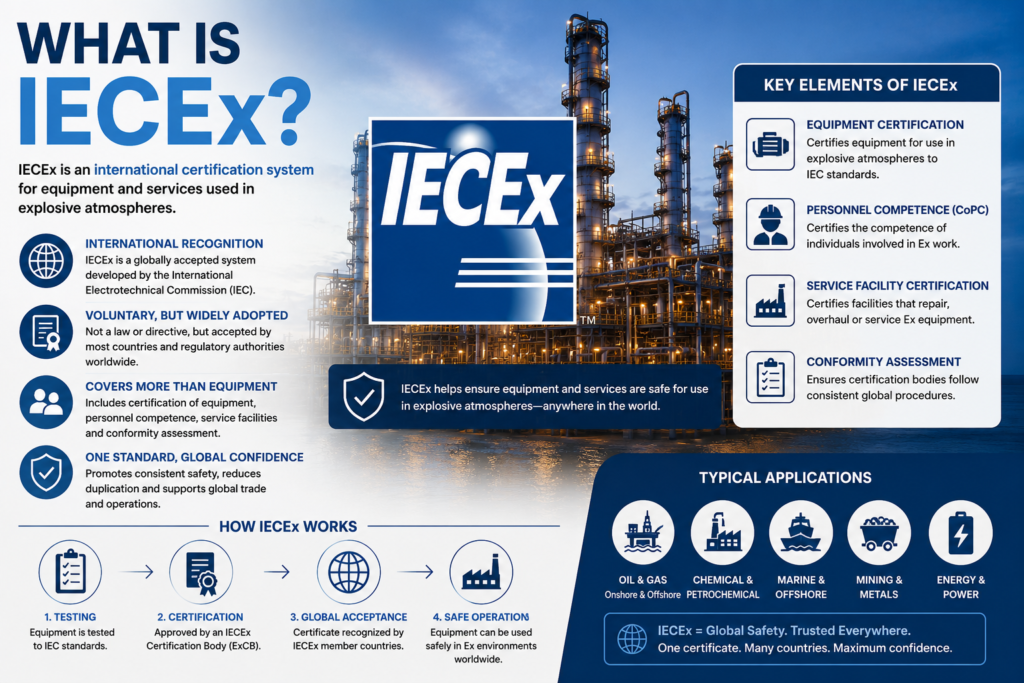
IECEx is an international certification scheme developed by the International Electrotechnical Commission (IEC).
Unlike ATEX, IECEx is not legislation. Instead, it provides globally accepted certification and conformity assessment procedures for equipment used in explosive atmospheres.
Many countries recognize or directly adopt IECEx certification.
IECEx covers:
IECEx has become the preferred framework for many multinational oil and gas operators because it enables standardization across geographically dispersed assets.
| Feature | ATEX | IECEx |
|---|---|---|
| Type | European legislation | International certification scheme |
| Geographic Scope | European Union | Global |
| Legal Requirement | Mandatory within EU | Voluntary unless adopted locally |
| Governing Body | European Union | International Electrotechnical Commission |
| Equipment Marking | CE + Ex Marking | IECEx Certificate Number |
| Personnel Certification | Not mandatory | IECEx CoPC available |
| Documentation Approach | EU Declaration of Conformity | IECEx Certificates and Reports |
| Primary Use | EU market access | International operations |
| Hazardous Area Focus | Workplace + equipment | Equipment + competence + systems |
The answer depends on several operational factors.
Your Facility Operates Within the European Union
Any equipment installed within EU member states typically requires ATEX compliance.
Regulatory Authorities Mandate ATEX
Local legislation often requires ATEX-certified equipment and documentation.
Your Asset Primarily Serves European Markets
Manufacturers supplying equipment to EU facilities generally require ATEX approval.
You Operate Internationally
Multinational operators frequently standardize on IECEx.
Offshore Assets Mobilize Between Regions
Floating assets such as rigs and FPSOs often work in different jurisdictions.
Personnel Competence Verification Is Critical
IECEx provides globally recognized competency certification for inspectors.
In practice, many offshore operators require both.
Consider an example:
A drilling contractor owns an offshore rig operating in:
The rig may contain:
Therefore, inspection teams must maintain accurate records of:
Managing this manually becomes increasingly difficult as assets expand.
Inspection organizations frequently encounter the following issues:
Different sites often use different templates.
As a result, findings become difficult to compare.
Many organizations still track Ex assets using spreadsheets.
Consequently, inspectors struggle to determine:
Auditors often request:
Retrieving these documents manually can consume days.
Offshore environments frequently suffer from poor network coverage.
Inspectors still need uninterrupted access to:
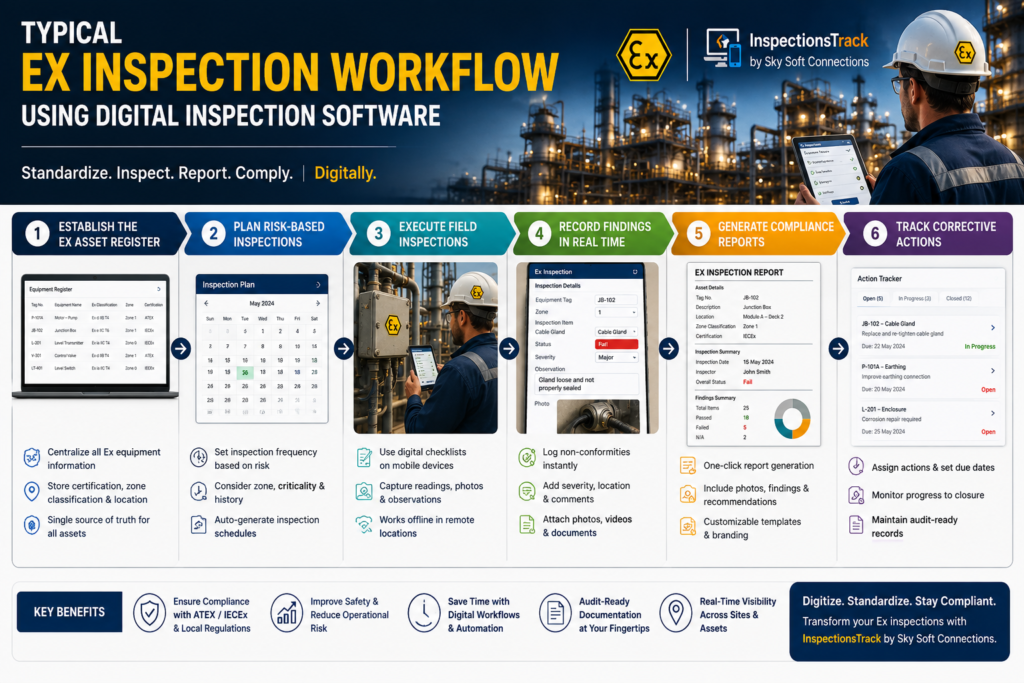
A structured workflow significantly improves compliance.
Create a centralized register containing:
Schedule inspections based on:
Inspectors perform checks on mobile devices using standardized digital forms.
Typical checks include:
Inspectors capture:
Even when offline, information remains available.
Reports should automatically include:
Open findings remain visible until formally closed.
This ensures audit readiness and improves asset integrity management.
Read more : atex zone ex inspections for oil gas safety
The InspectionsTrack Software Suite by Sky Soft Connections helps oil and gas organizations streamline hazardous area inspection activities.
Key capabilities include:
Maintain complete equipment records in one secure platform.
Inspectors can conduct inspections on offshore assets without network dependency.
Data synchronizes automatically once connectivity returns.
Organizations can create consistent inspection procedures aligned with:
Inspection teams can significantly reduce reporting delays.
Operations managers gain immediate insight into:
Historical reports, certificates, photographs, and corrective actions remain instantly accessible during audits.
Use the following decision framework.
Leading operators typically adopt the following practices:
These practices not only improve compliance but also reduce operational risk.
Choosing between ATEX and IECEx is rarely a simple regulatory decision. Instead, it is an operational decision that affects inspection workflows, asset integrity, audit readiness, and workforce competence.
For organizations operating solely within Europe, ATEX often remains the primary requirement. However, multinational operators frequently adopt IECEx or a combination of both standards to support global operations.
Regardless of the framework selected, digitalizing Ex inspection processes delivers substantial benefits. Standardized inspections, centralized records, faster reporting, and real-time visibility help organizations maintain safer and more compliant operations.
If your team is looking to improve Ex inspection workflows, accelerate reporting, or support broader digital transformation initiatives, consider exploring a free demo or consultation of the InspectionsTrack Software Suite by Sky Soft Connections to see how modern inspection management can simplify hazardous area compliance.
Read more : LOLER vs PUWER: What Oil & Gas Lifting Inspections Actually Require
ATEX is European legislation governing explosive atmosphere equipment, whereas IECEx is an international certification system recognized globally.
IECEx certificates may support compliance activities, but equipment placed on the EU market generally requires ATEX certification.
Yes. Many offshore operators working across multiple regions use both standards to satisfy varying client and regulatory requirements.
Yes. Digital inspection software centralizes asset records, standardizes inspections, improves reporting speed, and maintains audit-ready documentation.
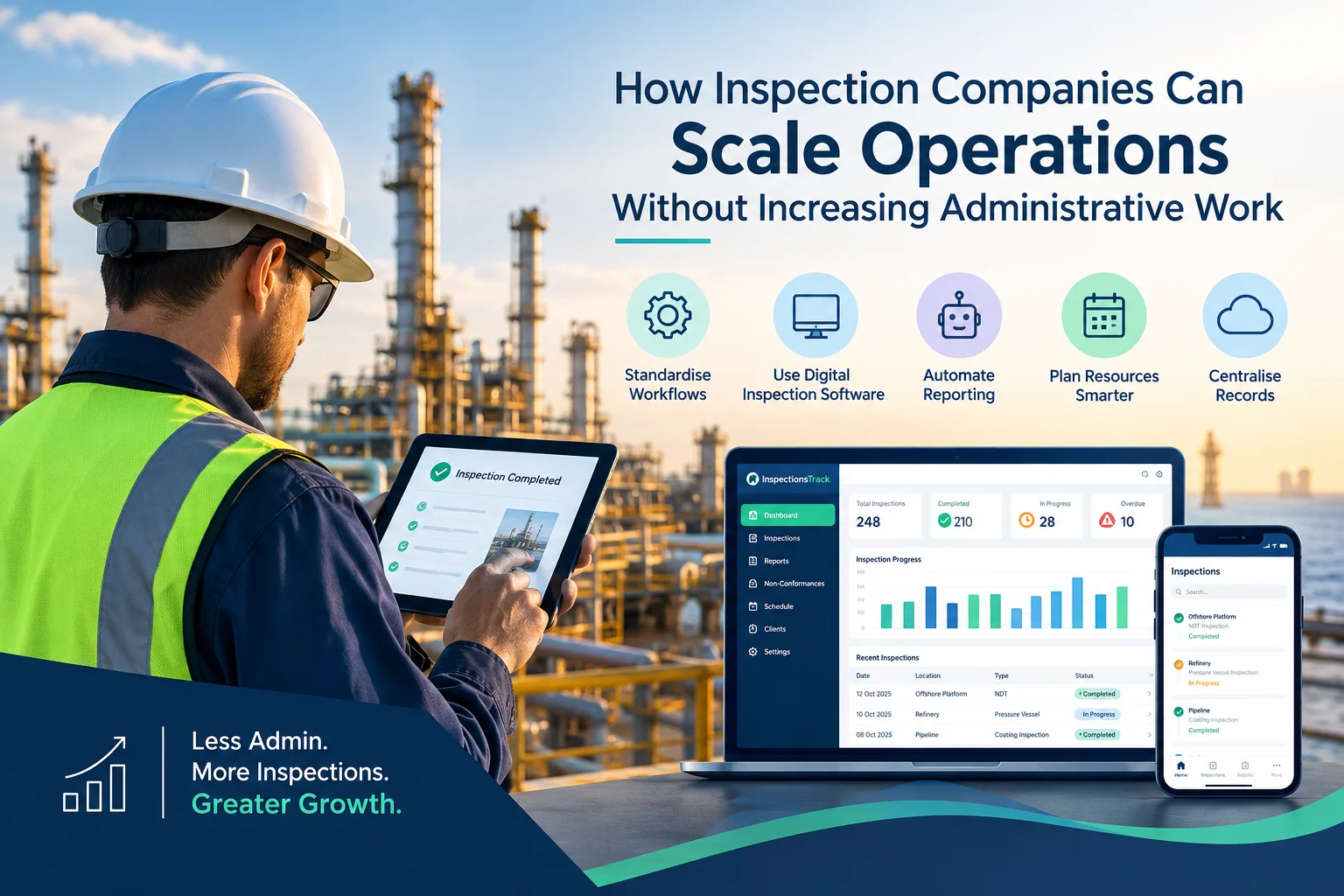
Inspection companies in the oil and gas industry face a common challenge: how to handle more inspections, manage larger projects, and meet client deadlines without increasing administrative workload. As businesses grow, inspection teams must manage…

Meeting client Service Level Agreements (SLAs) is essential for inspection companies working in demanding industries such as oil and gas, energy, and industrial maintenance. Clients expect inspections to be completed on time, reports to be…


