

Inspection evidence is more than a collection of photos and documents. For oil and gas inspection companies, it provides the proof behind inspection findings, compliance decisions, equipment condition, and corrective actions.
However, inspection teams often manage evidence across mobile devices, shared folders, spreadsheets, emails, and paper files. As a result, finding the right inspection photo, certificate, or report can become difficult when clients, auditors, or management need information quickly.
Inspection evidence management provides a structured way to capture, organize, store, retrieve, and share inspection records.
With the right inspection management software, companies can connect photos, certificates, reports, checklists, assets, and inspection findings in one organized system.
Inspection evidence management is the process of organizing and controlling the documentation collected during inspections.
This evidence can include:
Instead of storing each item separately, an effective system connects the evidence to the relevant job, asset, inspection, finding, and report.
Therefore, inspectors and managers can trace evidence back to the original inspection without searching through multiple folders or email threads.
Oil and gas inspections involve safety-critical equipment and assets. Consequently, inspection evidence must be accurate, accessible, and properly organized.
For example, an inspection of a crane may generate:
| Evidence Type | Example |
|---|---|
| Photos | Structural condition, wire rope, hooks, defects |
| Checklist | Completed crane inspection checklist |
| Certificate | Previous examination or calibration certificate |
| Findings | Identified defects or observations |
| Corrective Action | Evidence showing the issue was resolved |
| Report | Final inspection report |
| Asset History | Previous inspections and related records |
When these records are connected, teams can understand the complete inspection history of an asset.
Furthermore, organized evidence helps companies respond to client requests, internal reviews, audits, and compliance checks more efficiently.
Many inspection companies still rely on manual methods. Although these methods may work for small jobs, they become difficult to manage as inspection volumes increase.
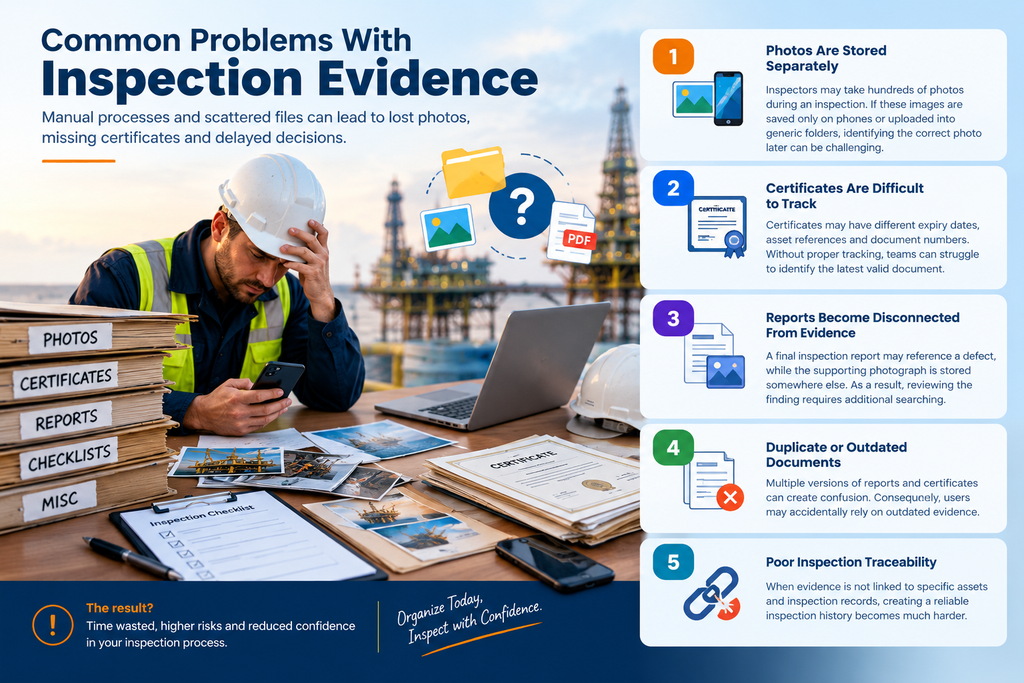
Inspectors may take hundreds of photos during an inspection. If these images are saved only on phones or uploaded into generic folders, identifying the correct photo later can be challenging.
Certificates may have different expiry dates, asset references, and document numbers. Without proper tracking, teams can struggle to identify the latest valid document.
A final inspection report may reference a defect, while the supporting photograph is stored somewhere else.
As a result, reviewing the finding requires additional searching.
Multiple versions of reports and certificates can create confusion. Consequently, users may accidentally rely on outdated evidence.
When evidence is not linked to specific assets and inspection records, creating a reliable inspection history becomes much harder.
A practical inspection evidence management process should follow a consistent structure.
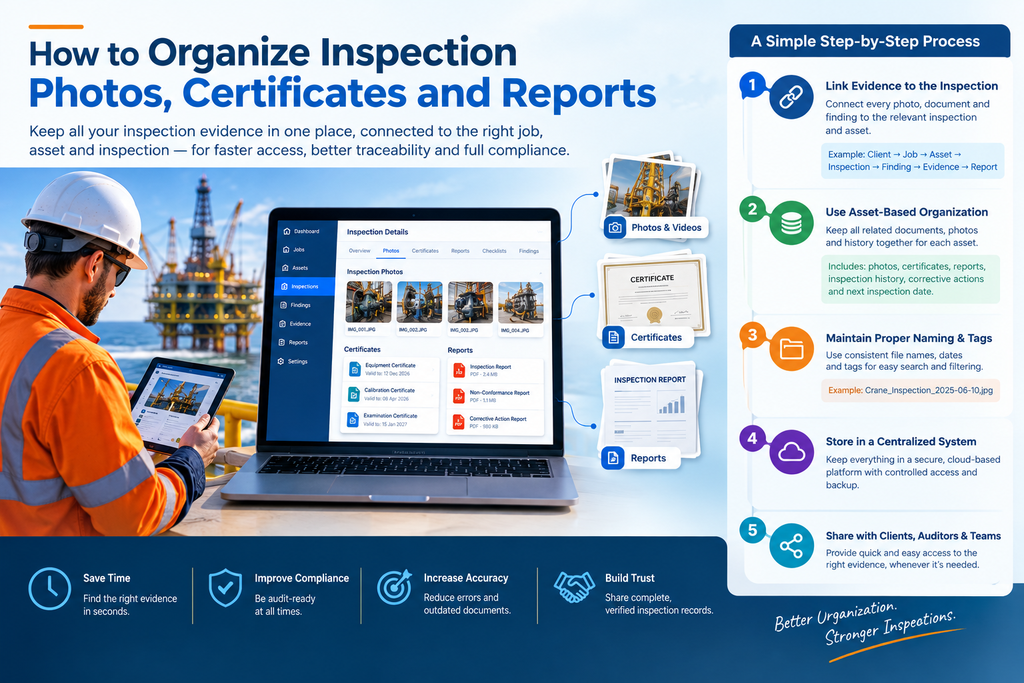
Every photo, document, and finding should be connected to the relevant inspection.
For example:
Client → Job → Asset → Inspection → Finding → Evidence → Report
This structure creates a clear audit trail.
Instead of organizing documents only by date, organize them around assets and equipment.
For example, an asset record can contain:
This approach makes historical information easier to retrieve.
Inspection teams should follow consistent photo practices.
Photos should clearly show:
Where possible, inspection software should associate photographs directly with inspection items instead of requiring inspectors to manually sort them later.
Certificates should not exist as isolated files.
Instead, link them to the relevant equipment or inspection record. This allows teams to identify supporting documentation when reviewing an asset.
Rather than manually creating reports from multiple sources, inspection software can use captured inspection data to generate standardized reports.
This reduces repetitive administrative work and helps maintain consistency.
For oil and gas inspection companies, useful capabilities include:
| Feature | Why It Matters |
|---|---|
| Photo management | Keeps visual evidence connected to inspections |
| Document management | Organizes certificates and supporting files |
| Asset history | Provides historical inspection visibility |
| Digital checklists | Standardizes inspection data collection |
| Offline capability | Supports inspections in areas with limited connectivity |
| Report generation | Speeds up final documentation |
| Audit trail | Tracks inspection activity and changes |
| Client portal | Makes approved records easier to share |
| Search and filtering | Helps teams find records quickly |
| QR traceability | Connects physical assets with digital records |
Sky Soft Connections’s InspectionsTrack is an inspection management software suite designed for inspection companies working across oil and gas and other industrial environments.
The platform brings inspection jobs, assets, evidence, reports, and inspection history into a connected digital workflow.
With InspectionsTrack, inspection teams can manage:
Because evidence can be captured during the inspection and connected to the relevant job or asset, teams can reduce the need for manual document sorting.
The platform also supports Windows Desktop, Android Mobile, and Web Portal workflows, making it suitable for teams that need inspection information across field and office environments.
Moving from scattered files to a structured inspection evidence system can improve several parts of the inspection process.
Teams can locate inspection records, photographs, certificates, and reports without searching through multiple storage locations.
A structured audit trail provides clearer evidence of what was inspected, when it was inspected, who performed the work, and what findings were recorded.
Clients can receive organized reports and supporting evidence rather than disconnected files.
Connecting current and previous inspections provides a clearer view of equipment condition over time.
Digital workflows reduce repetitive tasks such as manually renaming photographs, sorting documents, and compiling report information.
To build a reliable evidence management process, inspection companies should:
Read more : How to Create an Inspection History That Auditors and Clients Can Trust
Inspection evidence management is the process of capturing, organizing, storing, tracking, and retrieving inspection photos, certificates, reports, checklists, and other supporting records.
Linking photos to specific assets makes evidence easier to retrieve and provides stronger inspection traceability and equipment history.
Yes. Inspection management software can organize certificates, reports, photographs, checklists, and other documents and connect them with jobs, assets, and inspections.
Inspections Track helps oil and gas inspection companies manage digital checklists, inspection evidence, asset history, reports, certificates, QR traceability, audit trails, and client documentation through connected desktop, mobile, and web workflows.
Effective inspection evidence management turns scattered photos, certificates, reports, and inspection records into a structured source of information.
For oil and gas inspection companies, this means more than simply storing documents. Evidence should be connected to the correct asset, inspection, finding, and report so that teams can quickly understand what happened and verify the supporting information.
By using a dedicated inspection management platform such as InspectionsTrack, companies can create a more organized inspection workflow, improve traceability, simplify reporting, and make inspection evidence easier for inspectors, managers, clients, and auditors to access.
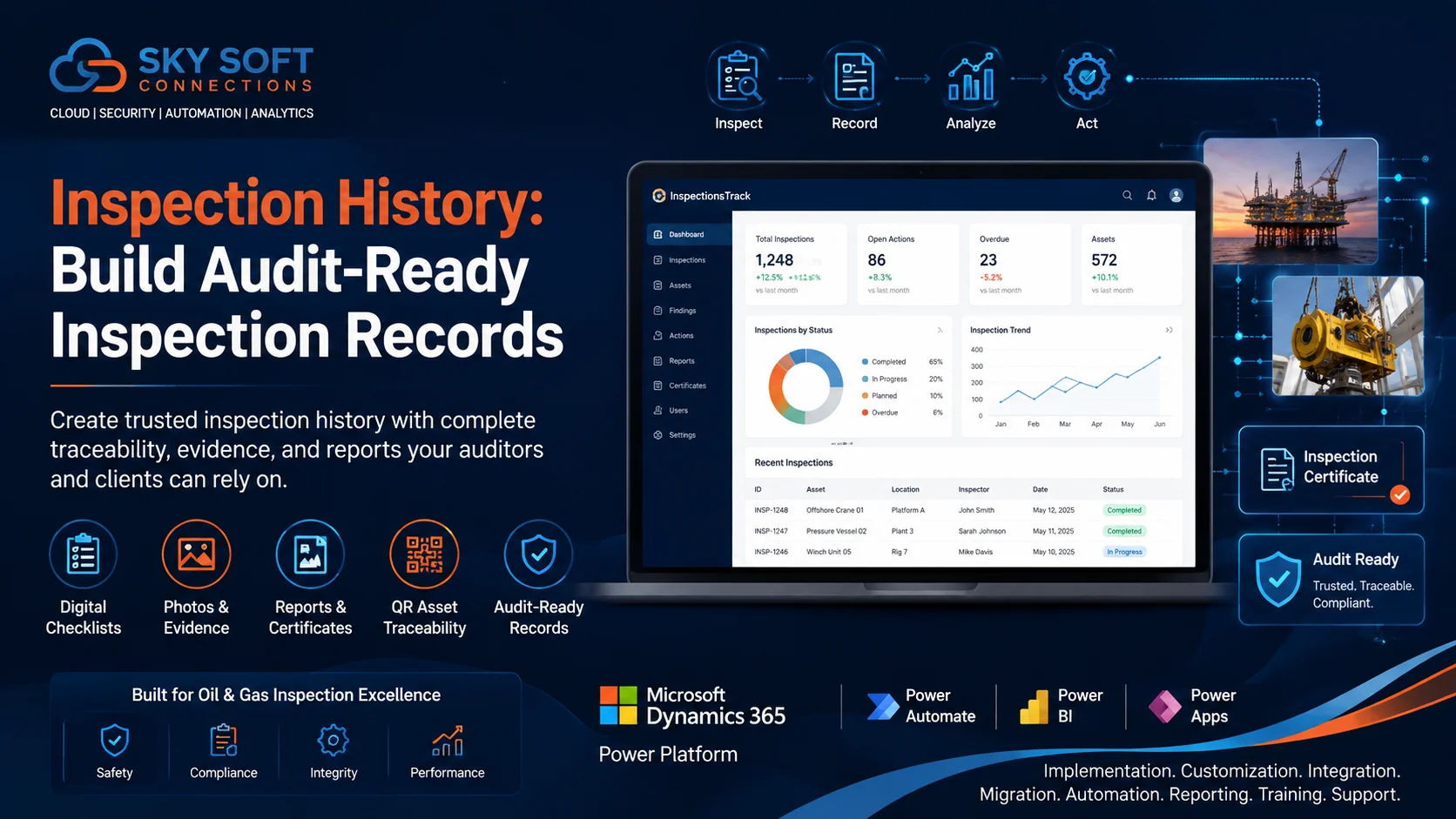
In oil and gas, inspection records are more than documents stored after a job is completed. They provide evidence that assets were inspected, defects were identified, corrective actions were tracked, and safety requirements were followed….

Missed and overdue inspections can create more than scheduling problems. In the oil and gas industry, delayed inspections can affect equipment availability, compliance records, maintenance planning, and operational visibility. For inspection companies managing multiple assets,…


