
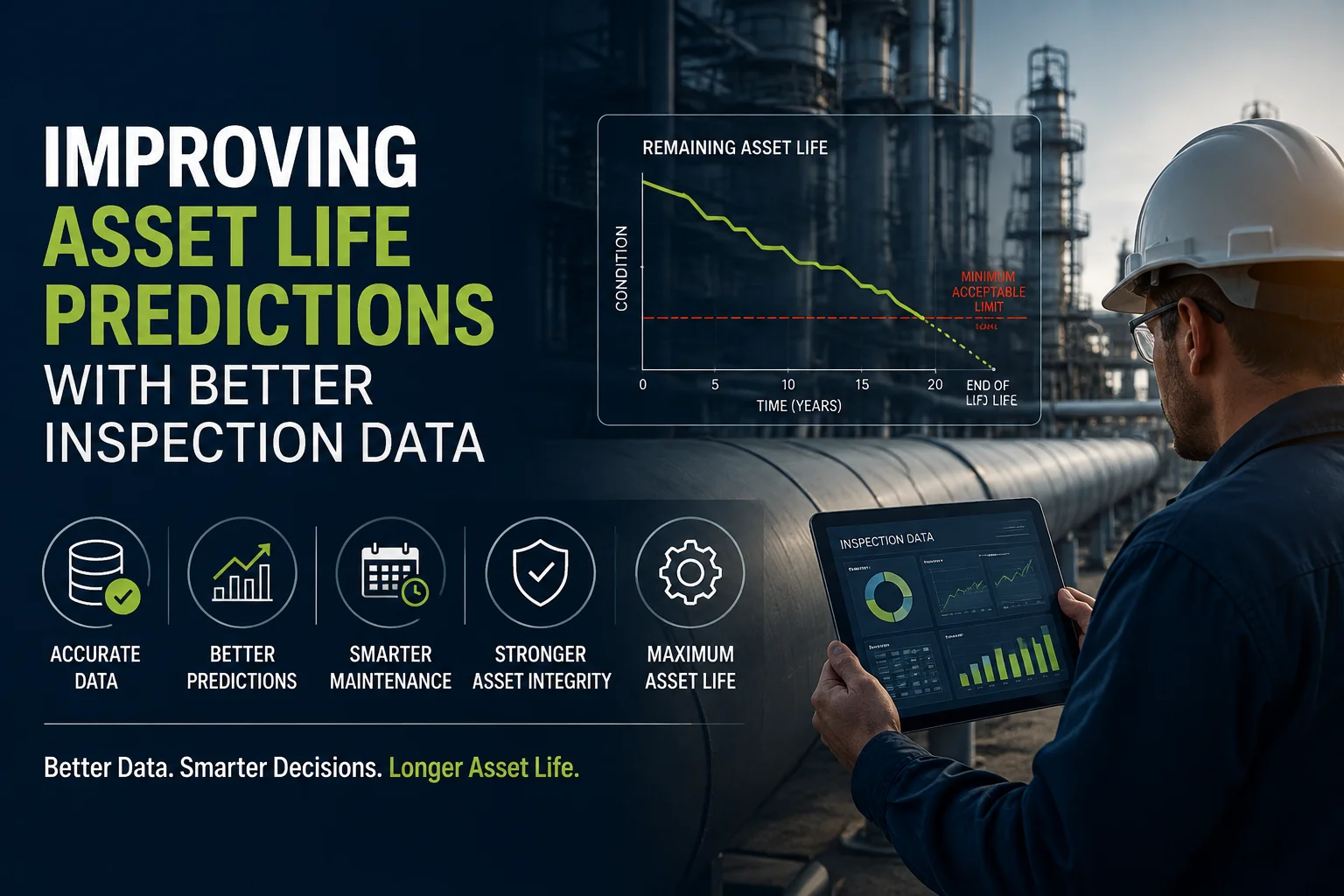
Knowing how long an industrial asset can continue operating safely is one of the most important questions for asset integrity and maintenance teams.
In the Oil & Gas industry, this question becomes even more important. Equipment such as pressure vessels, pipelines, storage tanks, cranes, derricks and other critical assets can operate for many years while being exposed to corrosion, fatigue, erosion, high temperatures, pressure and demanding operating environments.
The challenge is that asset life cannot be predicted accurately by looking at its current condition alone.
Inspection history matters.
A thickness measurement taken today tells an engineer what the asset looks like now. When that measurement is compared with previous inspection results, however, it can reveal how quickly the asset is changing.
This is why better inspection data plays such an important role in asset life predictions.
When inspection information is accurate, consistent and available over time, inspection and asset integrity teams can make better decisions about maintenance, inspection frequency, repairs and eventual asset replacement.
Asset life prediction is the process of estimating how long an asset can continue to operate before its condition reaches a defined safety, performance or integrity limit.
The prediction may be based on several factors, including the asset’s current condition, historical inspection results, deterioration rate, operating environment and maintenance history.
For example, an inspection team may discover that the wall thickness of a pipeline has reduced gradually over several inspection cycles. By comparing those measurements, engineers can estimate the corrosion rate and assess how much usable thickness remains.
This information can then contribute to a remaining useful life assessment.
In practice, asset life prediction is not simply about answering the question, “When will this asset fail?”
It is about understanding how the asset is changing and determining what should be done before its condition becomes unacceptable.
Industrial assets usually do not deteriorate at a constant or perfectly predictable rate.
Corrosion can accelerate because of changes in operating conditions. A crack can grow over time. Erosion can become more severe in certain areas. Previous repairs may also affect future performance.
As a result, a single inspection report provides only a snapshot.
Historical inspection data provides the bigger picture.
Consider a piece of equipment that has been inspected several times:
| Year | Wall Thickness | Condition |
|---|---|---|
| 2022 | 12.0 mm | Good |
| 2023 | 11.5 mm | Minor corrosion |
| 2024 | 10.9 mm | Moderate corrosion |
| 2025 | 10.2 mm | Increasing degradation |
| 2026 | 9.6 mm | Further assessment required |
Looking only at the 2026 result tells us that the wall thickness is 9.6 mm.
Looking at the complete history tells us something much more useful. The thickness has been declining consistently, which provides evidence of an ongoing deterioration process.
That information can support engineering assessments and maintenance planning.
Many inspection companies and Oil & Gas operators have years of valuable inspection information, but that information is not always easy to use.
Reports may be stored in different folders. Measurements might be recorded in spreadsheets. Photographs could be saved separately. Previous reports may exist as PDFs, while maintenance records are stored in another system.
Over time, this creates a data management problem.
An engineer trying to understand the history of a particular asset may need to search through several systems before finding the information required.
This becomes especially difficult when an organization manages thousands of assets across multiple facilities.
The problem is not necessarily a lack of inspection data.
The problem is that the data is difficult to connect.
Poor inspection data can have a direct impact on asset life predictions.
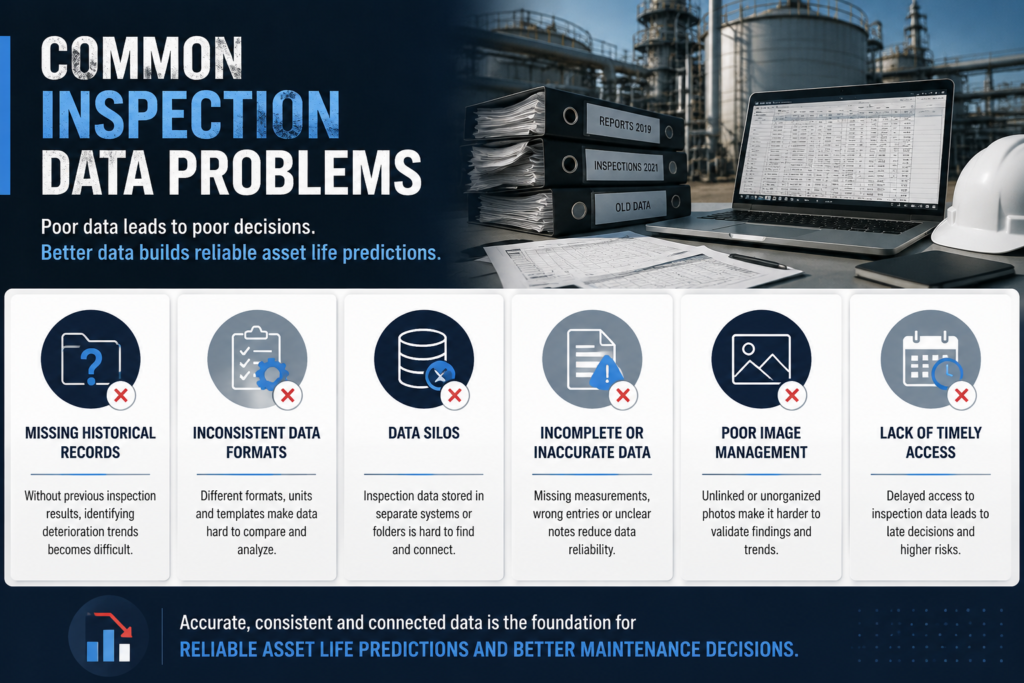
If previous inspection results are unavailable, it becomes harder to identify deterioration trends.
A current thickness reading is much more valuable when it can be compared with measurements from previous years.
Different inspectors may record similar findings in different ways.
For example, one inspector might record “general corrosion” while another uses “surface corrosion” or simply “corrosion.”
Without standard terminology and structured inspection forms, comparing results becomes more difficult.
Inspection information must be associated with the correct asset.
If equipment IDs, locations or inspection points are inconsistent, historical results may not be connected correctly.
That can lead to incomplete asset histories and unreliable analysis.
Manual data entry introduces another source of risk.
Measurements may be copied incorrectly from field notes into spreadsheets or reports. Over time, even small errors can affect the quality of historical datasets.
Photos and supporting documents often contain important information about asset condition.
If those files are separated from the inspection record, engineers may have to spend additional time finding the evidence behind a particular finding.
Useful inspection data should be accurate, consistent, complete and traceable.
It should also remain accessible throughout the asset’s lifecycle.
A strong inspection record may include the asset identification, inspection date, inspection method, measurements, observations, defect information, photographs, recommendations and corrective actions.
| Data Type | Example |
|---|---|
| Asset information | Asset ID, equipment type and location |
| Inspection details | Date, inspector and inspection method |
| Measurements | Thickness, dimensions and test readings |
| Defects | Corrosion, cracking, erosion or damage |
| Evidence | Photos and supporting documents |
| Maintenance history | Repairs and corrective actions |
| Risk information | Risk rating and priority |
| Compliance information | Certificates and inspection requirements |
When these elements are connected, an organization can build a much more useful history for every asset.
Digital inspection software can help solve many of the data problems associated with traditional inspection processes.
Instead of treating every inspection as a separate document, digital systems can connect inspection results to the relevant asset and maintain a history of previous inspections.
This creates a more complete view of asset condition.
Inspectors can use standardized digital forms and checklists, while management teams can access inspection information without searching through multiple folders and spreadsheets.
More importantly, the data collected during one inspection can remain useful during future inspections.
For Oil & Gas inspection companies and asset integrity teams, InspectionsTrack provides a digital platform for managing inspection activities, assets, inspection forms, reports and documentation.
The platform is designed to help inspection teams move away from fragmented paperwork and create a more structured digital inspection process.
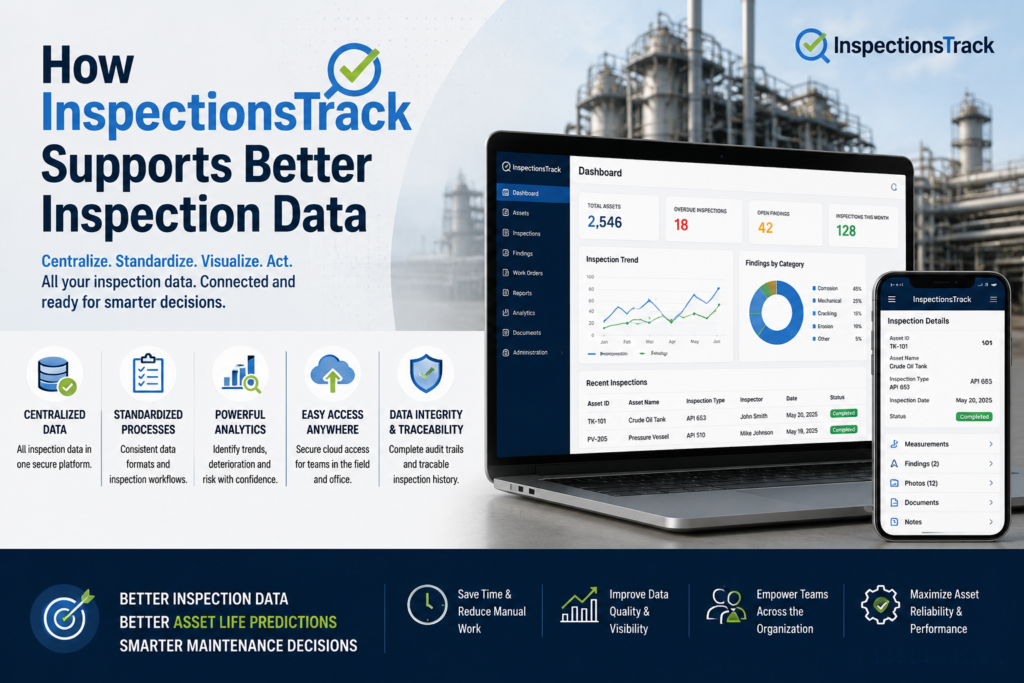
InspectionsTrack allows inspection information to be organized around assets.
This makes it easier for teams to review previous inspections and understand what has changed since the last inspection.
For an asset with recurring corrosion, for example, the inspection history can provide valuable context when reviewing its current condition.
Consistent data collection is important when inspection results need to be compared over several years.
InspectionsTrack provides digital forms and checklists that help inspection teams follow a consistent inspection process.
This reduces the variation that can occur when different inspectors use different paperwork or spreadsheets.
Keeping inspection information connected to the correct asset is essential.
InspectionsTrack helps teams organize asset information and associate inspection records with the relevant equipment.
This creates a clearer history that can be used during future inspections and asset reviews.
Photos, reports, certificates and other documentation can provide important context around an inspection finding.
Keeping inspection information organized digitally makes it easier to trace findings back to the supporting evidence.
Oil & Gas inspection work does not always take place in environments with reliable internet access.
With offline capabilities, inspection teams can continue collecting information in the field and synchronize their work when connectivity becomes available.
This helps reduce reliance on paper notes and manual data transfer.
One of the main benefits of maintaining reliable inspection history is the ability to understand deterioration over time.
For example, suppose an asset has a current wall thickness of 10 mm and the minimum acceptable thickness is 7 mm.
If historical inspections indicate that the asset is losing approximately 0.5 mm of thickness each year, a simplified estimate could indicate around six years before reaching the defined limit.
The calculation would be:
Remaining Life = (Current Thickness − Minimum Thickness) ÷ Corrosion Rate
In this example:
(10 − 7) ÷ 0.5 = 6 years
However, real asset life assessments are considerably more complex than this simplified example.
Engineers may need to consider material properties, inspection accuracy, operating conditions, corrosion mechanisms, defect location, pressure, temperature and other engineering factors.
Therefore, inspection software does not replace engineering judgment.
Instead, it helps provide the reliable historical information that engineers need when making those assessments.
Good inspection data can also help organizations move beyond purely reactive maintenance.
Reactive maintenance happens after a problem has already developed.
Preventive maintenance follows a predefined schedule.
Predictive maintenance takes a different approach. It uses available condition and historical data to identify signs of deterioration and potential problems before they become serious.
For example, if inspection data shows that corrosion is accelerating on a particular asset, the organization may decide to investigate the cause, increase inspection frequency or plan corrective work.
Without reliable historical data, these decisions are much harder to make.
The real value of inspection data often appears when results from multiple inspection cycles are compared.
Consider this example:
| Year | Corrosion Rate | Defect Severity | Risk |
|---|---|---|---|
| 2022 | 0.2 mm/year | Low | Low |
| 2023 | 0.2 mm/year | Low | Low |
| 2024 | 0.4 mm/year | Medium | Medium |
| 2025 | 0.5 mm/year | Medium | Medium |
| 2026 | 0.7 mm/year | High | High |
The important finding is not simply that the asset has a high risk rating in 2026.
The bigger concern is the increasing deterioration rate.
This trend may justify further investigation or a change in the inspection and maintenance strategy.
That is where historical inspection data becomes particularly valuable.
Asset life prediction is not only about estimating when an asset may need replacement.
The same information can help answer practical questions such as:
When should the asset be inspected again?
Should the inspection frequency be increased?
Does the asset require corrective maintenance?
Which equipment should receive priority?
Is repair more appropriate than replacement?
Has the condition of the asset changed significantly since the previous inspection?
These questions are central to effective asset integrity management.
Artificial intelligence and machine learning are increasingly being discussed in connection with predictive maintenance and asset integrity.
However, sophisticated analytics cannot compensate for poor underlying data.
If inspection records contain missing measurements, incorrect asset IDs, inconsistent terminology or incomplete historical information, an AI system may struggle to identify reliable patterns.
This is why organizations should focus on building a strong inspection data foundation before attempting to implement advanced predictive models.
Structured digital inspection data can provide that foundation.
Once reliable information has been collected consistently over time, organizations have a much stronger dataset for analytics, reporting and future AI applications.
Organizations looking to improve asset life predictions can start with a few practical steps.
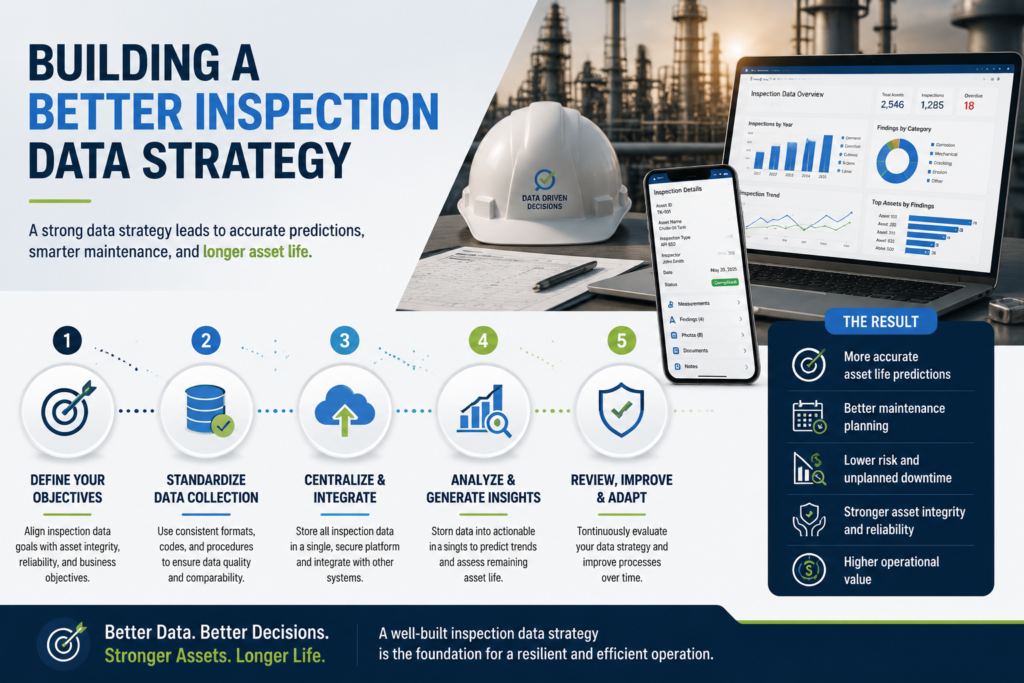
Every critical asset should have a consistent identifier and basic information such as location, equipment type and criticality.
Inspection teams should use consistent terminology, measurements, defect classifications and checklists.
Moving away from disconnected paper files and spreadsheets makes historical information easier to access and analyze.
Previous inspection results should remain accessible because they provide the context needed to understand deterioration.
Every inspection finding should be linked to the correct asset and, where relevant, the specific inspection point or component.
Inspection data becomes even more useful when teams can see what action was taken after a defect was identified.
Historical results should be reviewed to identify changes in condition, deterioration rates and recurring problems.
| Improvement | Potential Impact |
|---|---|
| Centralized inspection records | Easier access to asset history |
| Standardized data collection | More consistent inspection results |
| Historical trend analysis | Better understanding of deterioration |
| Digital evidence | Improved traceability |
| Faster reporting | Less manual administration |
| Asset-based records | Better lifecycle visibility |
| Structured data | Stronger foundation for analytics |
| Better condition information | More informed maintenance decisions |
Ultimately, the goal is not simply to collect more data.
The goal is to collect better data that can be used to make better decisions.
Inspection data shows how an asset’s condition changes over time. When current measurements are compared with historical results, teams can identify deterioration trends and support more informed remaining useful life assessments.
Useful information can include inspection dates, measurements, defect types, defect severity, corrosion rates, inspection methods, operating conditions, maintenance history and previous repairs.
Yes. Digital inspection software can organize historical inspection information, standardize data collection and make condition trends easier to identify. This creates a stronger foundation for predictive maintenance.
Historical data provides context. A single inspection provides a snapshot, while several inspections can show whether an asset is stable, deteriorating or experiencing an accelerating problem.
AI can support remaining useful life prediction and predictive maintenance. However, reliable results depend heavily on the quality and consistency of the inspection and asset data used by the system.
Industrial organizations are under increasing pressure to improve reliability while controlling maintenance costs and extending the useful life of critical equipment.
However, better asset life predictions do not start with a complicated algorithm.
They start with reliable inspection information.
When inspection teams consistently record accurate measurements, defects, observations, photographs, maintenance actions and asset details, they create a valuable historical record.
That record can reveal how an asset is changing over time.
Digital inspection platforms such as InspectionsTrack can help Oil & Gas inspection teams build this foundation by bringing asset information, inspection workflows, digital checklists, field data and reports into a more organized environment.
The result is not simply better documentation.
It is better visibility into asset condition.
And with better visibility, organizations can make more informed decisions about inspection intervals, maintenance, risk and the remaining life of critical equipment.
Better inspection data leads to better asset decisions. And better asset decisions can help organizations operate critical equipment more safely, efficiently and confidently.
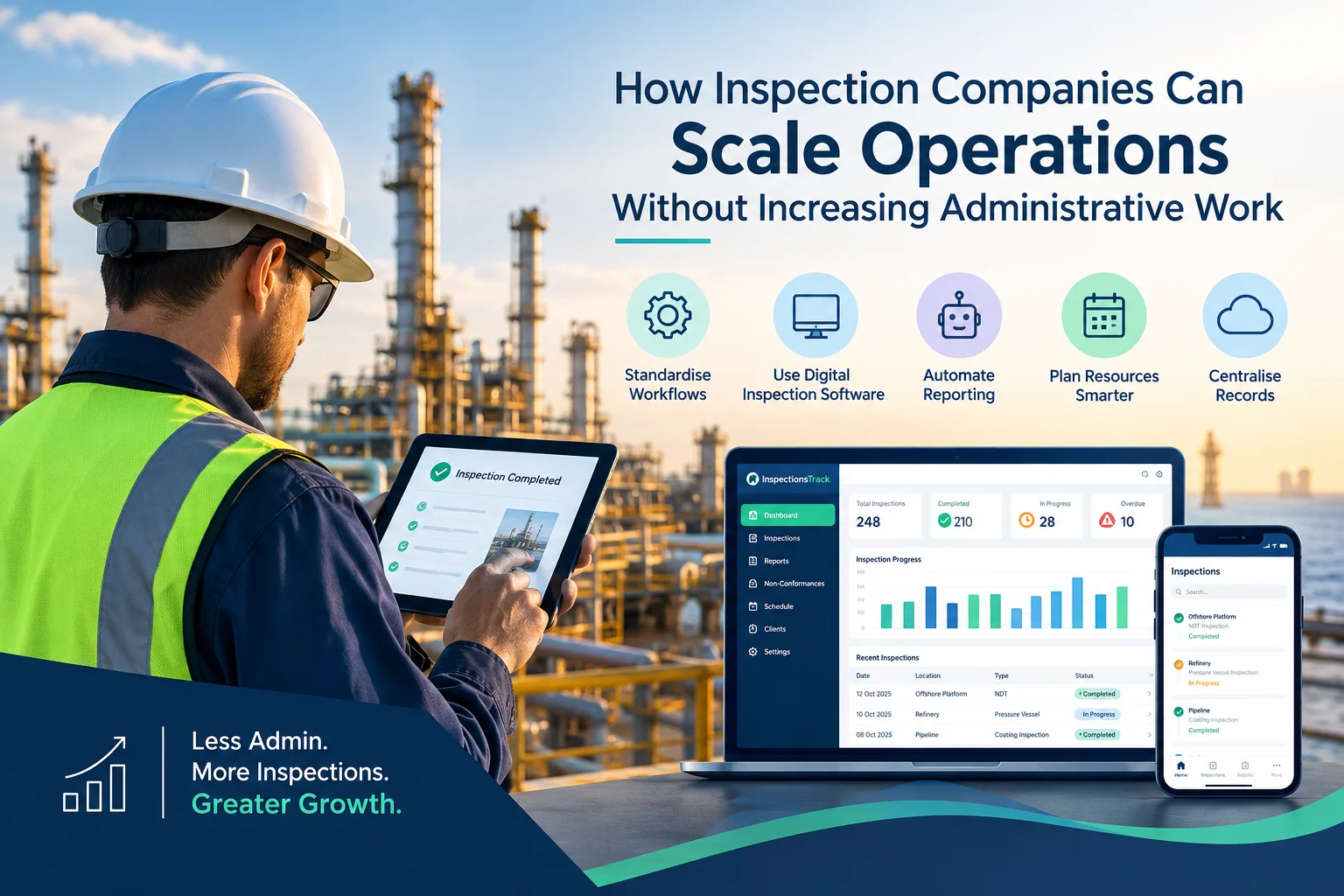
Inspection companies in the oil and gas industry face a common challenge: how to handle more inspections, manage larger projects, and meet client deadlines without increasing administrative workload. As businesses grow, inspection teams must manage…

Meeting client Service Level Agreements (SLAs) is essential for inspection companies working in demanding industries such as oil and gas, energy, and industrial maintenance. Clients expect inspections to be completed on time, reports to be…


Comment (1)
Corrosion Inspection Data: Turn Data Into Action - inspectionstrack
Aug 12, 2026[…] Read more : Improving Asset Life Predictions with Better Inspection Data […]
Comments are closed.