
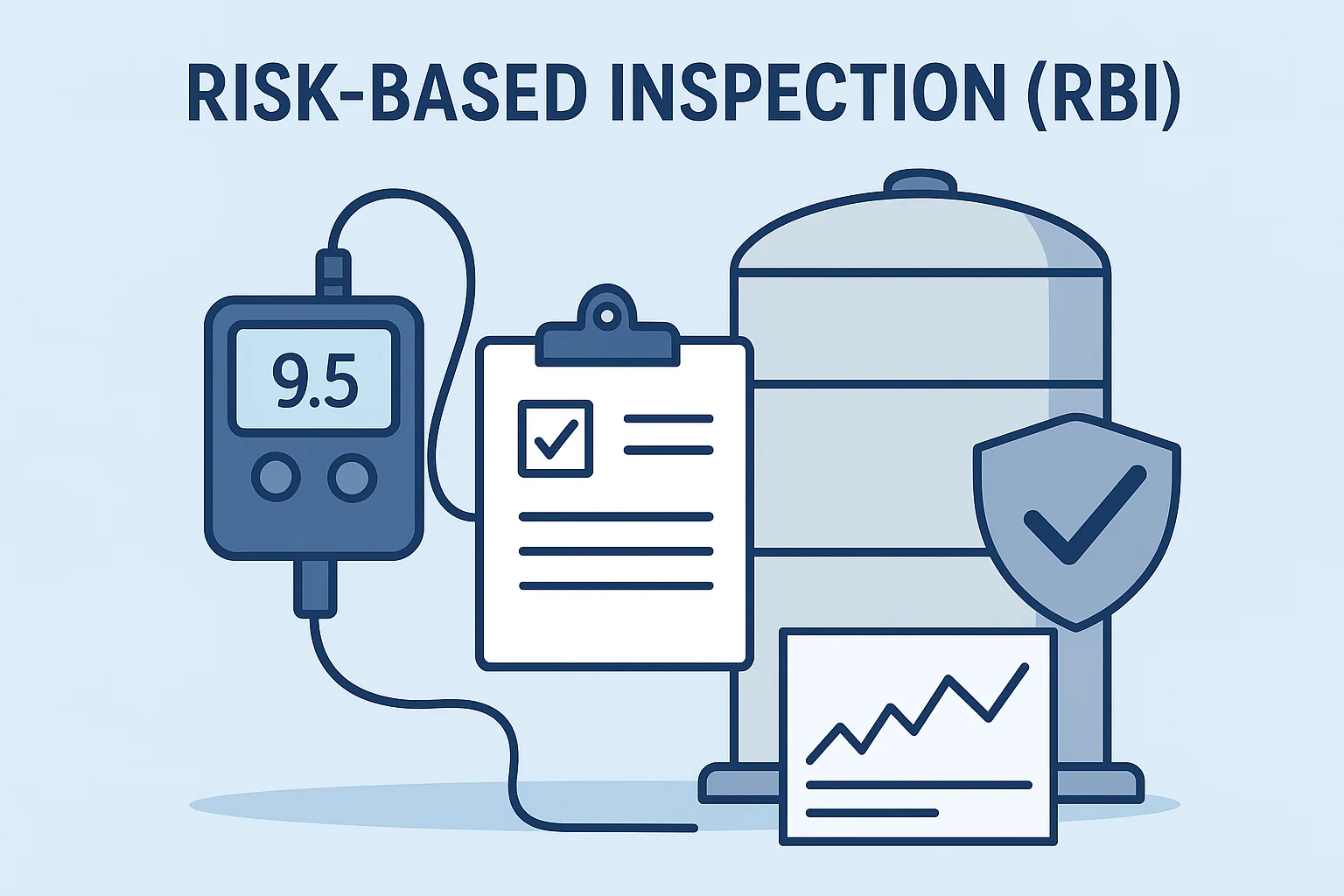
Risk-Based Inspection (RBI) has transformed how oil and gas companies manage asset integrity. Instead of inspecting everything on a fixed schedule, RBI enables maintenance teams to prioritize assets based on actual risk. As a result, organizations save time, reduce shutdowns, and improve safety. However, RBI also presents challenges—especially when data quality, workflows, and tools aren’t aligned.
In this guide, we move beyond the traditional thickness gauge to explore the promise and pitfalls of RBI, and how modern tools like Inspections Track are helping companies adopt more reliable and smarter inspection programs.
RBI is a methodology that evaluates the probability of failure (PoF) and consequence of failure (CoF) to determine inspection priorities. While traditional inspections rely heavily on periodic thickness measurements, RBI goes further by considering:
Because RBI is data-driven, it provides a more accurate picture of asset risk and helps maintenance teams allocate resources wisely.
Thickness gauging alone can’t capture the whole story. Although it shows wall loss, it ignores other critical risk factors. Therefore, companies need a holistic approach.
Because the oil & gas environment is complex, relying solely on thickness readings often leads to over-inspection, higher costs, and missed risks.
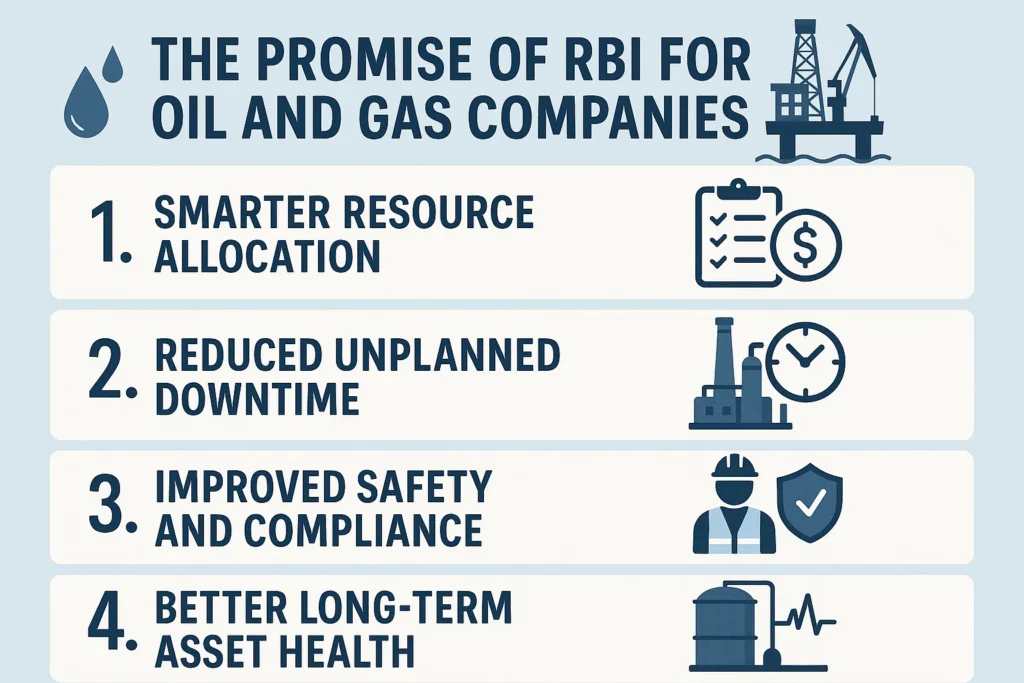
With RBI, high-risk assets get priority, while low-risk assets receive fewer inspections. Consequently, maintenance teams can work more efficiently.
Predictive insights allow operators to plan maintenance proactively instead of reacting to failures.
By focusing on high-consequence equipment, RBI strengthens safety programs and aligns with global standards such as API 580 and API 581.
RBI encourages continuous monitoring, providing long-term insight into corrosion, erosion, and fatigue.
Although powerful, RBI is not perfect. When poorly executed, it can introduce new risks.
| RBI Challenge | Impact on Operations |
|---|---|
| Poor Data Quality | Inaccurate risk assessments |
| Missing Inspection History | Wrong probability of failure calculations |
| Manual Data Entry | High chance of human error |
| Lack of Standardization | Difficult to compare assets |
| Limited Software Tools | Slow and unpredictable workflows |
In many cases, companies fail not because RBI is flawed, but because data capture and analysis are weak.
To overcome these pitfalls, companies are turning to advanced inspection platforms. Modern RBI-enabled systems help teams centralize data, automate risk calculations, and simplify compliance.
Inspections Track, a leading inspection software built for the oil and gas industry, provides real-time digital solutions that enhance RBI workflows. Since RBI requires reliable and structured data, the software plays a crucial role in making risk assessments more accurate.
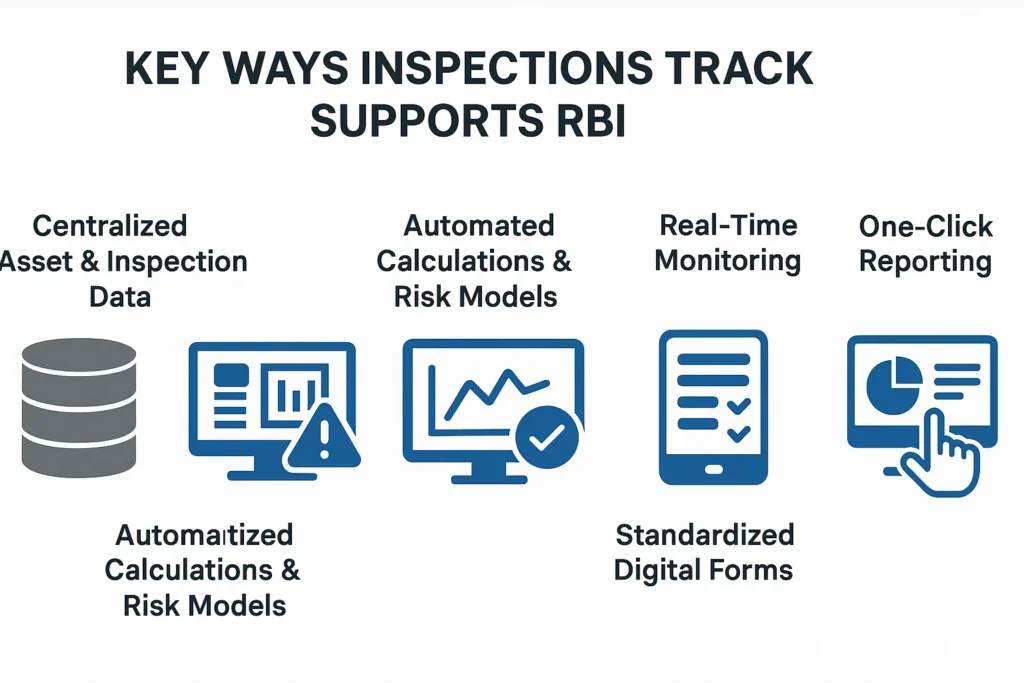
All inspection reports, thickness readings, corrosion data, and historical records are stored in one platform. Therefore, risk assessments become more accurate and consistent.
The platform reduces manual data entry and speeds up API-based evaluations.
Inspection teams can track anomalies instantly, helping prevent failures before they occur.
Instead of working with scattered spreadsheets, teams operate with unified, API-aligned templates that improve reliability.
RBI reports, trend charts, and dashboards can be generated instantly—saving time and improving decision-making.
| Feature | Thickness Gauge Only | RBI Approach |
|---|---|---|
| Scope | Measures metal loss | Evaluates PoF + CoF |
| Predictive Capability | Low | High |
| Data Requirement | Minimal | Comprehensive |
| Insight Depth | Surface-level | Holistic & risk-based |
| Cost Efficiency | Moderate | High |
| Ideal Use Case | Basic monitoring | Strategic asset integrity |
To ensure a successful RBI implementation, companies should follow these steps:
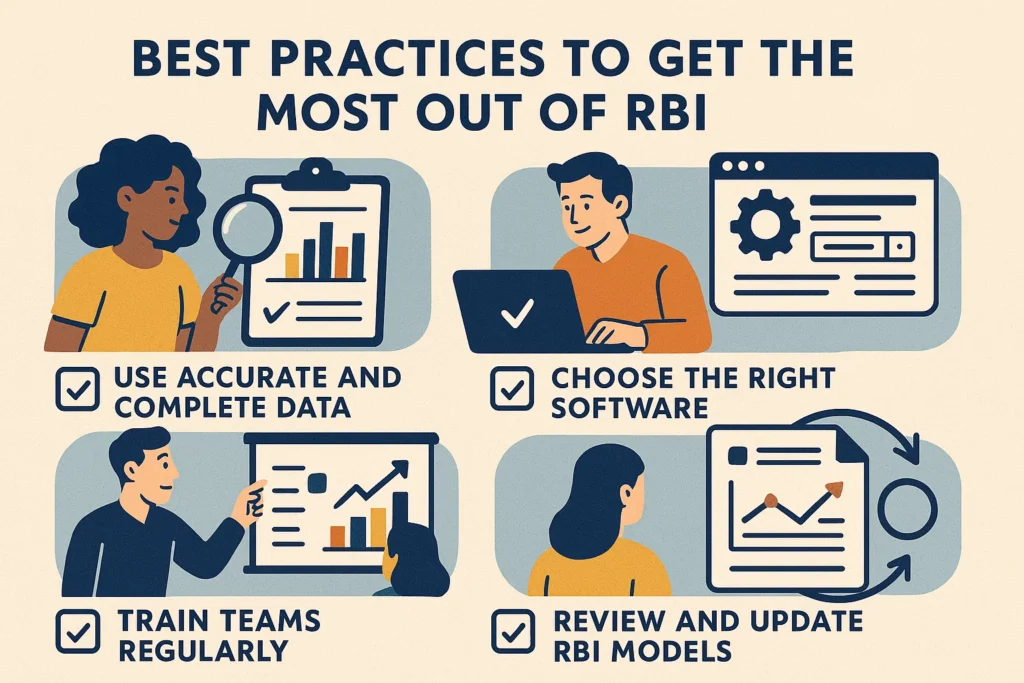
Ensure all historical inspection data, corrosion rates, and anomaly reports are updated.
Tools like Inspections Track reduce complexity and provide real-time insights.
Inspection engineers and field teams should be trained on RBI methodologies and software usage.
Because operating conditions change, RBI models must be reviewed at regular intervals.
RBI takes inspections far beyond the traditional thickness gauge, offering deeper insights, cost savings, and safer operations. However, its success depends heavily on data quality, standardization, and the right digital tools. With platforms like Inspections Track, oil and gas companies can overcome RBI pitfalls and build a more reliable, future-ready inspection strategy.
Readmore: streamlining maintenance processes for assets oil gas
RBI prioritizes inspections based on actual risk, offering better safety, fewer unnecessary inspections, and improved cost efficiency.
Most RBI failures happen due to poor data quality, missing inspection history, and the lack of a proper digital system to manage and analyze inspection data.
Inspections Track centralizes inspection data, automates risk calculations, and provides real-time reporting to make RBI assessments more accurate and structured.

Lifting gear plays a critical role in industrial operations, especially in sectors like oil and gas, offshore drilling, construction, and heavy manufacturing. However, these components operate under immense stress, which makes regular inspections essential for…

In the oil and gas industry, derrick operations rely heavily on lifting gear to move heavy loads safely and efficiently. From wire ropes to shackles and hoists, every component plays a critical role. However, if…


Comments (4)
Inspection Data Deluge: From PDFs to Integrity Dashboard - inspectionstrack
Dec 02, 2025[…] Read more : risk based inspection rbi promise pitfalls explained […]
UTM Measurements in Oil and Gas: Complete Industry Guide - inspectionstrack
Dec 09, 2025[…] RBI (Risk-Based Inspection) […]
Predictive Analytics for Oilfield Lifting Gear Safety - inspectionstrack
Jan 19, 2026[…] Risk-based inspection scheduling […]
Preventive vs RBI Inspections: Key Differences - inspectionstrack
Mar 03, 2026[…] Read more : risk based inspection rbi promise pitfalls explained […]
Comments are closed.