
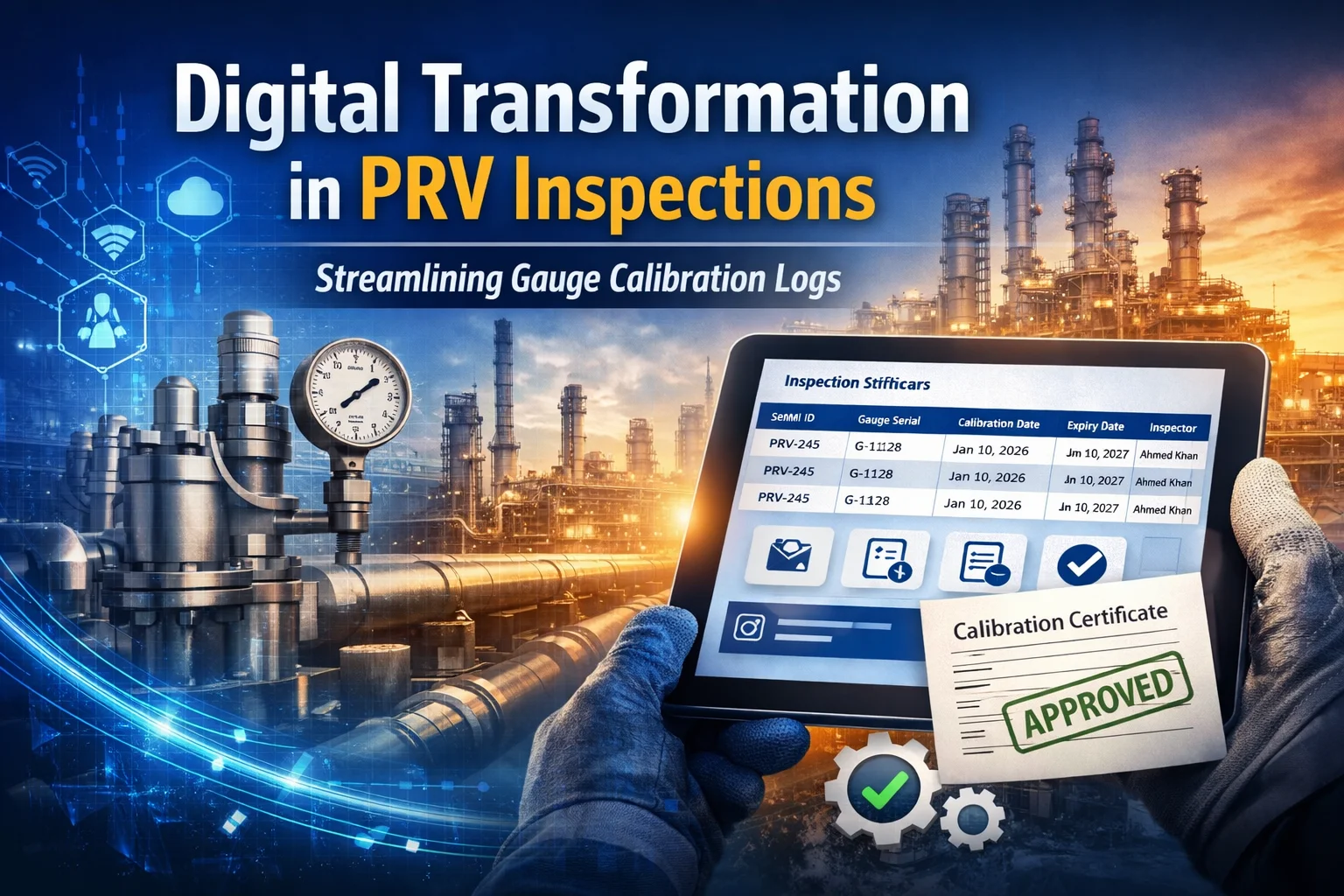
In the oil and gas industry, Pressure Relief Valve (PRV) inspections are essential for maintaining safety, compliance, and operational reliability. However, traditional methods of managing gauge calibration logs—often involving spreadsheets, paper records, or scattered digital files—can create inefficiencies and increase the risk of human error.
Today, digital transformation in PRV inspections is changing how inspection teams track calibration data, maintain compliance, and ensure accurate pressure measurements. Modern inspection platforms like Inspectionstrack software help organizations centralize calibration records, automate workflows, and simplify regulatory reporting.
This article explores how inspection software streamlines gauge calibration logs and improves efficiency across PRV inspection operations.
Pressure gauges play a critical role in verifying the set pressure and performance of PRVs. Therefore, maintaining accurate calibration records is necessary to ensure reliable inspection results.
If calibration logs are outdated or inaccurate, it can lead to:
Consequently, companies must ensure that every gauge used in PRV testing is properly calibrated and documented.
However, traditional logging methods often make this process difficult.
Many inspection teams still rely on manual tracking systems. While this approach worked in the past, it creates several operational challenges today.

Calibration certificates, test records, and inspection notes may exist in multiple systems. As a result, inspectors spend unnecessary time searching for information.
Manual entries increase the risk of:
Even small mistakes can cause compliance issues.
During regulatory audits, companies must prove that all gauges used during PRV testing were validly calibrated at the time of inspection. Without a centralized system, preparing these records becomes time-consuming.
Paper logs make it difficult to trace which gauge was used for a specific valve inspection.
Therefore, organizations are increasingly adopting digital inspection management systems.
Digital transformation introduces automation, real-time tracking, and centralized documentation into inspection operations.
Inspection software allows organizations to:
As a result, inspection teams can focus more on technical testing and safety assurance rather than manual documentation.
Modern inspection software platforms provide several tools designed specifically for managing calibration data in PRV testing environments.
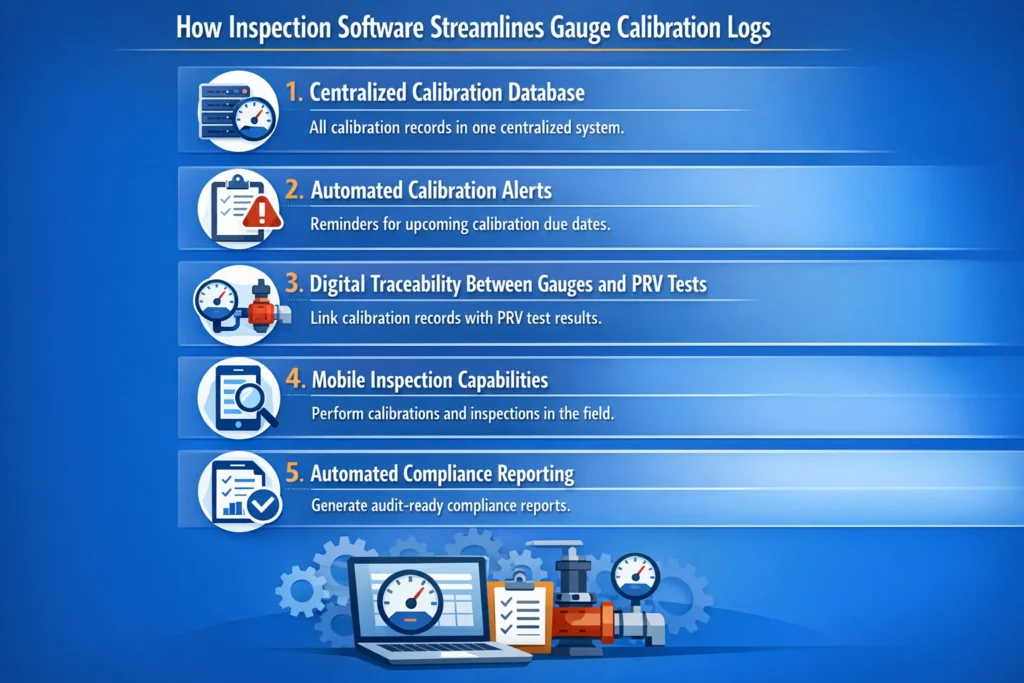
Inspection systems store all gauge calibration data in a single digital repository.
This includes:
Because of this centralization, inspectors can instantly access calibration records during field inspections.
Another key benefit is automated reminders.
Inspection software can notify teams when:
This proactive approach prevents inspectors from accidentally using out-of-calibration instruments.
Inspection software connects each gauge with the specific PRV inspection record.
For example:
| PRV ID | Gauge Serial Number | Calibration Date | Calibration Expiry | Inspector |
|---|---|---|---|---|
| PRV-245 | G-1128 | Jan 10, 2026 | Jan 10, 2027 | Ahmed Khan |
| PRV-312 | G-1084 | Feb 18, 2026 | Feb 18, 2027 | Ali Raza |
| PRV-419 | G-1250 | Mar 03, 2026 | Mar 03, 2027 | Imran Malik |
Because of this traceability, companies can easily verify compliance during audits.
Many inspection platforms provide mobile applications for field inspectors.
Using mobile devices, inspectors can:
Consequently, this eliminates paperwork and improves data accuracy.
Inspection software automatically generates reports required by industry standards such as:
These reports include:
Therefore, organizations can quickly prepare documentation for regulatory bodies and internal audits.
When selecting a digital inspection platform, companies should consider features specifically designed for oil and gas inspection workflows.
Important capabilities include:
Platforms designed for industrial inspections provide significantly more value than generic inspection tools.
Inspectionstrack software is designed specifically for oil and gas inspection operations. It helps inspection teams digitize PRV testing workflows and maintain accurate calibration records.
The platform simplifies gauge calibration tracking by offering:
Because the system connects inspection records, calibration data, and asset history, organizations gain complete traceability across the entire PRV inspection process.
As a result, companies can significantly reduce manual documentation while improving compliance and operational efficiency.
Organizations that adopt inspection software often experience immediate operational improvements.
Furthermore, digital systems help companies maintain consistent inspection standards across multiple facilities.
Digital transformation is only the beginning. In the near future, PRV inspection systems will integrate advanced technologies such as:
These innovations will allow companies to detect issues earlier and optimize maintenance planning.
Consequently, organizations that invest in digital inspection platforms today will be better prepared for the future of industrial asset management.
Gauge calibration logs are a critical component of PRV inspection accuracy and regulatory compliance. However, manual record-keeping methods often lead to inefficiencies, errors, and compliance risks.
By adopting digital inspection software, oil and gas companies can centralize calibration records, automate workflows, and ensure full traceability of inspection instruments.
Platforms like Inspectionstrack software enable inspection teams to streamline PRV testing operations, maintain accurate calibration logs, and generate audit-ready documentation.
Ultimately, digital transformation not only improves inspection efficiency but also enhances safety, compliance, and operational reliability across oil and gas facilities.
Read more : in house prv inspections cost saving hacks
Gauge calibration logs verify that the instruments used during PRV testing provide accurate pressure readings, ensuring compliance and safety.
Inspection software centralizes calibration records, provides automated alerts for due calibrations, and links gauges directly to PRV inspection records.
Industries such as oil and gas, petrochemicals, power generation, and refineries benefit from digital PRV inspection systems.

Lifting gear plays a critical role in industrial operations, especially in sectors like oil and gas, offshore drilling, construction, and heavy manufacturing. However, these components operate under immense stress, which makes regular inspections essential for…

In the oil and gas industry, derrick operations rely heavily on lifting gear to move heavy loads safely and efficiently. From wire ropes to shackles and hoists, every component plays a critical role. However, if…


