
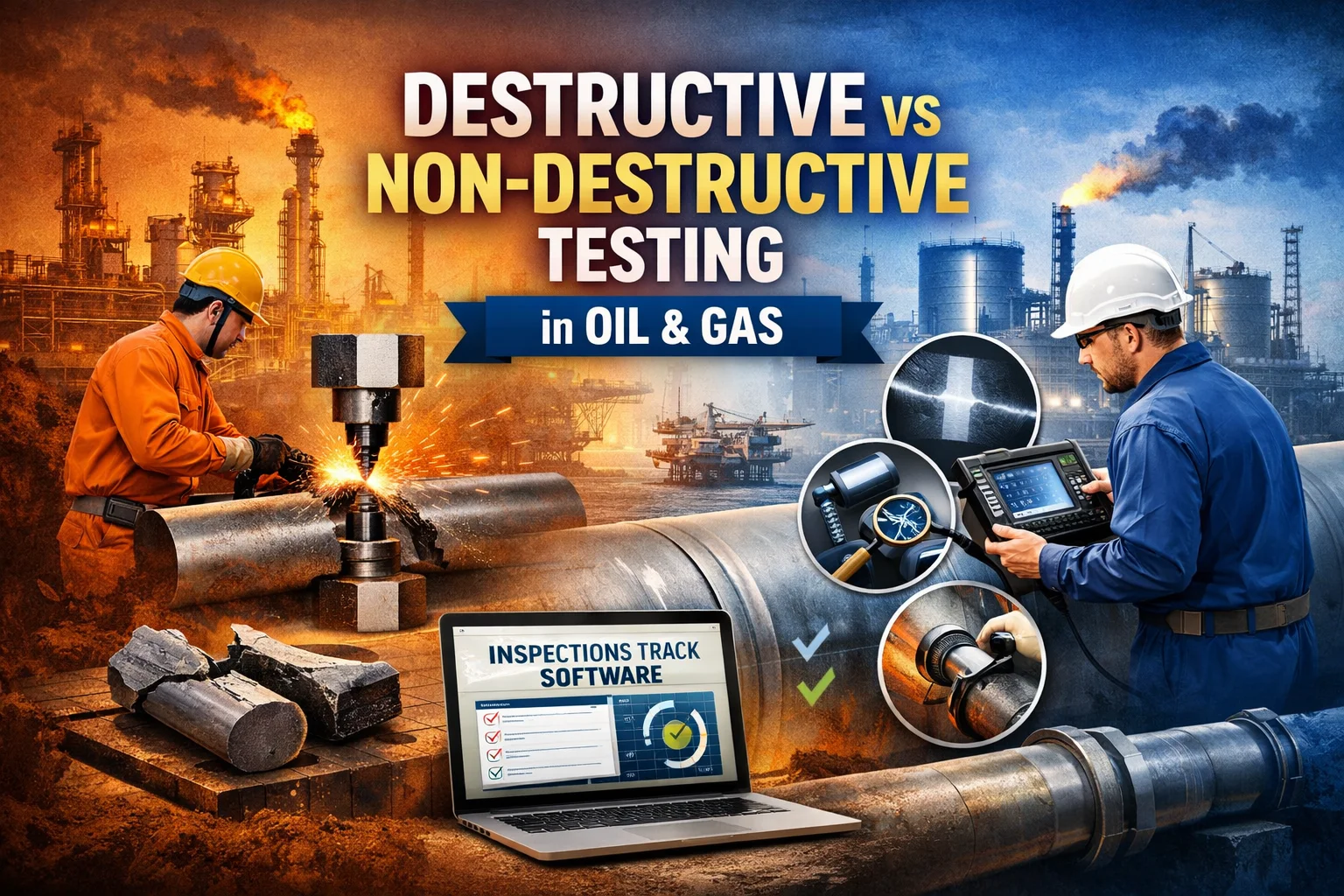
In the oil and gas industry, safety, reliability, and operational efficiency are paramount. To ensure equipment and structures meet quality standards, companies rely on Destructive Testing (DT) and Non-Destructive Testing (NDT). Understanding the difference between these two testing methods is crucial for inspection professionals and companies aiming to prevent failures, minimize downtime, and comply with industry regulations.
Keywords: destructive testing, non-destructive testing, oil and gas inspections, Inspections Track Software, quality assurance, equipment inspections
Destructive Testing, as the name implies, involves testing a material or component to failure. This method provides detailed information about material properties, structural integrity, and performance under extreme conditions.
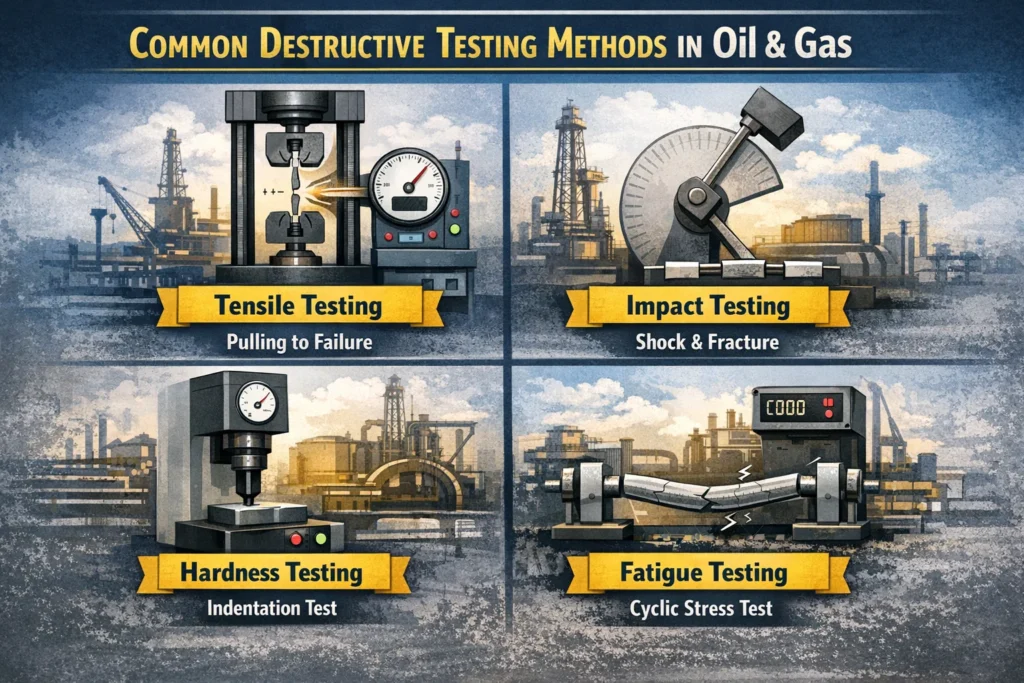
⚠️ Limitation: Destructive testing destroys the tested component, making it unsuitable for real-time operational use.
Non-Destructive Testing is a critical inspection technique that evaluates materials, components, or structures without causing damage. NDT ensures ongoing safety and compliance while reducing downtime and maintenance costs.
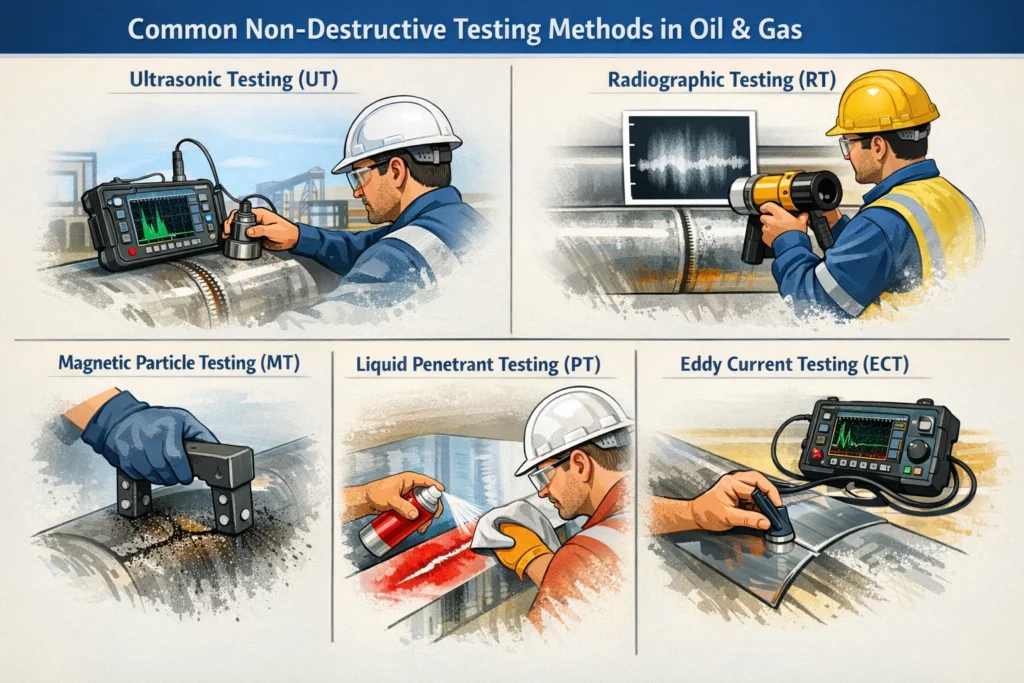
| NDT Method | Purpose | Application in Oil & Gas |
|---|---|---|
| Ultrasonic Testing (UT) | Detects internal flaws | Pipelines, pressure vessels |
| Radiographic Testing (RT) | Inspects welds and joints | Storage tanks, pipelines |
| Magnetic Particle Testing (MT) | Detects surface cracks | Valves, pumps, turbines |
| Liquid Penetrant Testing (PT) | Surface defect detection | Heat exchangers, structural components |
| Eddy Current Testing (ECT) | Identifies cracks and corrosion | Tubing, aircraft components |
| Feature | Destructive Testing (DT) | Non-Destructive Testing (NDT) |
|---|---|---|
| Equipment Status | Destroyed during testing | Remains intact |
| Cost | Higher due to replacement | Lower due to preservation |
| Data Accuracy | Highly accurate | Accurate but sometimes limited |
| Usage | Material validation, R&D | Field inspections, preventive maintenance |
| Safety | Requires lab precautions | Safer for on-site inspections |
In short, DT is for analyzing material properties, while NDT is for ensuring ongoing operational safety.
Managing oil and gas inspections is complex. Inspections Track Software simplifies both destructive and non-destructive testing by:
With Inspections Track, inspection teams can seamlessly manage DT and NDT activities, ensuring asset safety and operational reliability.
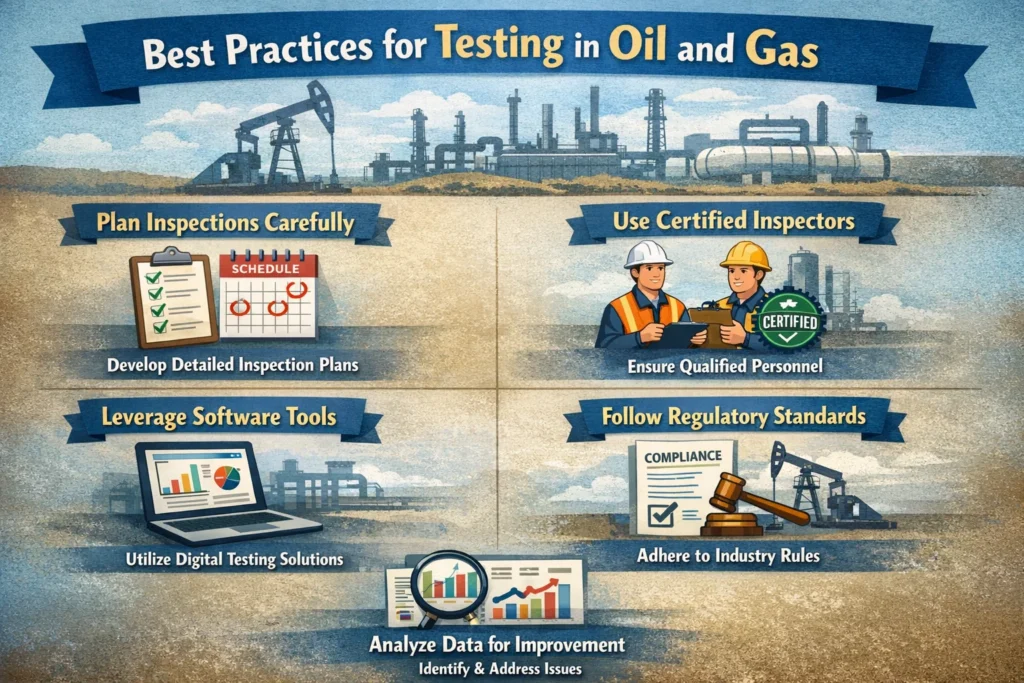
Understanding destructive and non-destructive testing is critical for the oil and gas industry. While DT provides precise data on material limits, NDT ensures ongoing operational safety without damaging assets. By integrating Inspections Track Software, companies can streamline inspections, maintain compliance, and reduce risks efficiently.
Invest in the right testing method and digital inspection solutions to maximize safety, reduce costs, and optimize operations.
Read more : rope access equipment inspection safety guide
FAQ’s
What is the main difference between destructive and non-destructive testing?Destructive testing (DT) destroys the tested component to measure material properties, while non-destructive testing (NDT) inspects equipment without causing damage.
Why is non-destructive testing important in oil and gas inspections?NDT ensures equipment safety, detects flaws early, reduces downtime, and helps maintain compliance with industry standards.
Can destructive testing be used in field inspections?No, DT is usually done in labs or controlled environments because it permanently damages the material or component.
How can Inspections Track Software help with testing management?Inspections Track Software digitizes inspections, tracks DT and NDT results, ensures compliance, and improves operational efficiency.

In high-pressure oilfield environments, safety is not optional—it’s critical. Equipment failure can lead to costly downtime, environmental hazards, and even loss of life. That’s why Eddy Current Testing (ECT) has become an essential part of…

Corrosion Under Insulation (CUI) is one of the most costly and difficult-to-detect challenges in upstream oil and gas operations. Because it develops beneath insulation layers, it often goes unnoticed until severe damage occurs. However, with…


Comment (1)
Rope Access Hazards in Oil & Gas: Top 5 Risks - inspectionstrack
Feb 03, 2026[…] Read more : destructive and non destructive testing explained […]
Comments are closed.