
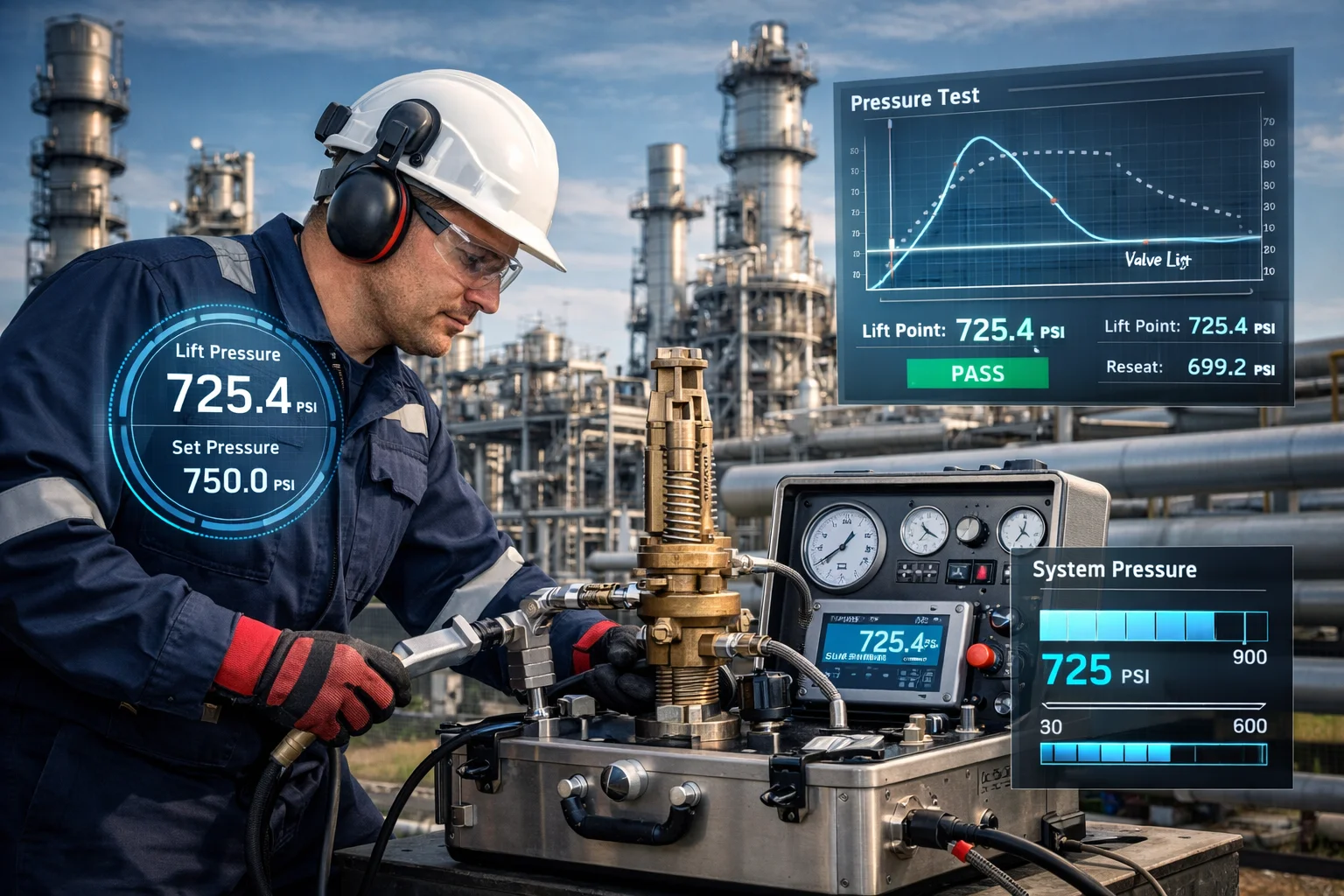
Pressure Relief Valves (PRVs) play a critical role in protecting equipment, pipelines, and personnel in the oil and gas industry. However, PRV inspections and calibration can become expensive, especially when organizations rely entirely on external laboratories.
As operations scale, many companies begin evaluating in-house PRV testing using portable calibration rigs versus traditional laboratory inspections. The key question becomes: Which approach saves more money while maintaining compliance and safety?
In this guide, we break down the cost-saving strategies, operational differences, and best practices for managing PRV inspections efficiently.
Pressure Relief Valves are safety devices designed to release excess pressure before equipment failure occurs. If a PRV fails, it can lead to:
Therefore, routine PRV testing and calibration are essential to maintain safe pressure levels and comply with industry standards such as API 510 and ASME guidelines.
However, inspection costs can quickly increase due to transportation, lab service charges, downtime, and administrative overhead.
Before choosing the best strategy, it’s important to understand how in-house inspections differ from laboratory testing.
| Factor | In-House PRV Inspection | Lab-Based PRV Inspection |
|---|---|---|
| Testing Location | Conducted onsite | Conducted in specialized labs |
| Equipment | Portable calibration rigs | Advanced lab testing equipment |
| Turnaround Time | Fast (same-day) | Several days or weeks |
| Cost Per Valve | Lower after initial investment | Higher due to service charges |
| Transportation | Not required | Required |
| Compliance Documentation | Managed internally | Provided by lab |
Clearly, both approaches have advantages. Therefore, many companies adopt a hybrid strategy to balance cost and compliance.
In-house inspections are gaining popularity because they significantly reduce recurring operational costs.
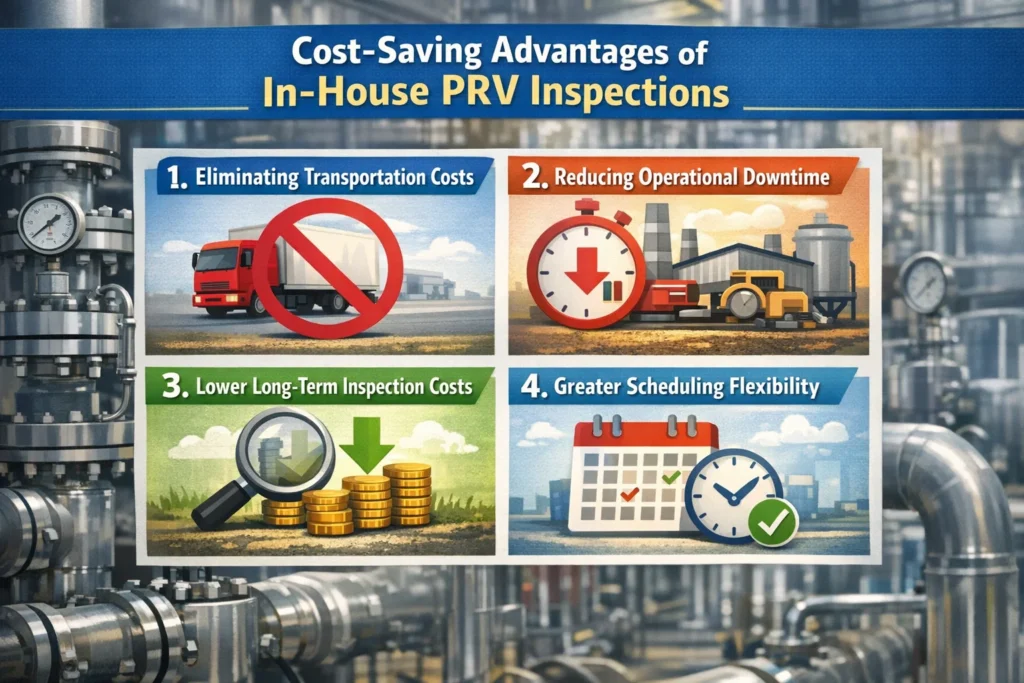
Sending valves to laboratories involves:
By performing onsite PRV testing, companies eliminate these costs entirely.
When valves are sent to labs, equipment may remain idle while waiting for calibration results.
However, portable calibration rigs allow technicians to:
As a result, production downtime decreases significantly.
Although portable rigs require an initial investment, the cost per inspection decreases over time.
Example cost comparison:
| Inspection Method | Approx Cost per PRV | Annual Cost (100 Valves) |
|---|---|---|
| External Lab | $120 – $250 | $12,000 – $25,000 |
| In-House Testing | $35 – $70 | $3,500 – $7,000 |
Over several years, the savings become substantial.
External labs often operate on fixed schedules. Consequently, inspection timelines may not align with operational needs.
In contrast, in-house teams can:
Therefore, operational planning becomes much more flexible.
Despite the benefits of in-house testing, laboratory inspections remain important in specific situations.
Some PRVs require:
These tasks are best handled by certified laboratories.
Certain regulatory authorities may require third-party certified testing reports.
Therefore, companies often send critical valves to laboratories periodically for verification.
Large industrial valves or unique configurations may exceed the capabilities of portable rigs.
In such cases, lab facilities provide the required testing environment.
Portable PRV calibration rigs have transformed onsite testing capabilities.
These rigs allow technicians to:
Because of these features, field inspections can achieve lab-level accuracy.
Organizations that successfully reduce inspection costs usually follow structured workflows.
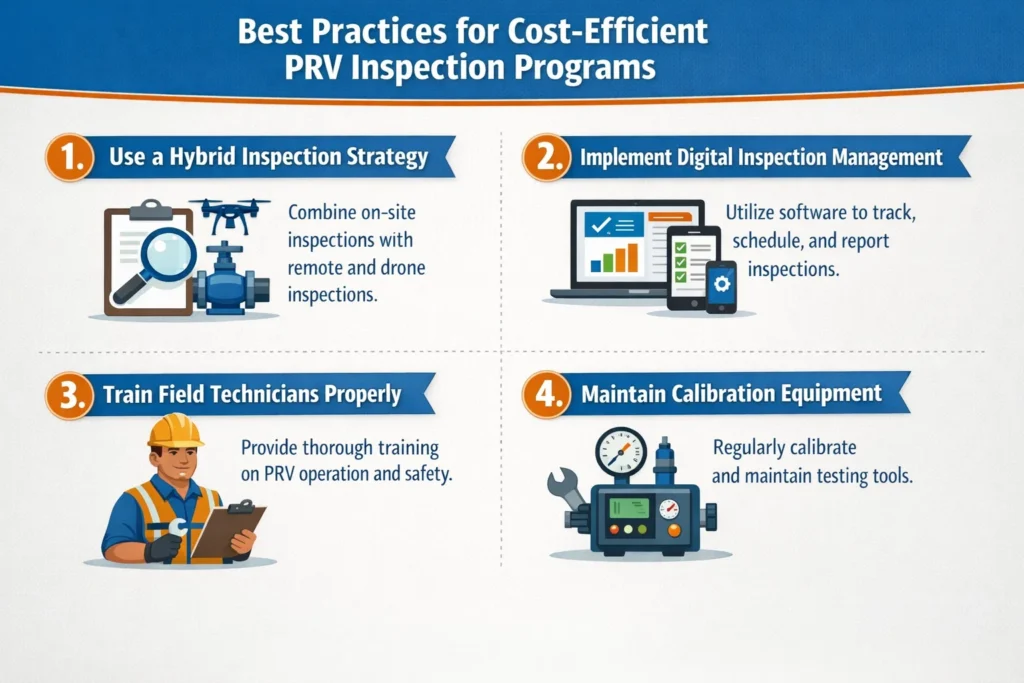
Rather than choosing one method, many operators combine both.
Recommended approach:
This approach maximizes both cost savings and compliance reliability.
Manual inspection tracking often leads to:
Therefore, many oil and gas companies now use inspection management software.
One powerful example is Inspectionstrack software, designed specifically for the oil and gas inspection industry.
The platform helps teams:
As a result, organizations gain better visibility and operational control.
Even the best equipment cannot replace skilled technicians.
Training programs should include:
Proper training ensures accurate testing and reliable results.
Portable rigs require regular maintenance and recalibration to maintain accuracy.
Best practices include:
Consequently, testing reliability remains consistent.
The oil and gas industry is increasingly adopting digital inspection platforms to streamline asset integrity programs.
Using Inspectionstrack software, companies can:
Additionally, automated reporting reduces administrative workload and improves regulatory compliance readiness.
Therefore, combining portable testing rigs with digital inspection software creates a powerful and efficient inspection ecosystem.
PRV inspections are essential for maintaining safety and operational reliability in oil and gas facilities. However, inspection costs can escalate when relying solely on external laboratories.
By adopting portable calibration rigs for in-house PRV inspections, companies can:
At the same time, laboratories still play an important role for complex repairs and certification testing.
Ultimately, the most cost-effective strategy is a hybrid approach supported by digital inspection management tools like Inspectionstrack software. This combination ensures both cost optimization and regulatory compliance, enabling oil and gas operators to maintain safer and more efficient operations.
Read more : prv inspections api 510 pop tests damage checks
They reduce costs, minimize downtime, and provide flexible scheduling for oil and gas operations.
Lab inspections are recommended for complex valves, certification audits, or specialized repairs.
It digitizes checklists, tracks calibration, generates reports, and ensures compliance efficiently.
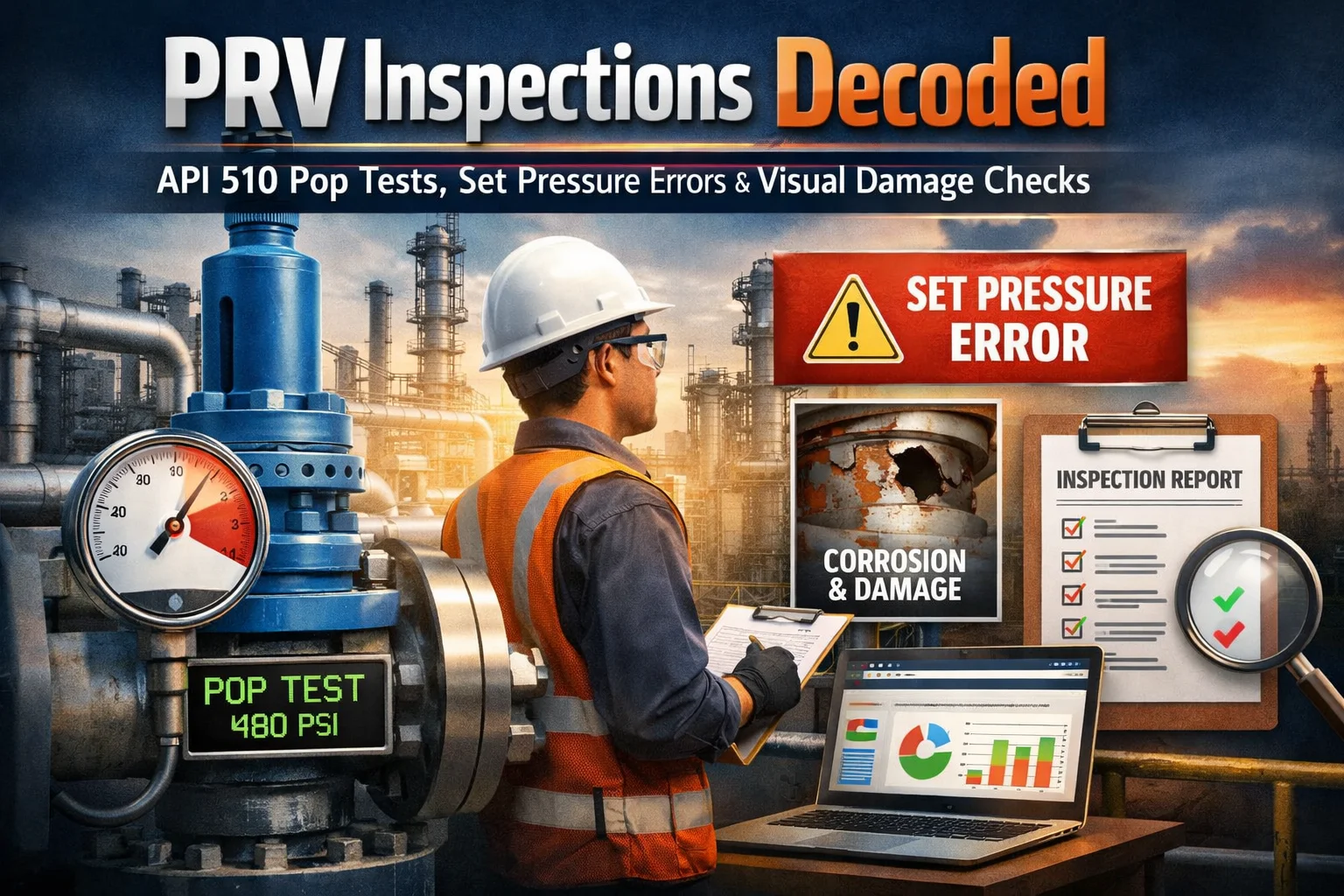
Pressure Relief Valves (PRVs) play a critical role in protecting pressurized systems across the oil and gas industry. When pressure exceeds safe limits, these valves automatically release excess pressure to prevent equipment failure, explosions, or…

The oil and gas industry operates in high-risk environments where Ex (explosion-proof) inspections are critical. Traditional manual inspections are often slow, error-prone, and difficult to track. Today, the digital revolution is transforming Ex inspections with…


